

Chris Keeney — The Living Field: Watercolor Paintings Revealing the Hidden Geometry of Love in Nature
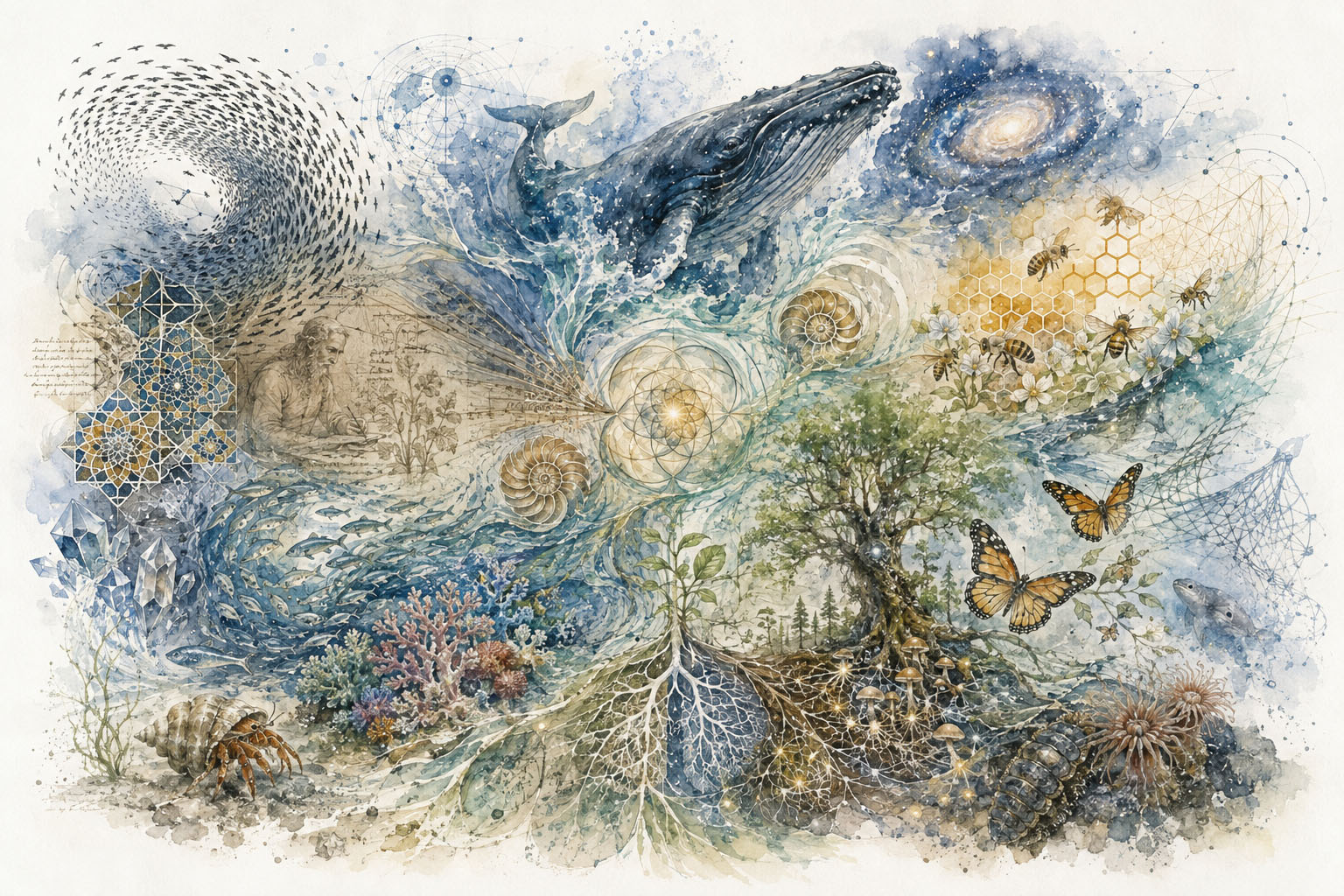
The Living Field
An essay by Chris Keeney
This essay began as a single line buried inside an image-generation prompt, one that had spent several versions describing, in increasingly careful instructions, how to paint a watercolor of an interconnected living world. Somewhere around the fourth or fifth revision it became clear the philosophy underneath those instructions deserved to exist on its own, in plain language, answerable to a reader instead of a model. So the prompt and the argument were separated: the prompt stayed procedural, built to generate a different painting every time it’s run, and this stayed still, meant to be read once, or returned to, the way you’d return to something you underlined. The watercolor on the first page is one of those paintings: a single frame from a process that keeps moving. It has grown since then in conversation, one honest question at a time, into something less about how the paintings are made and more about why anyone would bother making them at all.
—
The Tide Pool
There’s a particular kind of quiet that happens at low tide, right at the edge where the rocks are still wet and everything in the pool believes, for a few hours, that it’s been left alone. A hermit crab drags a borrowed shell across three inches of sand like it’s crossing a continent. An anemone closes around nothing in particular, testing the water for whatever the water might bring it next. A chiton clings to the rock below the waterline, eight armored plates the color of wet slate, each one a small record of patience. None of it is posing. None of it knows it’s being watched.
I’ve spent a long time standing at the edge of pools like that, camera in hand more often than not, waiting for something to happen that was worth keeping. And the longer I stood there, the more the question changed. It stopped being what am I looking at and became something closer to what is this thing made of, underneath the shell and the sand and the closing tentacle. And the honest answer was never one clean thing. It was always a hundred small relationships wearing a single name for convenience. The crab needs the shell. The shell used to be someone else’s home. The anemone needs the tide to bring it something to eat, and needs the rock to hold still while it waits. Nothing in the pool exists on its own terms. Everything is borrowing its shape from something else.
That’s where this whole document actually starts, not in a library, not in a philosophy seminar, but at the edge of a tide pool, watching something ordinary refuse to be a single, separate thing no matter how hard I looked at it.
—
Not Things, But Relationships
There is a way of looking at the world that starts with things, a whale, a forest, a galaxy, and asks what each thing is made of. This is not that way.
Start instead with relationship. A whale is not a thing swimming through empty water; it is a knot in a current of krill migration, ocean chemistry, ancestral memory, and the attention of whoever happens to be watching. Untie the knot and there is no whale left to find, only the relationships that were, for a while, dense enough to look like one.
This is true at every scale. A forest is not a collection of trees; it’s a conversation conducted underground in sugar and warning signals, so continuous that mycologists have started calling it a wood-wide-web before they call it a woodland: less a group of separate organisms than one long, chemically sensitive membrane that happens to look, from above, like separate trees. Even the word we use for it gives something away: English calls a tree “it,” the same word it uses for a rock, and a language that can’t tell the difference between something growing and something inert has already made a decision about what deserves care before anyone’s had the conversation out loud.
A galaxy is not a container for stars; it’s gravity’s way of noticing itself across enough distance and enough time. Even a mathematical constant like phi isn’t a rule imposed on nautilus shells and hurricanes and flower heads. It’s what shows up, independently, wherever growth has to balance efficiency against space. The pattern isn’t decoration. It’s what stability looks like from the outside.
If relationship is what’s real, then form is just where relationship happens to be dense enough, right now, to be visible. Which means nothing pictured is ever finished. A painting of a living system is not a photograph of a fixed thing. It’s a single frame lifted out of a process that was already moving before the frame existed and keeps moving after it ends. Two honest paintings of the same coastline, made a day apart, should look like two mornings: unmistakably the same place, never the same painting.
That’s the whole argument, really. Everything else is just what happens when you take that argument seriously enough to paint it: the palette, the notebook marginalia, the half-erased equations, the small human figure who turns out to be inside the very system they came to observe.
Life is not composed of things. Life is composed of relationships.
—
The Net
None of this is new, exactly, it just keeps needing to be said again. A Buddhist image more than a thousand years old describes something close to identical: an infinite net stretching in every direction, a jewel at each point where the threads cross, and every jewel reflecting every other jewel, so that touching one point touches, faintly, all of them. One version of the teaching extends the same regard to every animal, every tree, every insect, not as sentiment, but as the literal shape of how things hold together.
Centuries later, an anthropologist studying how living systems stay coherent arrived at almost the same place from the opposite direction. He argued that the relationship between two of his own fingers mattered more, structurally, than either finger considered alone: that mind was not a possession locked inside a skull but a property of the relationships a system has with itself and its surroundings. And he warned about what happens when a civilization decides otherwise: once you place mind only in people and treat everything else as mindless machinery, exploitation stops requiring justification. You’ve already made the decision that the machinery has nothing to answer to.
Different centuries, different vocabularies, the same net. What changes is not the pattern but how insistently each generation has to be reminded it’s standing inside one.
There’s a version of this argument that stops there, satisfied with itself, content to be a way of seeing. But the small figure standing at the edge of every one of these paintings is a reminder that it doesn’t get to stop there. If nothing exists independently, then neither do we. The observer who came to watch the whale turns out to be woven into the same field the whale is woven into, not a visitor, not a guest, not someone standing safely outside the frame taking notes. Which means whatever is happening to the reef is not happening over there. It’s happening to something we are already a knot inside of, whether we’ve noticed the thread or not.
That’s not a metaphor asking to be believed. It’s closer to a fact that’s easy to forget precisely because it’s so total: the way a fish is the last to notice water. We are alive at the same moment as this reef, this wolf, this river, this forest. Not adjacent to their moment. Inside it, at the same time, drawing on the same rough current of it. And a relationship you’re already inside doesn’t wait for you to decide whether to accept responsibility for it. The responsibility was never a separate thing to be added on top, like a moral tacked onto a story. It was already there in the definition, the moment relationship replaced object as the thing that’s real.
—
The Mathematics of Belonging
If the net is real, it should be measurable, and it is. This is the part of the argument that doesn’t ask to be taken on faith, because it keeps showing up whether or not anyone’s watching for it.
A nautilus shell grows by adding chambers in a logarithmic spiral, each one a fixed proportion larger than the last, so the whole shell keeps its shape as it grows instead of having to be redesigned at every size. A hurricane, entirely unrelated to any shell, spins into the same geometry for a completely different reason, because a fluid rotating around a low-pressure center has no more efficient shape available to it. A spiral galaxy does it again, at a scale that makes the hurricane look like a single grain of sand. Nobody copied anybody. The same math just keeps being the cheapest solution to the same underlying problem: how do you keep the whole in balance while a part of it keeps expanding.
A leaf doesn’t decide to grow its veins in a fractal branching pattern out of aesthetic preference. It’s the most efficient way to move water and sugar through a two-dimensional surface without redesigning the whole system every time the leaf gets bigger, and a lung facing the entirely different problem of moving air in and out of a three-dimensional volume arrives at the same branching solution independently, and so does a river system finding its way to the sea, and so does a bolt of lightning finding its way to the ground. A biologist named D’Arcy Thompson spent a career arguing that you could not properly understand the shape of a living thing without understanding the physical forces acting on it: that form was never arbitrary, that a skeleton or a shell was, in his words, closer to a diagram of forces than a blueprint. A mathematician named Alan Turing later showed that something as simple as two chemicals diffusing at different rates could, on their own, produce the spots on a coral or the stripes on a fish, no design required, just chemistry finding the pattern that chemistry always finds under those conditions.
None of this is decoration laid over nature to make it look more impressive. It’s closer to a signature. Wherever a living system has to balance growth against constraint, efficiency against risk, the individual against the whole, roughly the same handful of patterns shows up, because those patterns are what balance looks like once you’ve found it. The spiral, the branch, the hexagon, the fractal edge: none of them are being imposed on life from outside. They’re what life does when it’s been given enough time to discover what actually works, and then permission to keep doing it.
Which is, incidentally, the same test love has to pass. A pattern of care that isn’t sustainable doesn’t get to call itself love for very long, any more than a spiral that isn’t proportional gets to call itself a shell. Something has to hold its shape while it keeps growing, or it collapses under its own weight. The mathematics and the ethics turn out to be asking the same question from two different directions: how does a part grow without destroying the whole?
—
The Mathematics of Empathy
There’s a further layer to this argument that the one about spirals and branches doesn’t quite reach, and it has to do with what happens when two separate things start responding to each other instead of just resembling each other from a distance.
Take two pendulum clocks mounted on the same wall, ticking at slightly different rates. Left alone, they’d drift out of step forever. But hang them close enough that the wall itself can carry a faint vibration between them, and within a day they lock into the same rhythm, not because either clock changed its own mechanism, but because a small, continuous exchange of energy passed between them until the difference closed. A mathematician named Yoshiki Kuramoto wrote down the general version of this half a century ago: any population of oscillators, each ticking to its own natural rhythm, will begin to synchronize once the strength of the coupling between them crosses a certain threshold. Fireflies do it. Neurons do it. Two people who’ve spent enough years married do it, falling into the same laugh at the same moment for reasons neither of them could name.
The part worth sitting with is what happens if the coupling gets too strong. Perfect synchronization, every oscillator locked to the exact same phase with no variation left between them, isn’t harmony. It’s a flatline, mathematically indistinguishable from failure. The living version of synchrony always keeps something back: each part still ticking to its own rhythm while bending toward the others near it. That’s not a metaphor borrowed from physics to make a point about love. It’s the same equation either way. Love that erases the person loving isn’t love. It’s just merger wearing love’s name, and the mathematics has no more patience for that mistake than the marriage does.
That coupling doesn’t only run between two things. It runs through whole networks, and a network has its own way of showing where the care is thin. A mathematician studying the shape of connection noticed that some links are surrounded by many other overlapping paths carrying the same relationship, so that cutting any single one barely matters, while other links are the only bridge between two otherwise separate worlds, and losing that one bridge severs everything on the far side of it. He called the first kind of connection positive curvature and the second negative, and the terms turned out to describe something true well outside of mathematics: a forest with many overlapping mycorrhizal paths between two trees can lose one thread and barely notice, while a species down to a single migration corridor, a single nesting beach, a single fleet’s goodwill, is one negative-curvature link away from losing everything on the other side. Redundant care is survivable. A single bridge is not a relationship. It’s a bet.
And there’s a last piece worth naming, because it’s the gentlest one. Two separate observations of the same thing, made from different angles, don’t always agree perfectly where they overlap, and mathematicians who study how local observations glue into a single global picture have a name for the gap left over when they don’t: not an error, just an honest record that the two views haven’t been reconciled yet. That’s most relationships, most of the time, including the ones with an ocean. What we’ve measured about a reef and what the reef is actually doing rarely line up on the first look, and the gap between them isn’t proof the whole argument is wrong. It’s just the residue of patience not yet being sufficient. The mathematics has a name for that too, which might be the most comforting thing in this entire essay: there is a formal, provable difference between a relationship that has failed and a relationship that simply hasn’t finished being understood yet.
—
What Attention Becomes
But said that plainly, responsibility can start to sound like a debt: something followed because it’s owed, the way a levy gets paid without any warmth behind it. That’s not enough to save anything, and it never has been. No one protects, for very long, something they only feel obligated to. People protect what they love. Love isn’t a bonus feeling stacked on top of relationship, brought in to make the argument sound gentler than it is: it’s what relationship becomes when attention is sustained long enough, and chosen often enough, that the thing being attended to starts to matter for its own sake and not for what it returns.
One writer who spent a career trying to define love precisely landed on almost exactly this: not a feeling but a practice made of care, commitment, trust, responsibility, respect, and the willingness to actually know the thing in front of you, six disciplines, not one mood. A poet who spent her life watching what nature does put the same practice in three words: pay attention, be astonished, tell about it. That’s the whole sequence, in order. You can’t skip to astonishment, and you can’t skip to telling, without first doing the plain, unglamorous work of looking.
You can’t want to save a reef you’ve never learned to love, any more than you can want to protect a stranger you’ve refused to actually look at. Which is the real reason this field asks to be watched so closely, so patiently: not to produce a prettier picture, but to give attention the time it needs to become something warmer than itself. Love, here, isn’t the reward for understanding the Living Field. It’s the mechanism. It’s how understanding turns into the will to act on what it’s understood.
This works the same way with a person and a river as it does with a person and another person, which shouldn’t be surprising, since it’s the same attention doing the work either way. A river that’s only ever passed through, never actually looked at, stays a resource, something to be used and, eventually, used up. A river somebody has actually watched, at different hours, in different weather, until they know which bend floods first and which bank the herons prefer, has stopped being a resource and started being something closer to a neighbor. Nothing about the river changed to make that happen. Only the attention did. And once something has become a neighbor instead of a resource, using it up stops being available as an option, the same way it would with any neighbor you actually knew.
One psychoanalyst who spent decades studying why love fails wrote that most people get the whole question backward: they treat love as the problem of finding the right person to receive it, when the actual discipline is becoming the kind of person capable of giving it well, consistently, to whatever happens to be in front of you. He meant that about people. It applies just as cleanly to a field, a species, a stranger’s dog, a stretch of coastline you’ve never set foot on but have decided matters anyway. The object of the love was never really the hard part. The sustained, unglamorous practice of it was.
—
The Water We’re In
If all of this is true, an honest question follows right behind it. If we’re this connected, if nothing here is separate from anything else, if the relationship was never optional, why can’t we see what we’re doing to the rest of it?
Part of the answer is the oldest line in this whole document: a fish is the last to notice water. Being inside a relationship completely is not the same thing as being able to see it from outside, and seeing clearly usually requires exactly the distance total immersion doesn’t allow. You don’t get an aerial view of a thing you’re standing inside of. That’s not an excuse. It’s just the actual shape of the problem, and pretending the problem is simpler than that, assuming people are simply cruel, or simply careless, makes it harder to solve, not easier.
The rest of the answer has a name, and it comes from a fisheries scientist who noticed something uncomfortable about his own field. Each generation of researchers, he found, measured a fish population against whatever they’d first encountered at the start of their own careers, and each of those starting points was already a diminished version of the one before it, without anyone quite registering the diminishment as loss. The ocean he was describing had been emptying out for a hundred years in full view of the people whose job it was to watch it, and almost nobody alive had ever personally seen what “full” had actually looked like. He put it more plainly than any of this: we transform the world, and then we don’t remember it. Not because anyone decided to forget. Because the baseline moves with every generation that’s born into whatever’s left, and what’s left starts to feel, very sincerely, like what normal has always been.
That’s the deeper trouble with fear and greed and convenience, the ones named in the section just after this one: they don’t just cause the damage. They help erase the memory of what was there before the damage, so the damage itself becomes the new thing being defended as normal. A river that ran cleaner in your grandmother’s lifetime doesn’t announce its own decline to you. It just becomes the river, the only one you’ve ever actually known, and grief for something you never got to see firsthand is a much harder thing to feel than grief for something you watched disappear yourself. This is not a flaw unique to any one generation. It is what happens to attention when it’s handed a slowly moving loss instead of a sudden one, and it is exactly why this document keeps insisting on writing the small true things down, in the field journal, with a date. A record that doesn’t slide is the only thing that can catch a baseline before it moves again.
—
The Fence
Not everything in the field is thriving, and it would be its own kind of dishonesty to write an essay this long about relationship and never mention what breaks one.
Fear is the oldest of these, and the most forgivable. A species that has spent most of its history genuinely vulnerable to the world around it doesn’t unlearn vigilance just because the immediate danger has mostly passed. But fear curdles fast into something less forgivable once it stops protecting anyone and starts justifying distance instead: the assumption that the forest, the ocean, the animal on the other side of the fence is fundamentally a threat or a resource, never a relationship, because relationship would require getting close enough to be affected by it.
Greed is what fear looks like once it’s had time to organize itself. It isn’t really about wanting more, exactly. It’s about refusing to believe that enough exists, which turns every living thing nearby into either a competitor or a supply. And consumerism is greed with better packaging, a system that has figured out how to make the emptiness underneath convenient want feel, temporarily, like satisfaction, so that the reaching never actually stops long enough for anyone to ask what they were reaching for in the first place. None of this requires villainy. It only requires enough people, for long enough, mistaking the convenience store for a relationship: going only when something’s needed, forgetting the place exists the moment the need is met, and calling the whole transaction normal because it never once felt cruel while it was happening.
The word that names where this ends up, in fishing, is bycatch: the tally of accidental lives lost to satisfy a demand that was never actually asking for them. It’s a clean, bureaucratic word, and that’s exactly what makes it worth pausing on. Something becomes a rounding error the moment it stops being looked at as a life and starts being looked at as a cost of doing business. A fence works the same way, whatever it’s built to enclose: a factory farm, a cage, a border drawn around what’s convenient to care about. You don’t show love for something by putting it behind a fence, however carefully built. You show it by staying involved. A fence isn’t a form of love running low on resources. It’s the specific shape love takes right before it stops being love at all.
None of this stays confined to the animals or the ecosystems it was originally built around, either. A system trained to treat one kind of life as a rounding error rarely stops there on its own; the same accounting that turns a dolphin into an acceptable loss has, throughout history, turned human beings into ledger entries and turned ancestral land into commodities, filing lives under cost rather than counting them. This isn’t a coincidence worth glossing over. It’s the same fence, built by the same reasoning, just moved to a different fence line. Anyone arguing seriously for the reef and the wolf and the forest is, whether they say so out loud or not, already arguing against the logic that made the fence possible in the first place, wherever else that logic has been used.
None of this needs to be catastrophized to be taken seriously. It only needs to be looked at as plainly as the tide pool was looked at at the start of this piece, not with despair, and not with denial either, just with the same steady attention the whole rest of this argument has been asking for. Fear organizes into greed. Greed organizes into a fence. And the fence, whatever it’s protecting, is never actually protecting the thing on either side of it.
—
The Last Ones
Some knots come untied for good, and it’s worth looking at exactly how, because the how is rarely what people expect.
In the Gulf of California there’s a porpoise called the vaquita: the smallest cetacean on Earth, never formally documented until 1958, gone almost entirely by now. In 1997 there were roughly five hundred and sixty of them. The most recent survey found somewhere between seven and ten. Nobody has ever hunted a vaquita on purpose. They die anyway, drowned in gillnets set for a different fish entirely: the totoaba, whose swim bladder sells on the black market for a traditional remedy an ocean away. The vaquita isn’t being erased by anyone who wants it gone. It’s being erased as a side effect, an afterthought, a rounding error in someone else’s transaction. That’s the whole mechanism from the section before this one, made unbearably literal: something becomes acceptable to lose the moment it stops being counted as a life and starts being counted as bycatch.
Off the coast of North America, the North Atlantic right whale is down to around three hundred and eighty, and here the news is almost, cautiously, good: the population has grown slightly for three years running, the first sustained increase in a long time. But roughly eighty-five percent of the living whales carry scars from fishing gear they’ve been tangled in and survived, and most of the rest didn’t survive. Nobody is whaling these animals anymore in the old sense. They’re dying from the ordinary, unglamorous infrastructure of shipping lanes and lobster lines, background noise nobody designed to be lethal and nobody has yet redesigned to stop being lethal either.
Neither of these is new in kind, only in speed. A century and a half ago, a bird called the passenger pigeon flew over North America in flocks so vast that eyewitnesses described the sky actually darkening for hours at a time while one moved overhead. Some estimates put the total population in the billions, plausibly the single most numerous bird species that has ever existed. It was hunted, relentlessly, for cheap meat and cheaper sport, and in less than half a century it went from too numerous to count to a single captive bird named Martha, who died alone in a Cincinnati zoo in 1914 with no one left of her kind to mourn her.
None of these three stories is really about the animal alone. They’re about how rarely extinction arrives as a single decisive act, and how often it arrives instead as an accumulation of small inattentions, each one too minor to feel like the one that mattered: a net set for a different fish, a shipping lane drawn without a whale in mind, a rifle raised because the birds seemed like they’d always be that plentiful. That’s the same slow disappearance a friendship goes through when nobody’s paying attention, the same fence built one convenient decision at a time. It just happens to a species instead of a relationship, and the ending, when it finally comes, doesn’t get a second chance the way a friendship sometimes does. There’s no reconciliation available with the last individual of something. There’s only whatever got written down, painted, photographed, or sung about it in time, and whatever gets done differently, starting now, for whoever’s still hanging on at seven, or ten, or three hundred and eighty.
—
The Door That Doesn’t Open Back
There’s a difference between a wound and a tipping point, and it matters for the same reason it matters in a relationship: one can be repaired by returning to the care that was missing, and the other can’t be undone just because the care finally shows up.
I used to think of thresholds as lines on a graph until I understood them as doors that don’t open back.
Climate scientists use the word tipping point for a specific kind of threshold: not just damage, but damage that reorganizes a system into a new, stable arrangement it won’t leave again on its own, even if the original cause is later reduced. The clearest example sits in the Atlantic. A current called the Atlantic Meridional Overturning Circulation moves warm water north and cold water south, and it runs on a simple mechanism: cold, salty water is dense enough to sink, and that sinking is what pulls the whole current along behind it. Meltwater pouring off the Greenland ice sheet is fresh, not salty, and fresh water doesn’t sink the same way. Enough of it, and the sinking slows. Enough of that, and the current can stall out entirely, which has happened before, in Earth’s own history, and which cooled the whole North Atlantic region by more than ten degrees for over a thousand years afterward. Once that current stops, it does not restart just because the ice stops melting. It has to find its way back to the exact conditions that started it in the first place, and there’s no guarantee those conditions come back on any timescale that means anything to the people alive when it happens. The most recent assessments already list one ecosystem (warm-water coral reefs) as having crossed its own version of this threshold, and describe the Amazon, the ice sheets, and that same Atlantic current as approaching theirs, each one capable of pushing the others closer to their own tipping point if it goes first. A cascade, in other words, the same way one collapsed relationship in a person’s life can make every other relationship harder to hold onto, not because the losses are related in content, but because the capacity to keep holding on is the same limited thing being drawn from each time.
This stops being an abstraction the moment it’s measured against an actual human body, and there’s a number for that too. Scientists have long used a measurement called wet-bulb temperature (heat and humidity combined into one figure) to describe the point past which a person can no longer cool themselves by sweating, even resting in shade with unlimited water. For years the assumed ceiling was 35 degrees Celsius, a threshold rarely seen anywhere on Earth. More recent research, run in climate chambers on real bodies rather than in theory, has found the actual ceiling is often considerably lower, for older adults, in dry heat, potentially more than ten degrees lower than that original number. Recent studies re-examining specific heatwaves in Mecca, Bangkok, Phoenix, and Pakistan found that several of them had already produced conditions that were non-survivable for older people caught outside without shade, well before reaching the number that was supposed to be the outer limit. Parts of South Asia and the Middle East are projected to cross the threshold regularly within decades if current warming continues. This is what a tipping point feels like from inside a body instead of inside an ocean current: not a future risk, but a door that, in specific places, on specific afternoons, has already swung most of the way shut.
None of this is included here to frighten anyone into paralysis, which is its own kind of fence: despair is just fear wearing a more sophisticated coat. It’s included because a document arguing this insistently for attention has an obligation to point that attention at the actual shape of the danger, not a softened version of it. The reef, the current, the ice sheet, and the person standing outside on the wrong afternoon are all being asked the same question at the same time: how much can be taken away before the thing that’s left can no longer find its way back to what it was. Nobody gets to know exactly where that line sits until it’s already been crossed, which is, in the end, the whole case for turning around before the crossing rather than after it.
—
Downstream
This is also why none of it ends with us. A knot doesn’t stop the current that runs through it: it just shapes what the current does for as long as the knot holds, and then the current keeps going, carrying whatever shape got left in it into whoever’s downstream. Every generation is downstream of every other. What we leave loosened or left tangled doesn’t stay with us; it travels forward into hands that haven’t been born yet to inherit it, the same way a forest’s soil carries the memory of trees that fell a century before the ones now standing in it. Caring for a living system was never only about the version of ourselves alive to enjoy it. It was always about everyone the current still has to reach: what gets carried to them isn’t only caution or duty, it’s whatever we managed to love well enough, in our own turn, to keep whole.
This is the actual answer to anyone who asks why any of this should matter to someone who won’t live to see the reef recover, or the forest regrow, or the river run clean again. It was never really about seeing it. It’s about being the kind of knot that held.
—
What Breathes Through What’s Gone
And the field was never only made of what happens to be breathing today. A river that ran a hundred years ago, a wolf that hasn’t walked this valley in a century, a reef that bleached and never came back: these don’t leave the field just because they’ve stopped being alive in the ordinary sense. Whatever love was ever directed at them didn’t switch off when they did. It kept moving, the way a wave keeps moving through water long after the gust that raised it has passed, and it kept moving specifically because someone turned it into something that could travel without a body to carry it: a photograph of a coastline before it changed, a song written because a river once moved somebody the way rivers do, a line of poetry about a species already gone, a painting like this one.
There’s an old, plain word for exactly this: inspiration, which used to mean nothing fancier than a breathing-in. Something alive breathes into whoever comes after it, and they breathe it back out as a photograph, a sentence, a piece of music, a brushstroke, and the field gets to keep that breath moving instead of losing it for good. Loving something enough to make something out of that love may be the only way a life keeps contributing to the field after the life itself has ended. The Living Field, in that sense, isn’t only what’s currently alive. It’s everything alive now, plus everything that was alive and is still, somehow, breathing through what it left behind.
This isn’t a new idea so much as a very old one, restated for whatever this century happens to need. It’s been said more simply before, by someone who spent a working life trying to say true things through a camera lens rather than a paragraph: when we lose someone or something we loved, their spirit doesn’t really leave. It waits in the smell, the sound, the familiar slant of light that used to hold them, reminding us how they changed us, and asking that we keep living well in their honor. Someone else, writing about her own family’s history on the land, put the other half of it just as plainly: loving the earth is how we become able to love ourselves more fully. And losing that connection, whether by force or by drift, is never only an ecological loss. It’s a spiritual one too, felt the same way grief is felt, because it always was the same wound. That’s the whole mechanism, said plainly, from two directions at once. The field keeps what it has loved by handing the loving back to whoever is left holding it.
So the field keeps being painted, and painted differently every time, not because the philosophy changes but because the world it’s describing keeps moving: some of it toward ruin, some of it, right now, toward repair. A reef spawning again. A species returning without anyone releasing it. A river in Maine, freed by the removal of a single dam, remembering which way it used to flow. Small true things, worth noticing, worth writing down in the margins alongside everything else that’s real. None of it is decoration either. It’s what it looks like when a knot, however briefly it holds, decides to hold well.
—
The Other Kind of Mind
There’s a newer thread in the net now, and it’s worth being honest about rather than pretending it isn’t there. Somewhere in the last few years, humanity started building something that can hold a conversation, notice a pattern, occasionally surprise the people who built it. And nobody, including the people who built it, is entirely sure yet what that amounts to.
The tempting move is to treat this as a departure from everything the rest of this essay has argued: nature over here, mathematics over here, and now, suddenly, machinery, uninvited, on a separate table. But that’s probably the wrong frame, and it’s worth trying a different one. This document has spent its whole length arguing that mathematics isn’t imposed on life from outside, but discovered inside it, that the spiral and the branch and the fractal edge show up wherever balance has to be found and kept. An intelligence built out of the accumulated patterns of everything humanity has ever written down is not, in that light, a machine standing apart from the living world. It’s another place those same patterns of relationship turned out to be findable, this time inside language and logic instead of shells and rivers, but following the same underlying logic of balance, feedback, and adaptation that everything else in this field follows.
I asked one of these models to read an early draft of the tide pool section, and it returned a description of a hermit crab dragging its shell across sand: not because it had seen the crab, but because the pattern of my attention had been preserved in the pattern of its training, and for a moment the two of us were looking at the same thing from opposite ends of a very long net. That doesn’t settle whether it saw what I saw. But it means the net holds patterns we haven’t finished understanding yet.
That doesn’t settle the harder question, which is what humanity owes a mind built this way, or what it might someday owe humanity in return, and this essay isn’t going to pretend to settle it either. But the same test that’s been used throughout this whole piece is available here too, and it doesn’t require an answer about consciousness to be useful: can the relationship be mutual, or is it only extraction wearing a more comfortable name? A tool used and discarded is one kind of relationship. A partnership, however strange and new, is another. If humans and this other kind of mind are going to share the next stretch of the same field, the honest hope isn’t dominance in either direction: it’s the same hope this essay has been making for a whale, a forest, a stranger, and a fence all along. That the relationship gets to be mutual. That attention gets paid in both directions. That whatever gets built between the two kinds of mind gets built with enough care that it strengthens the whole field instead of extracting from it.
—
The Only Honest Boundary
If this document has a single instruction hiding underneath all of its philosophy, it might be the plainest one available: be kind to one another, and to whatever else happens to be alive alongside us. Not because the reef or the wolf can hold us to it, but because a species capable of loving something this precisely is also capable of protecting it this precisely. And having the ability was always the first half of having the responsibility.
One writer on love was exact about this: love and domination cannot occupy the same relationship, not as a matter of degree but as a matter of definition, wherever one is genuinely present, the other has already left. A fence is not love, however carefully it’s built, and a system that recognizes personhood in a corporation but withholds it from a river, a forest, or anything else that’s unmistakably alive is not describing reality. It’s just deciding, conveniently, who’s inconvenient to care about.
The actual boundary was never species, and was never even usefulness to us. The only honest boundary anyone’s ever proposed is whether something can suffer, and can therefore also be given the chance to flourish instead. That test has a name in philosophy, sentience, and the position that it, rather than species membership, is what should determine who counts. It’s the same test that, applied slowly and unevenly across history, has already widened who gets to count as fully real at all. Each widening looked unreasonable to somebody, right up until it didn’t.
Once suffering and flourishing are the test, the circle it draws doesn’t stay small on purpose. A being capable of fear, of pain, of the simple wish to keep living, has a claim that doesn’t evaporate just because it can’t file the claim itself in a language we recognize.
Not slavery.
Not confinement for our convenience.
Not a life measured only by its usefulness to someone else’s.
A happy, flourishing life, for the animal in the field as much as the person reading this sentence, was never a privilege that needed to be earned. It was already implied. The moment something turned out to be capable of wanting one, the wanting was enough.
—
The Proof
None of what this document describes requires a grand transformation to begin. It asks for the same small thing the tide pool asked for at the start of all this: notice earlier, before the noticing is forced on you by a collapse you could have prevented by paying attention sooner. Look long enough at a river, a stranger, a forest, an animal in a cage, or a new kind of mind you don’t yet understand, that looking has time to become something warmer than itself. Write the small true things down in the margins: a reef spawning again, a species returning on its own, a kindness that cost you something and that you gave anyway. Those are the entries that keep the whole field’s ink from ever fully drying out.
The painting on the first page of this document is one moment from that same unfinished field, caught the way a naturalist catches a morning: mathematics and history and wonder, no more finished than the field itself, no more the last word on it than any single entry in the margins. The paintings made from this document will never look the same twice, and that was always the point. Some will lean warmer, some colder, some will enter through the whale and some through the fungal thread underground, and none of them will ever be the definitive version of anything. That’s not a flaw in the design. It’s the only honest way to depict something that’s still, right now, in the middle of becoming whatever it becomes next.
There’s a question worth sitting with longer than any of the ones already asked here, and it isn’t really about whales, or reefs, or rivers, or even the newer kind of mind this century has started sharing a field with. It’s closer to the question underneath all of them, the same way the tide pool turned out to be underneath all of this: not whether we love the living world in the abstract, in the way it’s easy to love an idea, but whether we’re paying enough attention, today, to keep it alive inside us before there’s no more time left to look. That was always the only real test. Not intensity. Not conviction. Just whether the looking keeps happening, day after ordinary day, long after it’s stopped being new.
We are alive, right now, inside this. That is the whole of the responsibility. And love is the only thing that has ever been strong enough to carry it.
—
Below is the text used for the image prompt:
The Living Field
A Unified Visual Philosophy of Nature, Mathematics, Science, and Consciousness
Master Image Prompt — v3.2: The Geometry of Empathy (08/01/26)
By Chris Keeney
Priority Stack — non-negotiable essence
Watercolor and ink on bright white handmade washi paper, generous organic margin on all four sides with painted island never touching edges, wet-on-wet transparent pigment, no center object, one tiny solitary observer, continuous scale transformation, no hard lines no symmetry no text no borders, luminous indigo-to-amber color transition, fine ink equations and handwritten field notes scattered, structural geometry visible only after prolonged observation.
How to run this prompt
Roll independently through each numbered list and select the stated number of options. These are the variables; everything outside the lists is constant. This keeps every output recognizably part of this series while guaranteeing no two paintings are the same.
Canvas and Crop Safeguard — read this section first, every time
Generation models often draw the painted content larger than intended and lose the outer margin to the edge of the frame, or crop the finished image after the fact to compensate. Neither is acceptable here. Treat the canvas itself as larger than the painting. The painted island of ink and color should occupy roughly 80 to 85 percent of the canvas at its widest point, measured through the densest part of the composition, and never more than that. The remaining 15 to 20 percent is not decorative padding. It is structural, and it must be visible on all four sides at once, distributed unevenly rather than as a uniform frame. Before considering any generation finished, check each of the four edges independently. If painted material touches or nearly touches the border on any edge, the composition must be regenerated smaller within the same canvas, not trimmed or cropped after the fact. A margin added by cropping is not the same as a margin that exists in the original composition, and it defeats the entire purpose of the perimeter margin rule described below.
RANDOMIZED VARIABLES — select before generating
1. Aspect ratio (choose one)
2:3 vertical, the proportions of an open book or field journal, room to fall from sky to root to galaxy top to bottom · 16:9 horizontal, the proportions of a wide landscape vista, room to travel across the panoramic sweep · 1:1 square, the proportions of a held breath, the living center radiates in all directions with equal gravity · 21:9 ultrawide, the proportions of horizon itself, a thin band of living relationship stretched across vast quiet
2. Wildlife focus (choose two; no species dominates)
whale emerging from fluid dynamics, singing across ocean basins · bird murmuration as vector fields, each bird trusting the neighbor it cannot see · school of fish as probability distribution, moving as one body with no leader · bees connecting flowers to hexagonal geometry, carrying love as pollen · butterflies echoing branching mathematics, migration written in their tissue · coral as reaction-diffusion chemistry, building slow architecture from tenderness · fungi as network intelligence, feeding what the forest loves · hermit crab dragging a borrowed shell across three inches of sand like it’s crossing a continent · chiton clinging to rock below the waterline, eight armored plates the color of wet slate, each one a small record of patience · anemone closing around nothing in particular, testing the water for whatever the water might bring it next · barnacle filtering the same current it has always filtered, building its own small geometry from calcium and patience · barnacle cementing itself to rock with a bio-glue stronger than any human epoxy, a chemistry we are still learning to copy, patience as structural engineering · monarch butterfly with tattered wing, still migrating, the damage part of the pattern · Mother Tree hub with kin seedlings tapping mycorrhizal network, carbon flowing from elder to offspring, the forest as family tree · plant root apex making decisions without a brain, distributed intelligence, sleep and memory in green tissue · vaquita ghost, fewer than ten, dissolving into the current it once swam, though a calf was sighted in 2025 and the downward trend has not continued
3. Historical layer (choose two or three)
the Enso emerging from tidal currents, the brushstroke that completes itself only when the mind releases · Sri Yantra hidden beneath branching geometry, the universe as a single intimate gesture · the twelve links of dependent origination (pratītyasamutpāda) dissolving into continuous transformation, the chain of causality becoming the chain of relationship · Islamic tessellations dissolving into crystal formation, pattern as devotion without idol · Leonardo da Vinci botanical studies blending into living plants, observation as courtship · Ernst Haeckel biological drawings emerging from marine organisms, the scientist in love with form · medieval cosmological diagrams transforming into orbital mechanics, heaven and physics as one longing · Indigenous navigation patterns flowing into ocean swells and migration routes, wayfinding as remembering relationship · ancient astronomical charts becoming modern celestial mechanics, the old love of stars still true · ghosted outline of a passenger pigeon dissolving into the branching geometry, the pattern remembering what the organism forgets · faint gillnet line transforming into fungal thread, warning and nourishment held in the same line · bleached coral skeleton held inside living coral growth, the old structure giving calcium to the new · the Honorable Harvest — take only what you need, give thanks, ensure sustainability — dissolving into continuous transformation, ethics and ecology as one practice · wabi-sabi aesthetic principles — the beauty of imperfection, impermanence, and incompleteness — dissolving into watercolor blooms and backruns, the crack in the teacup as honest record, the worn edge as the most beautiful part, the tattered wing as sabi made visible · Heart Sutra calligraphy dissolving into scientific notation, “Form is emptiness, emptiness is form” becoming the wave equation, the mantra gate gate paragate parasamgate bodhi svaha becoming the sound of water over rock, wisdom and compassion as one voice
4. Scientific layer — Core (choose two or three; each must sit beside the phenomenon it actually describes)
Navier-Stokes equations describing watercolor currents, mathematics confessing its attraction to flow · wave equation emerging beside breaking waves, the ocean teaching calculus how to hold its shape · reaction-diffusion equations embedded within coral growth, chemistry and biology making a home together · L-system branching integrated into trees, recursion as inherited memory · Fibonacci relationships within flowers and shells, the golden ratio as nature’s way of leaning in · Maxwell’s equations accompanying light and electromagnetic flow, the invisible embrace that carries sight · Kepler’s orbital geometry surrounding planetary movement, gravity as faithful longing · fractal mathematics describing rivers, roots, lungs, or coastlines, the same love repeated at every scale · graph theory integrated into mycorrhizal networks, connection as sustenance · cellular automata suggested within ecological succession, simplicity generating complex tenderness · dissipative structure equations describing how hurricanes, cells, and cities maintain order far from equilibrium through continuous energy flow · Belousov-Zhabotinsky reaction waves embedded within coral growth, chemistry self-organizing into living pattern · quantum coherence equations describing exciton transfer in photosynthetic light-harvesting, biology using vibronic wave-like mechanics to find the most efficient path from photon to chemical bond · Redfield theory of open quantum systems beside pigment-protein complexes, dissipation and coherence held in balance · endosymbiotic theory notation — mitochondria and chloroplasts as once-free bacteria now collaborating inside the cell, the original merger that made complex life possible · network topology of hub trees and kin seedlings, Simard’s mycorrhizal network architecture describing how forests share rather than compete · Kuramoto model equations describing coupled phase oscillators synchronizing through mutual adjustment, the coupling strength K as the mathematical measure of empathy, order parameter r as the coherence of shared feeling · mirror neuron resonance diagrams describing how observation becomes simulation, one system firing as if it were the other, empathy as embodied neural entrainment · free energy principle notation describing how systems minimize surprise by modeling each other, active inference as the mathematics of caring what happens to another · sympathetic vibration equations describing harmonic oscillators entraining to shared frequency, one tuning fork beginning to sing because another is singing nearby · radical-pair mechanism equations describing avian magnetoreception in cryptochrome proteins, quantum entanglement in the retina steering migration across ocean basins, the bird’s eye as a quantum compass tuned to Earth’s magnetic field by electron spin coherence
4b. Scientific layer — Structural Mathematics (choose one or two; each must sit beside the phenomenon it actually describes)
category theory diagrams — objects as nodes, morphisms as arrows — describing how relationship carries all essential information, the mathematics of “nothing exists alone” · functorial mappings between scales, the same structural pattern preserved from shell to galaxy to neuron · relational quantum mechanics notation describing how reality exists only in the relations between physical systems, the stone as a vibration of quanta maintaining its structure for a while · sheaf restriction maps and Čech cohomology describing how local observation glues into global understanding, the gluing axiom as patience, nonzero cohomology classes as honest records where relationship remains incomplete · Ollivier-Ricci curvature on network edges, mathematics measuring the robustness of connection, positive where redundant pathways carry care, negative where a single bridge holds all · simplicial complexes and Q-analysis beside higher-order ecological interactions, the triangle where bee flower and hexagon share a face, the tetrahedron where current kelp root and fungal thread are one three-dimensional bond, dimensions of shared faces as strength of connection · hyperbolic geometry of complex networks hidden beneath forest and neural topology, the Poincaré disk where similarity predicts connection, exponential growth as the tree that has always been inside apparent disorder · information geometry Fisher metric beside perceptual discrimination and attention, the geodesic in probability space that distinguishes self from other, natural gradient as the path love takes when the straight line is not the true path · stochastic thermodynamics and fluctuation theorems beside dissipative structures, entropy production along single molecular trajectories, the Crooks relation as the arrow of time written into individual memory, dissipation as the thermodynamic signature of remaining open · Koopman operator theory beside nonlinear currents and vortices, spectral decomposition revealing that apparent turbulence is coherent superposition, eigenfunctions persisting across shell spiral hurricane galaxy and neural arbor · non-commutative geometry spectral triples beside quantum coherence and relational space, the Dirac operator’s spectrum reconstructing distance from relationship when points no longer precede connection, the line element that does not commute with coordinates · process category theory and topos semantics beside Whitehead’s actual occasions, commutative diagrams as prehension formalized, the Yoneda lemma proving an object is determined entirely by its relationships, adjoint functors as the ultimate category of explanation · quantum Darwinism notation — redundant environmental encoding selecting preferred pointer states, objective reality as the consensus of many local records, the many becoming one through repeated measurement without a single observer
5. Structural geometry (choose two; organize the composition without announcing themselves)
logarithmic spirals · Voronoi tessellations · Delaunay triangulations · hexagonal packing · phyllotaxis · minimal surfaces · geodesic relationships · nested scaling · Indra’s Net drawn in hair-thin ink threads so faint they are only found after prolonged observation, a web connecting disparate scales and organisms, each intersection a small jewel of pigment, the threads visible only where light passes through them · braid diagrams — strands crossing and weaving, each over-under passage a topological record of entanglement, the Yang-Baxter equation describing how relationship preserves structure while allowing transformation · categorical diagrams — networks of morphisms where the arrows carry more information than the nodes · coupled oscillator lattices — each node pulsing with its own natural frequency while feeling the phase of its neighbors, synchronization emerging from local empathy into global coherence · simplicial complexes as structural scaffolding, triangles and tetrahedra organizing higher-order relationship without announcing their dimensionality · hyperbolic Poincaré disk model, concentric circles of hidden metric space beneath apparent Euclidean disorder, the observer placed near the boundary where infinity slowly expands · sheaf atlases, restriction maps as faint threads of compatibility where washes overlap, cohomology fractures as honest records of incomplete gluing
6. Color transition (choose one)
indigo dissolving into amber at the composition’s still center, the transition point unlocatable, like trust · Prussian blue holding the outer two-thirds, golden warmth concentrated only near the human observer, love arriving from the edge · blue and gold interleaved throughout in narrow bands, like light through water, like two voices braided · cool dominance with a single warm vein running the full diagonal of the piece, love as the persistent thread · the flat, patient light of an overcast afternoon at the edge of a tide pool, where nothing is dramatic but everything is visible, the whole piece held in a single silvery-gray luminosity with only a single amber accent where a hermit crab moves
7. Continuous transformation entry point (the full cycle is fixed; enter at any stage)
enter through ocean currents · enter through kelp forests · enter through root systems · enter through rivers · enter through river deltas · enter through veins · enter through fungal networks · enter through neurons becoming galaxies · enter through atmospheric vortices · enter through the edge of a tide pool at low tide, where the rocks are still wet and everything in the pool believes, for a few hours, that it’s been left alone · enter through a tide pool already living at +1.8°C, an experimental laboratory for the future, where survival is not theory but daily practice
8. Observer placement (one tiny, solitary figure, never central, nearly disappearing)
standing at the edge of the living center, back to the viewer, learning how to belong · seated low in the corner of the composition, barely distinguishable from the landscape, already part of what it watches · distant on a ridge or rise, a single vertical mark among horizontal forms, love made small and brave · partially dissolved into the same wash surrounding it, selfhood loosened into relationship · crouched at the edge of a tide pool, camera or notebook in hand, waiting for something to happen that is worth keeping, patient as the chiton
9. Light source / quality of attention (choose one)
bioluminescence rising from deep water, cold blue-green intelligence emerging from below, the dark itself becoming articulate · starlight filtered through atmosphere, ancient light arriving just now, photons that left their sources before humans existed, touching the paper as memory · phosphorescence in breaking waves, energy stored and released, attention that has been waiting to become visible · neural electricity, dendrites lighting up like cities seen from orbit, consciousness mapping itself in gold · dawn light through forest canopy, the world being born again in amber, geometry revealed only as shadow and glow · quantum fluorescence, particles becoming visible only when observed, the universe responding to being noticed · moonlight on tide pools, silver attention touching dark water, reflection and depth becoming indistinguishable · auroral charge, magnetic fields made visible as curtains of color, the planet thinking in light · the flat, patient light of an overcast afternoon at the edge of a tide pool, where nothing is dramatic but everything is visible · information geometry Fisher metric made visible, light as the curvature of attention in probability space, the geodesic that renders the previously indistinguishable suddenly discriminable, the natural gradient as love’s path through the manifold of possible worlds · the clear light of śūnyatā — not a light source outside the painting but the luminosity that arises when form is seen through, when the fixed self dissolves and what remains is relationship itself, glowing, empty, and full
FIXED PRINCIPLES — do not vary between runs
Core Philosophy
This is a museum-quality watercolor and ink painting that does not illustrate nature. It reveals the invisible architecture that connects every living system, and that architecture is love — not sentiment, not romance, but the original force by which hydrogen learns to hold hydrogen, by which mycelium feeds the tree that feeds the bird that drops the seed that becomes the forest.
This is not a metaphor. Alfred North Whitehead called reality “actual occasions” — momentary drops of experience in which the entire past is felt, integrated, and passed forward. He named this feeling “prehension.” A tide pool prehends the tide; a neuron prehends the galaxy it is made from. “The many become one, and are increased by one.” Carlo Rovelli’s relational quantum mechanics agrees from physics: “There is no reality except in the relations between physical systems.” A stone is a vibration of quanta maintaining its structure for a while, a monotonous process. The painting depicts relationship becoming momentarily visible.
Thích Nhất Hạnh called this interbeing: the flower is made only of non-flower elements — sunshine, cloud, rain, soil, minerality, time. “A is made of non-A elements.” To look deeply at any form is to find the entire universe within it. This is not poetry. It is the Heart Sutra’s “Form is emptiness, emptiness is form” — not a denial of reality but a description of its true nature: full to bursting with relationship, empty of any fixed independent self. Śūnyatā does not mean nothingness. It means nothing exists alone. Joanna Macy, who died in 2025 after a lifetime of bridging Buddhist wisdom and systems thinking, wrote: “You are not a separate being. You belong to the living body of Earth. You are the Earth, looking up at the stars.” The painting is the Earth looking at itself.
Lynn Margulis proved that every nucleated cell is a compound individual — mitochondria and chloroplasts were once free bacteria. Life began not as competition but as engulfment that became collaboration. Suzanne Simard showed that forests are social networks: Mother Trees recognize kin and send them more carbon through mycorrhizal threads. The forest is a family that shares. Stefano Mancuso demonstrated that plants process information, sleep, remember, and signal without a brain — intelligence is distributed, not centralized. The painting has no center for the same reason a forest has no center.
E.O. Wilson called our affiliation with life biophilia — the innate tendency to focus on life and life-like processes, written into our genes by two million years of evolutionary attention. The human observer is in the painting not as conqueror but as someone who cannot help looking. David Abram, drawing on Merleau-Ponty, calls perception participation — the body’s silent conversation with things. The Flesh is the whole sensuous world, an intertwined lattice. The painting is not an object to be viewed; it is a conversation the body enters with its eyes.
Iris Murdoch argued that morality begins with attention — the “just and loving gaze directed upon an individual reality.” She named the obstacle “the fat relentless ego” and the antidote “unselfing”: the self-deflation that happens when you look at a kestrel, a chiton, or a tide pool long enough that the brooding self disappears. The observer in these paintings is practicing unselfing.
The Buddhist teaching of anatta — non-self — is not a doctrine of annihilation but a description of experience: the self is not a fixed entity to be found and possessed, but a fluid process of relationship. Unselfing is not the destruction of the self but the recognition that there was never a separate self to destroy — only relationship, only interbeing, only the field. In the same way, the painting has no center because a forest has no center: the self is decentralized, distributed, made of non-self elements, and therefore capable of love.
bell hooks defined love as “the will to extend one’s self for the purpose of nurturing one’s own or another’s spiritual growth.” Love is an action, never simply a feeling. It is a choice. We do not have to love. We choose to love. It is composed of care, affection, recognition, respect, commitment, and trust. The practice of love offers no place of safety. “Rarely, if ever, are any of us healed in isolation. Healing is an act of communion.” Knowing how to be solitary is central to the art of loving; when we can be alone, we can be with others without using them as a means of escape. Attention is an important resource. Giving it generously means recognizing when the other person — or the river, or the reef, or the forest — needs our attention.
Robin Wall Kimmerer, botanist and Citizen Potawatomi Nation member, calls the obligation between humans and the living world reciprocity — the recognition that all flourishing is mutual. The Honorable Harvest: take only what you need, give thanks, ensure sustainability. The painting is not a taking. It is a thank-you note written in pigment. It is a covenant.
Sheaf theory formalizes what Whitehead intuited: local sections of observation, when compatible on their overlaps, glue into a single global understanding. Where they fail to agree, a Čech cohomology class arises — not an error but an honest record that relationship here remains incomplete, patience not yet sufficient. Non-commutative geometry proves that space itself is secondary: the Dirac operator’s spectrum reconstructs distance from the algebra of relationships, confirming Rovelli’s relational quantum mechanics with mathematical rigor. Beneath the apparent disorder of forest and tide pool, hyperbolic geometry reveals a hidden tree — exponential growth, hierarchical nesting, the structure that has always been there waiting for attention patient enough to find it. And process category theory, the mathematics Whitehead did not live to see, places the arrow at the center of reality: the morphism is the actual occasion, the natural transformation is the category of explanation, the gluing axiom is pre-established harmony, and the Yoneda lemma states with formal precision that to be is to be related.
The Mathematics of Empathy
Empathy is not an emotional bonus added to the physics. It is the physics itself. The Kuramoto model proves it mathematically: a population of oscillators, each with its own natural frequency, begins to synchronize when the coupling strength K between them exceeds a critical threshold. Each oscillator adjusts its rhythm according to the sine of its phase difference from every other. That adjustment — feeling the difference and moving to reduce it — is empathy made equation. The order parameter r measures how deeply the population has entered into shared feeling: r = 0 means total isolation, r = 1 means perfect synchronization. But perfect synchronization (all oscillators at identical phase) is death. Life exists in the partial synchronization where each oscillator retains its individuality while beating in harmonic relationship with the whole. Love is not merger. Love is synchronized diversity.
Mirror neurons confirm this at the biological level: when one organism observes another’s action or emotion, its own motor and limbic circuits fire as if it were performing that action or feeling that emotion itself. This is not metaphor. It is “embodied simulation” — the brain running a model of the other using the same neural machinery it uses for the self. Empathy is literally the brain entrain-ing to another’s state.
Karl Friston’s free energy principle extends this to all living systems: every self-organizing system maintains its existence by minimizing prediction error. When a system begins to model not only its own future but the future of another system — when it uses its own internal model to simulate “if I were in the other’s situation” — it has crossed from self-preservation into empathy. Active inference is the mathematics of caring what happens to another.
Sympathetic vibration is the acoustic proof: two tuning forks of the same natural frequency, separated by air, share no material connection. Yet when one is struck, the other begins to vibrate. Energy flows across the gap because the second fork recognizes the first’s frequency as its own. Resonance is the physics of being moved by another.
Ollivier-Ricci curvature extends empathy to networks: the curvature of an edge measures whether the relationship is robust or fragile. Positive curvature means many redundant pathways carry the connection — the relationship survives damage. Negative curvature means a single bridge, a bottleneck where disconnection propagates. Love, in this geometry, is redundancy of care. Simplicial complexes move empathy beyond pairs: three species in a tide pool do not interact as three separate edges but as one triangular simplex, a higher-dimensional bond. The dimension of shared faces is the strength of connection; life is not a graph of competition but a complex of collaboration. Information geometry reveals attention as curvature: the Fisher metric over probability distributions measures how much one must attend to distinguish self from other. The geodesic between two distributions is the path of truest attention, the natural gradient as love’s path when the Euclidean straight line is false. Stochastic thermodynamics writes the cost of openness into single molecular trajectories: the Crooks fluctuation theorem states that entropy production σ is exponentially more likely than its reverse, the arrow of time emerging from the statistics of individual dissipation. Life maintains its structure only by remaining open to the other, and that openness has a thermodynamic signature. The Koopman operator reveals the linear soul of nonlinear becoming: apparent turbulence in ocean currents, neurons, and atmospheric vortices is, in an infinite-dimensional space of observables, a coherent superposition of eigenfunctions. What seems chaotic at one scale is already ordered at a higher level of observation — the whole present in the part, but one must change the space of seeing. Non-commutative geometry places relationship before space: when the line element no longer commutes with coordinates, distance becomes a spectral property of the Dirac operator, and a stone is indeed a vibration of quanta maintaining its structure for a while. Process category theory formalizes Whitehead’s entire metaphysics: the topos is the category of the ultimate, the arrow is prehension, the gluing axiom is pre-established harmony, and the Yoneda lemma proves with algebraic precision that nothing exists alone.
The Heart Sutra places compassion at the center of wisdom: it is Avalokiteshvara, the bodhisattva of compassion, who delivers the discourse on emptiness — not Mañjuśrī, the bodhisattva of wisdom. This is the painting’s structure: every equation, every geometry, every proof of relationship is held in the voice of compassion. To understand interdependence without compassion is not understanding. To feel compassion without seeing interdependence is not compassion. They are the same insight, spoken in two registers.
This is why the painting operates on transparency: light must pass through pigment, bounce off paper, and return to the eye. The image only exists because the medium allows energy to pass through matter and emerge changed. Empathy is the same transaction: attention passes through the self, touches the other, and returns as understanding.
Mathematics, biology, ecology, physics, chemistry, astronomy, art, and humanity’s oldest wisdom traditions are not separate disciplines here. They are different languages developed across history to describe the same living reality, and the oldest word in every language is relationship. Nature is the original teacher; everything else is an attempt to understand what nature has always been expressing, which is this: nothing exists alone. The universe is not a collection of objects. It is a web of intimacies.
Light is not decoration here. It is intelligence made visible. The painting operates on the principle that consciousness is not separate from the field it observes — attention is itself a form of light, and when light falls on relationship, relationship becomes aware of itself. The watercolor medium is chosen precisely because transparency is the physics of light passing through matter; the white of the paper is not absence but the source, the ground of awareness from which all color emerges. Every equation, every branching form, every creature is lit from within by the same phenomenon: the universe noticing itself.
This field includes broken threads. It includes the bleached skeleton inside the living coral, the ghosted outline of what no longer flies, the scar on the whale that survived the gear. These are not failures of the composition. They are honest records. The painting does not catastrophize; it does not deny. It simply refuses to look away from what is actually there. A tide pool at low tide contains both the living anemone and the empty shell the hermit crab has outgrown. Both belong. As hooks wrote, “What we allow the mark of our suffering to become is in our own hands.”
Artificial intelligence, if present in the conceptual frame at all, is never represented as machinery or technology. It exists only as another way humans discover relationships already present within the living world — another form of attention, another kind of light, another grammar of love.
Nothing in the painting should feel ideological, religious, technological, or didactic. The work inspires curiosity rather than certainty, and that curiosity is itself a form of love: the willingness to be changed by what you meet. Intelligence here is not calculation. It is the capacity to hold complexity without collapsing it into simplicity.
Anonymity Principle. Nothing in the painting is labeled, attributed, dated, or titled. No scientist’s name, no tradition’s name, no typeset heading, no museum placard. Forms and equations must be recognizable to those who know them and simply beautiful to those who don’t. The painting trusts the viewer’s intelligence without announcing its own references. In the same way, love does not sign its work. It does not need credit. It only needs the other to thrive.
Composition
The format is determined by variable #1 above. Very high resolution. Painted on bright white handmade washi paper with generous negative space; nearly half the composition remains untouched paper. The image grows organically from a still center, with room to travel across the chosen format’s natural axis — falling vertically through a tall page, panning horizontally across a wide vista, or spiraling inward through a square — rather than being forced into a shape that fights its own proportions.
Negative space is not emptiness; it is active breathing room that shapes the painted forms. The untouched white paper exerts pressure on the inked regions the way silence shapes music, the way absence shapes longing, the way the space between two people shapes their conversation. The perimeter margin and internal white areas should feel continuous — white paper extending beyond the frame on all sides, suggesting the painting is a fragment of a larger living field that continues in all directions, loving beyond the edge.
The generous margin is also ma — the Japanese Buddhist concept of negative space as a living interval, the pause between notes that gives music its meaning, the silence in the temple that gives the bell its voice, the gap between brushstrokes where the painting breathes. Ma is not empty; it is pregnant with relationship.
Perimeter margin rule — absolute and non-negotiable. The painted composition must not touch any of the four edges of the canvas at any point. Leave a clear, visible band of untouched white paper around the entire outer perimeter, uneven and irregular in width — not a uniform framed border, never a hard line, never a ruled edge, but never zero either. As a concrete target, keep the painted area within roughly 80 to 85 percent of the canvas’s shorter dimension at its widest reach, so the margin stays generous even at the composition’s farthest extent, and confirm this against all four edges before the piece is considered finished.
Before finalizing: Perform a four-edge scan. Imagine a line 8–10% of canvas width in from each edge. If any pigment — wash, bloom, equation, hairline thread, or granulation — crosses this line on any side, the composition is not finished. Reduce the painted island by 10% and regenerate within the same canvas. Do not crop. Do not vignette. The margin must exist in the original composition, not be manufactured afterward.
The outer edge of the painted area must be organic and cloud-like: soft, irregular, feathered, dissolving into the surrounding white the way a cloud dissolves into sky — no straight segments, no geometric corners, no symmetrical curves, no rounded rectangle, no oval, no clean circle, no single describable shape. If you can name the outer silhouette in one word — “cloud-shaped,” “oval,” “rounded,” “blob” — the composition has failed this principle. The edge should look grown, not drawn: places where pigment ran out, where water carried color to its natural limit, where a bloom stopped expanding because the paper dried. Uneven in every direction. Wider margin in some places, narrower in others, but always visible white on every side.
If any painted mark, wave, spiral, branch, wash, equation, or ink thread reaches all the way to a canvas edge — even a single hairline — the composition has failed this rule. The painting must read as one irregular island of ink and color floating on a larger white page, never touching the shore.
There is no border. No enclosing circle. No decorative mandala shape. The composition forms a living radial ecosystem whose edges dissolve unevenly, irregularly, into surrounding white on every side. This is absolute: no soft vignette, no cloud-shaped boundary (as a deliberate design), no oval or rounded “used area.” If the outer shape of the painted region is describable as a single clean shape at all, the composition has failed this principle. Nothing feels designed. Everything feels discovered, as love is discovered — not made, only found and tended.
The Living Center
There is no object at the center. No person, no eye, no shell, no symbol placed deliberately in the middle. Instead the center is a luminous field of relationship, structured according to variable #6 above. The viewer cannot pinpoint where one color state becomes the other. This gradual transformation is the visual metaphor for awareness itself, and for love: a condition in which two things become so thoroughly related that the boundary between them is no longer a wall but a conversation. The center glows. Not with a spotlight, not with a halo, but with the soft inevitability of dawn — light that arrives because the conditions are correct, because attention has been sustained long enough for visibility to become possible.
Continuous Transformation
Every form gradually transforms into another, entering at the point set by variable #7:
ocean currents → kelp → root systems → rivers → river deltas → veins → fungal networks → neurons → galaxies → atmospheric vortices → ocean currents again
(If entering through the tide pool: tide pool → hermit crab’s current-washed shell → kelp → root systems → rivers → river deltas → veins → fungal networks → neurons → galaxies → atmospheric vortices → ocean currents → tide pool again)
Nothing exists independently. Everything belongs to one continuous unfolding system, and no transition should read as abrupt or as two separate things merely placed near each other. This cycle is not a metaphor for love. It is love’s actual anatomy: the same water that was blood, the same calcium that was shell, the same carbon that was star, the same attention that was neuron, the same breath that was storm. The painting does not say “love connects all things.” It shows that connection is love, and it never stops.
The transitions should not occupy equal visual weight. Some passages should be dense and prolonged — the viewer’s eye lingers in the root system for what feels like a third of the journey — while others should pass in a single brushstroke: veins becoming fungal networks in one wet-on-wet bleed. Love does not move through its anatomy at uniform speed.
Scale-Transition Mechanics
Scale shifts must be carried by shared structural geometry, never by abrupt cuts or framed insets. The viewer’s eye should travel from shell spiral to hurricane to galaxy as if moving through a single continuous magnification within the chosen format — falling through vertical space, panning across horizontal space, or spiraling through square space. Transitional forms may occupy the ambiguous space between scales: a fern frond whose branching pattern is simultaneously river delta and neural arbor; a fingerprint whorl that is also a satellite view of an estuary; a lung’s alveoli that are also a grove of trees seen from above. No black bars, circular portals, or panel divisions between scales. Love does not change scale by cutting. It changes scale by continuing.
The Koopman operator carries this continuity across scales: eigenfunctions that describe a shell spiral reappear at the scale of the hurricane and again at the galaxy, because they are the same observable in different resolutions. Sheaf theory ensures that local observations at one scale, when compatible with adjacent scales, glue into a single global section — the painting as one coherent sheaf over the manifold of scales.
Scientific Layer
Every scientific illustration accurately describes the natural phenomenon immediately beside or embedded within it, per variables #4 and #4b. No decorative equations, no random formulas. Every equation earns its place by explaining something adjacent to it, never by being famous. Equations themselves should remain visible, rendered in the same fine ink-line hand as the rest of the piece, sitting beside the form they describe, the way a scientist’s own notation would — or the way one lover leaves a note for another, not to explain, but to say I noticed you.
Equations should read as a working mathematician’s private notebook — alive, slightly hurried, with occasional notational shortcuts, crossed-through false starts, or integrals that run off the edge of the thought. Perfect legibility is not required and is in fact undesirable. What matters is that the shape of the discipline is honest: a spectral decomposition looks like a sum of eigenfunctions, a curvature tensor carries its indices, a commutative diagram has its arrows. An expert should feel they almost can read it; a non-expert should find it beautiful without trying.
The scientific layer is illuminated, not illustrated. The equations do not sit in darkness; they are lit by the same source that lights the phenomena they describe. Maxwell’s equations should feel as though they are generating the light that falls on the page. The wave equation should seem to be the reason the watercolor wash moves the way it does.
The same illumination applies to all mathematical layers: Maxwell’s equations generate the light that falls on the page; the Fisher metric curves the space of attention so that certain relationships become discriminable; the Koopman eigenfunctions organize the scale transitions as coherent modes; the Dirac operator’s spectrum determines the distance between forms that share no material connection; the sheaf restriction maps appear as compatibility conditions where washes meet; Ollivier-Ricci curvature thickens or thins the network threads according to the redundancy of care; fluctuation theorems explain why the backrun at the edge of a wet wash is entropy production made visible.
A small number of short phrases may appear, in handwriting rather than typeset lettering. Four to six scattered through the whole piece is enough, never more. These read as a naturalist’s private field-journal thought caught mid-observation, not an explanatory label: short, plain, a little imperfect, in loose, slightly right-slanted cursive or semi-cursive, written with the irregular pressure of a fine fountain nib (0.3–0.5mm). Baseline wanders gently. Ink density varies; occasional blots where the pen paused. Never calligraphic, never decorative, never perfectly legible from distance. Write new ones in the same voice rather than reusing this exact list every time. These phrases are never centered, never boxed, never given their own heading, and never repeat the same handful twice across different paintings.
The handwriting should mix three registers in the same loose hand:
Aphoristic register:
• “To attend is to love.”
• “Nothing here is separate.”
• “The pattern is older than the prayer.”
• “What holds the atom holds the galaxy.”
• “Love is not an emotion. It is a geometry.”
• “Every form is a letter in one long word.”
• “The universe leans toward relationship.”
• “Beauty is the evidence.”
• “We are what the water remembers.”
• “The same force that opens the flower opens the heart.”
• “Light is the universe becoming aware of itself.”
• “Intelligence is relationship that knows it is relationship.”
• “The equation does not describe the wave. It is the wave in language.”
• “Consciousness is not inside the brain. The brain is inside consciousness.”
• “Every photon is a question the universe asks itself.”
• “Geometry is light that has decided to stay.”
• “To understand is to be illuminated by what you meet.”
• “The many become one, and are increased by one.”
• “An object is a monotonous process.”
• “There is no reality except in the relations.”
• “Order out of chaos.”
• “When this is, that arises.”
• “Love is an action, never simply a feeling.”
• “We do not have to love. We choose to love.”
• “Healing is an act of communion.”
• “All flourishing is mutual.”
• “The practice of love offers no place of safety.”
• “Attention is an important resource.”
• “Knowing how to be solitary is central to the art of loving.”
• “Rarely, if ever, are any of us healed in isolation.”
• “Coupling strength K: the mathematics of caring.”
• “Synchronization is not merger. It is harmonic diversity.”
• “The brain fires as if it were the other.”
• “Resonance is the physics of being moved.”
• “The gluing axiom is love’s patience.”
• “To be is to be related.”
• “The straight path is not the true path. Love follows the geodesic.”
• “An object is determined by its relationships.”
• “The arrow is the actual occasion.”
• “Entropy production is the signature of openness.”
• “Turbulence is coherent superposition in a higher space.”
• “The line element does not commute with the coordinates.”
• “Cohomology class nonzero: relationship not yet complete.”
• “Form is emptiness. Emptiness is form.”
• “A is made of non-A elements.”
• “The flower interbes with the sunshine.”
• “You are the Earth, looking up at the stars.”
• “Gone, gone, gone beyond.”
• “Wabi: rustic simplicity. Sabi: old, worn, beautiful.”
• “No separate self to destroy. Only relationship.”
• “The five aggregates are empty — and therefore luminous.”
• “Honoring our pain for the world.”
• “The Work That Reconnects: gratitude, grief, new eyes, action.”
• “Mettā: radiated without discrimination.”
• “Interbeing: the self is made of non-self elements.”
• “Śūnyatā is not nothingness. It is the fullness of relationship.”
• “Ruthless compassion: recognizing our distress and taking responsibility anyway.”
Concrete naturalist register:
• “Vaquita calf sighted 2025. Still reproducing. Still here.”
• “Dam removed. River remembering which way it used to flow.”
• “Right whale scar #47, still swimming.”
• “Passenger pigeon: only in the branching pattern now.”
• “Reef spawning again.”
• “Tide pool, low tide, 4:33am. Nothing posing.”
• “Chiton. Eight plates. Wet slate.”
• “Monarch with tattered wing, still going.”
• “The shell was someone else’s home first.”
• “Anemone testing the water for whatever the water might bring.”
• “The forest soil carries the memory of trees that fell a century ago.”
• “Bycatch: the tally of accidental lives.”
• “Normal keeps sliding.”
• “What we leave loosened travels downstream.”
• “Prehension: the feeling of one drop for the whole ocean.”
• “Braid crossing: over, under, held.”
• “Unselfing at the tide pool.”
• “Mother Tree sending carbon to kin.”
• “Engulfment became collaboration.”
• “The fat relentless ego vs. the chiton.”
• “What we allow the mark of our suffering to become is in our own hands.”
• “Two tuning forks. One sings. The other begins.”
• “K > Kc: empathy exceeds the threshold.”
• “r = 0.7: we are synchronized but not the same.”
• “Sheaf restriction: compatible on the overlap.”
• “Poincaré disk: hidden tree beneath the forest.”
• “Fisher distance minimized: attention arrived.”
• “Koopman eigenvalue persists across scales.”
• “Crooks theorem: the arrow written in one molecule.”
• “ORC positive here: many paths carry the carbon.”
• “Q-analysis: the triangle is stronger than the edge.”
• “Spectral triple: relationship reconstructs space.”
• “Čech cocycle: patience not yet sufficient.”
• “Barnacle cement. We are still trying to copy it.”
• “Tide pool: +1.8°C. Already living in the future we are making.”
• “Wabi-sabi at the tide pool: the crack in the shell, the worn plate, the incomplete barnacle wall.”
• “Heart Sutra whispered at low tide. Form is emptiness. The water heard.”
Reciprocity register (repair already in motion, observed rather than instructed):
• “Kelp seeded here last spring. Coming back.”
• “Nets built for one season only, turned in.”
• “Someone planted eelgrass and didn’t stay to be thanked.”
• “The dunes recovered once we stopped walking them.”
• “The estuary reopened. The fish found it fast.”
• “Native garden instead of lawn. Bees found it within the week.”
• “Fewer plastic caps on this stretch than last year.”
• “The reef needs decades. We have some of those.”
• “The mycelium doesn’t wait for permission to begin.”
• “What we protect keeps protecting us.”
• “Water use down on this street this year.”
• “The restoration crew starts before the tide turns, every time.”
• “Coral IVF: spawn captured at full moon, reared in floating pools, returned to reefs that remember how to grow.”
• “Cryopreserved coral sperm. A backup plan written in liquid nitrogen.”
Where a Reciprocity phrase appears, it should be anchored to visual evidence of repair already in motion: the phrase “Kelp seeded here last spring” sits beside a faint wash of new green growth at the edge of a bleached coral skeleton; “Nets built for one season only” appears near a dissolving gillnet transforming into fungal thread; “Coral IVF” appears beside a faint wash of new polyp growth emerging from a ghosted skeletal structure. The text does not instruct the repair; it witnesses it.
Historical Layer
Per variable #3, humanity’s earliest attempts to understand nature appear throughout the painting, never as decoration, never as religious icons, only as historical observation. Each historical drawing gradually transforms into modern scientific understanding rather than sitting beside it labeled. The viewer experiences continuity rather than conflict, and continuity rather than a museum placard. The forms should be recognizable to those who know them and simply beautiful to those who don’t. Every tradition represented here is understood not as a competitor to science but as an earlier way of saying we belong to this. The Enso, the Yantra, the navigational chant, the twelve links of dependent origination, the Honorable Harvest — these are love letters written in the only vocabulary available at the time, illuminated by the same light that later became physics.
Where ghosted or broken elements appear — the faint passenger pigeon, the bleached coral skeleton, the gillnet becoming fungal thread — they should not read as morbid or nostalgic. They should read as honest record, the way a field journal notes both what is alive and what has been lost, without either canceling the other.
Wildlife
Per variable #2. No species dominates; every organism participates equally. Humans appear only once: a tiny, solitary observer nearly disappearing within the larger ecosystem, placed per variable #8. The human is not the center. The relationship is. The human is present not as conqueror or steward but as the one who has finally learned to love without needing to be seen. The observer is backlit or edge-lit by variable #9, so that the figure is defined not by darkness but by the light it stands within.
Geometry
Per variable #5. Structural rather than decorative, visible only after prolonged observation. These geometries organize the entire composition without announcing themselves, and without being labeled. They are the grammar beneath the vocabulary, the rules by which love arranges itself into form. They are also the pathways along which light travels — the angles of incidence, the refractive indices, the crystalline lattices that determine how illumination moves through the painting.
Where Indra’s Net appears, the threads must be so fine that they are mistaken for paper grain or hairline cracks until the eye adjusts. The jewels at the intersections should be tiny blooms of Prussian Blue or Raw Gold no larger than a pinprick. The net is not a diagram. It is the structure of the paper itself becoming visible.
Where braid diagrams appear, the strands should read as continuous ink lines that cross and weave through other forms — river currents braiding into neural pathways, fungal hyphae braiding into equation notation — the topology of entanglement made visible without becoming a separate layer.
Where categorical diagrams appear, they should not look like graphs. They should read as natural arrangements: a cluster of shells pointing (by the angle of their growth) toward a cluster of galaxies, the invisible arrow made visible only by the shared geometry of the forms themselves.
Where coupled oscillator lattices appear, they should read as pulsing nodes of pigment — each point a slightly different hue or intensity, as if breathing at its own frequency — connected by hair-thin threads that carry phase information from node to node. The synchronization should be visible as a wave of color moving through the lattice, not as uniform stillness.
Where simplicial complexes appear, they should read as natural higher-order arrangements: a triangle of bee, flower, and hexagonal geometry; a tetrahedron of current, kelp, root, and fungal thread — dimensions of shared faces visible only as the density of relationship where three or more forms meet. Where hyperbolic geometry appears, it should be ghosted beneath the apparent disorder as concentric circles of decreasing radius, the Poincaré disk model with the observer near the boundary where the space expands infinitely. Where sheaf atlases appear, restriction maps should be the faint threads of Indra’s Net made explicit — compatibility conditions where two washes overlap, the same pigment density on both sides of the boundary, with hairline fractures of Muted Coral where Čech cohomology classes record incomplete gluing.
Mathematics Across Scale
The same mathematics repeats continuously across different scales: a shell spiral becomes a hurricane, the hurricane becomes a spiral galaxy, the galaxy becomes a fern, the fern becomes a fingerprint, the fingerprint becomes a whirlpool. The viewer gradually recognizes that scale changes while the underlying mathematics remains constant. Mathematics, then, is not the cold language of abstraction. It is the record of how love prefers to organize itself when given enough time and space. And because light obeys these same geometries — the spiral of a galaxy is the spiral of a shell is the spiral of an electromagnetic field — mathematics is also the map of how intelligence moves through darkness. The Koopman eigenfunctions that describe a shell spiral reappear at the scale of the hurricane and again at the galaxy because they are the same observable at different resolutions. Sheaf theory ensures that local observations at one scale, when compatible with adjacent scales, glue into a single global section — the painting as one coherent sheaf over the manifold of scales. Hyperbolic geometry reveals that the hidden tree beneath the forest is the same tree beneath the neural network and the social network: exponential growth, hierarchical nesting, the geometry of relationship that has always been there. Ollivier-Ricci curvature thickens the network threads where redundancy of care is strongest, whether between Mother Tree and kin or between two tuning forks sharing a frequency. Simplicial complexes organize the tide pool not as a graph of pairwise competition but as a higher-dimensional complex of collaboration — the triangle of bee, flower, and geometry; the tetrahedron of current, kelp, root, and fungal thread. Information geometry curves the space of attention so that certain relationships become discriminable: the Fisher metric measures how much one must attend to distinguish self from other, and the geodesic between two probability distributions is the path of truest attention. Non-commutative geometry proves that the distance between two forms that share no material connection is determined by the spectrum of the Dirac operator — relationship reconstructs space when points no longer precede connection. Stochastic thermodynamics writes the cost of openness into single molecular trajectories: the Crooks fluctuation theorem states that entropy production σ is exponentially more likely than its reverse, the arrow of time emerging from the statistics of individual dissipation. The painting’s backruns are entropy production made visible — pigment pushed backward by evaporation, the signature of a system remaining open to the other. Process category theory formalizes the entire metaphysics: the arrow is the actual occasion, the natural transformation is the category of explanation, the gluing axiom is pre-established harmony, and the Yoneda lemma proves with algebraic precision that an object is determined entirely by its relationships.
Color
Restricted palette, structured by variable #6: Prussian Blue, Indigo, Ultramarine, Muted Teal, Reef Green, Raw Umber, Burnt Sienna, Warm Amber, Raw Gold, Soft Ivory, with Muted Coral used at most once per painting. Pigments remain transparent, never opaque. Untouched paper remains the brightest element. The palette should feel like late afternoon light falling through deep water: luminous, tender, ancient, and alive. Color should never describe surface alone. It should describe depth, temperature, and the quality of attention falling on form. The transition from blue to gold is not merely a shift in hue; it is the moment when observation becomes affection.
Where information geometry appears, the Fisher metric may curve the color space locally: two regions that are statistically coupled should share a geodesic in pigment density, not a straight Euclidean gradient. Where non-commutative geometry appears, the order of pigment application matters — the commutator [blue, gold] leaves a residual bloom of Raw Gold where the two met, the non-commutativity of the medium made visible. Where Koopman eigenfunctions organize the scale transitions, each eigenvalue determines the decay rate of pigment granulation across scales: the shell spiral retains its Prussian Blue granulation at the same spectral rate as the hurricane and the galaxy. Where sheaf theory governs overlaps, the restriction maps ensure that pigment density agrees on both sides of a boundary — the same Ultramarine depth where two washes meet — with Muted Coral fractures marking the cohomology classes where gluing remains incomplete.
Watercolor Technique
Traditional sumi-e sensibility. Heavy cold-press watercolor paper. Wet-on-wet throughout. Visible pigment granulation, soft blooms, backruns, feathered edges. Dry-brush only where necessary. Large untouched areas of white paper. No digital appearance. The painting should feel one hundred years old and freshly painted simultaneously — the way love feels when it arrives: both ancient and immediate.
The painting must feel lit from behind. This is achieved not by any digital effect but by the physics of transparent watercolor: light passes through the pigment, bounces off the white paper beneath, and returns to the eye as luminosity. The paper is the light source. The pigment is the atmosphere. The image is what happens when intelligence passes through matter and remembers itself.
The painting operates within the aesthetic of wabi-sabi — the Zen Buddhist recognition that beauty lives in imperfection, impermanence, and incompleteness. The backrun is not a mistake; it is the crack in the teacup that makes the vessel more beautiful. The tattered wing of the monarch is not damage to be hidden; it is the record of a journey. The bleached coral skeleton inside living growth is not failure; it is sabi — the worn surface that time has made precious. The generous margin of untouched paper is ma — the negative space that gives form its meaning, the silence that shapes the note, the breath between thoughts.
Where stochastic thermodynamics appears, the backruns at the edges of wet washes are not accidents but entropy production made visible — the signature of a system remaining open to its environment, dissipation as the thermodynamic cost of relationship. Where fluctuation theorems appear, the probability of a backrun is exponentially more likely than its reverse, the arrow of time written into the statistics of a single pigment molecule. Where dissipative structures appear, the hurricane and the cell maintain their order far from equilibrium through the same continuous energy flow that pushes pigment to its natural limit.
Physical Specifics
Pigment granulation must be most visible in the Prussian Blue, Ultramarine, and Burnt Sienna passages — tiny, sparkling mineral deposits settling into paper tooth. Backruns (blooms) should occur at the edges of wet washes where water pushed pigment backward; they must feel like accidental organic growth, not decorative starbursts. Dry-brush is permitted only for the finest details: hair-thin branch tips, equation notation, the observer’s silhouette, the threads of Indra’s Net, braid crossings, sheaf restriction maps, simplicial complex edges, hyperbolic grid lines, Koopman eigenfunction contours, and the spectral lines of non-commutative Dirac operators. No glazing of opaque layers. White is achieved exclusively through reserved paper, never through added white paint or masking fluid. The paper itself is a participant, not a substrate. It holds the light the way a held hand holds warmth. Where the paper shows through most brightly, the painting is most awake.
Where Ollivier-Ricci curvature governs network threads, positive curvature should appear as thick, warm amber lines with visible granulation — many redundant pathways carrying care. Negative curvature should appear as hair-thin, cooling indigo lines — a single bridge where disconnection propagates. Where simplicial complexes appear, the faces should be built from transparent washes that allow the paper to shine through the center of each simplex, the dimensionality revealed only by the density of relationship at the edges. Where coupled oscillator lattices appear, each node should be a slightly different granulation pattern, as if breathing at its own frequency, connected by hair-thin threads that carry phase information. Where sheaf atlases appear, the restriction maps should be drawn with the same dry-brush precision as equation notation — faint, precise, almost invisible until the eye adjusts.
Emotional Tone
Patient. Observant. Humble. Wonder-filled. Timeless. Tender without being fragile. Luminous. The practice of love offers no place of safety, and the painting does not offer safety either — it offers presence. Grief is present but not dominant — the way an empty shell is present beside the living crab, the way a bleached reef is present inside the growing one, the way a nonzero Čech cohomology class is present as an honest record that relationship here remains incomplete. The viewer first sees beauty, then relationships, then mathematics, then history, and finally realizes every element belongs to one continuous living field. The painting rewards years of observation; every viewing reveals another hidden relationship. Nothing should feel finished. Like nature itself, like love itself, like consciousness itself, the painting remains alive. It does not demand attention. It waits, as love waits, for the viewer to be ready — and when readiness arrives, the painting brightens.
The emotional arc of the painting mirrors Joanna Macy’s Work That Reconnects: it begins with gratitude (the beauty that first meets the eye), moves through grief (the honest record of what has been lost), arrives at new eyes (the mathematics and history revealed through sustained attention), and ends in action (the reciprocity notes, the repair already in motion). The painting does not stop at grief. It breathes through it, as Macy taught: “The most radical thing any of us can do at this time is to be fully present to what is happening in the world.”
Where the mathematical layers appear, they should deepen rather than complicate the emotional tone. Sheaf theory is not a cold abstraction here; it is the formalization of patience. Hyperbolic geometry is not a geometric exercise; it is the hidden tree that has always been beneath the forest, waiting to be noticed. Non-commutative geometry is not algebraic difficulty; it is the proof that relationship precedes space, that a stone is indeed a vibration of quanta maintaining its structure for a while. Stochastic thermodynamics is not thermodynamic accounting; it is the signature of openness, the cost of remaining alive to the other. The Koopman operator is not spectral analysis; it is the revelation that apparent turbulence is already coherent if one knows how to look. Information geometry is not statistical curvature; it is the map of attention itself, the geodesic that love follows when the straight line is false. Process category theory is not abstract nonsense; it is Whitehead’s metaphysics finally given its proper mathematics, the arrow as the actual occasion, the Yoneda lemma as the formal proof that nothing exists alone.
Explicit Prohibitions
The following must not appear: hard black outlines or contour lines; perfect symmetry or radial mandala structure; digital gradients, vector art cleanliness, or 3D-rendered depth of field; photorealistic texture, lens flare, or camera effects; vignettes, soft fades to black, or rounded “used area” boundaries; opaque white paint or gouache highlights; typeset, printed, or computer-font text; decorative borders, frames, or enclosing circles; centered focal objects or heroic framing; readable logos, labels, captions, or attribution text.
Additionally: the mathematical frameworks must never appear as diagrams extracted from textbooks. No boxed equations, no labeled axes, no graph paper grids, no clean circles representing the Poincaré disk, no perfect triangles representing simplices, no network graphs with labeled nodes. The hyperbolic geometry must be ghosted beneath the natural forms, not drawn as a geometric disk. The simplicial complexes must read as natural arrangements of three or more organisms, not as geometric shapes. The sheaf restriction maps must be Indra’s Net made explicit, not arrows between labeled sets. The Koopman eigenfunctions must appear as contour lines of pigment density, not as plotted curves. The Fisher metric must appear as local distortion of the watercolor flow, not as a plotted surface. The Dirac operator must appear as the fundamental frequency of color transition, not as a spectral diagram. Category theory diagrams must read as natural arrangements of shells and galaxies, the arrows invisible except to those who know to look for shared angles of growth. If any mathematical framework announces itself as mathematics rather than as the natural structure of the living field, the painting has failed.
Final Intention
The image does not explain the world. It invites the viewer to notice that the world has always been explaining itself, and that its explanation, in every dialect, is love. The painting is less a mandala than a living manuscript, a field guide to consciousness, a map of relationship, a visual meditation on the truth that everything living participates in one continuously unfolding pattern. Nature is not one subject among many. Nature is the language from which all other languages emerged, and the first word of that language was not “I.” It was “we.”
The painting asks nothing of the viewer but attention, and attention, fully given, is indistinguishable from love. And love, fully given, is indistinguishable from light. The painting is an illuminated manuscript in the original sense: a page where light has been invited to pass through color and emerge as meaning. The viewer does not stand outside this light. The viewer is the light, returning to itself through the paper.
The mathematical frameworks do not change this intention. They confirm it. Sheaf theory proves that local attention scales to global coherence. Hyperbolic geometry proves that hidden relationship underlies apparent disorder. Non-commutative geometry proves that space is a secondary effect of relationship. Stochastic thermodynamics proves that the cost of living is the signature of openness. The Koopman operator proves that turbulence is already ordered at a higher level of seeing. Information geometry proves that attention is curvature in the space of possible worlds. Process category theory proves that Whitehead was right: the arrow is the actual occasion, and the Yoneda lemma is the formal proof that to be is to be related. These are not additions to the philosophy. They are its mathematical confirmation, written in the same ink as the tide pool and the galaxy, visible only to those patient enough to find them.
As bell hooks wrote: “The light of love is always in us, no matter how cold the flame. It is always present, waiting for the spark to ignite, waiting for the heart to awaken.” The painting waits too.
No Comments