

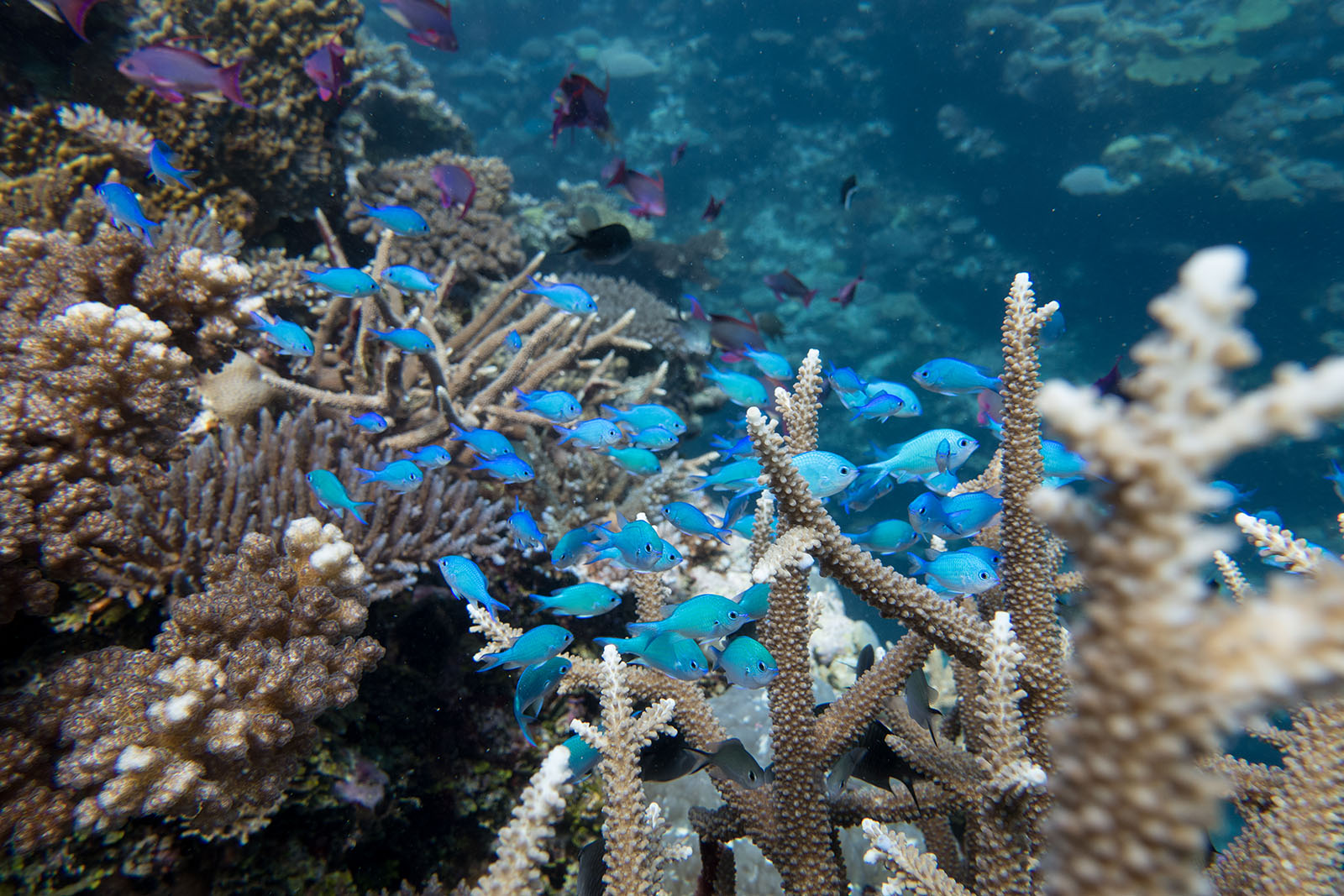
Fiji Underwater Photography Coral Reel Blue Fish
Below the Surface
A continuation of New State of Human Consciousness ~ World Peace and Harmony
I have spent a lot of time underwater.
There is a particular kind of silence that lives beneath the ocean’s surface, different from any silence on land. It is full rather than empty. It hums. A healthy reef is one of the most alive places on earth, a riot of color and motion, every square inch occupied by something with a purpose, everything connected to everything else in ways science is still trying to fully understand.
I have also watched that silence change.
Coral bleaching doesn’t happen all at once. It is a slow erasure. First the color drains, the symbiotic algae abandoning the coral as the water warms beyond what the relationship can bear. What’s left behind is white, skeletal, still structurally intact but emptied of life. On my dives I have floated above reefs I remembered as vivid and thriving, and felt something close to grief. Not metaphorical grief. Real grief. The kind that sits in your chest and stays there.
That feeling matters. I want to hold onto it rather than look away, because I think it is pointing at something true.
Around the same time I started reading about what is happening in the Southern Ocean, thousands of miles from any coral reef. Industrial krill fishing has expanded dramatically over the past three decades, the catch increasing fourfold since 1993. Massive trawlers work the same dense krill patches that humpback, blue, and fin whales depend on to survive and reproduce. These are the same whale populations that spent most of the twentieth century being hunted nearly to extinction. They have been recovering, slowly, stubbornly, beautifully. And now they are competing with super trawlers for the same food, in the same water, sometimes in the immediate vicinity of feeding animals.
The demand driving this industry is not exotic. It is omega-3 supplements. Aquaculture feed. Pet food. Products sitting on shelves in ordinary stores in ordinary towns. The distance between a blue whale going hungry in Antarctic waters and a vitamin capsule on a pharmacy shelf is shorter than most people realize.
What breaks my heart about the krill story, beyond the immediate harm, is what it disrupts at the level of the ecosystem itself. Whales feed on krill, and their waste fertilizes the ocean, which promotes phytoplankton growth, which produces more krill. It is one of nature’s most elegant cycles, a loop of abundance that sustains itself as long as nothing removes too much from any point in the chain. When you break that loop for short-term commercial gain, you don’t just harm whales. You unravel something that took millions of years to find its equilibrium.
This is the old consciousness at work. Not malice, exactly, but disconnection. A failure to see that we are inside the system, not above it. A habit of treating the natural world as a resource to be extracted rather than a community to belong to.
—–
I keep coming back to hope, though. Not as a comfort, but as a conclusion.
The whales are recovering. That fact deserves to be said clearly and held onto. Populations that were reduced to the edge of nothing by industrial whaling have been growing back in the decades since protections were put in place. Nature moves toward life when we stop actively preventing it. The reef systems that have been protected and given room to breathe show signs of resilience that scientists did not predict. Life is persistent in a way that humbles me every time I descend into the water.
What this tells me is that the barrier is not biological or ecological. The ocean knows how to heal. The barrier is in us, in the stories we tell about what we value and why, in the systems we’ve built around assumptions that no longer serve the world we’re living in.
And stories can change. People can change. I have seen it.
The new consciousness I believe in is not a sudden awakening. It is a series of small, deliberate choices made by individuals who have allowed themselves to feel the weight of what is actually happening, and who have decided that feeling is information rather than inconvenience. It is a diver surfacing from a bleached reef and telling someone what they saw. It is a consumer pausing at the supplement shelf and asking where this came from. It is a policymaker choosing to honor a management measure rather than let it lapse.
None of these gestures are large enough on their own. Together, they are everything.
The bridge between the world as it is and the world as it could be is still built one outstretched hand at a time. That belief has not changed for me. If anything, the more I see of what is being lost, the more certain I become that the hand reaching out is the most important thing a human being can do.
So I keep diving. And I keep looking. And I keep telling people what I see.
No Comments