

Warrior Poet Watercolor Mandala Art
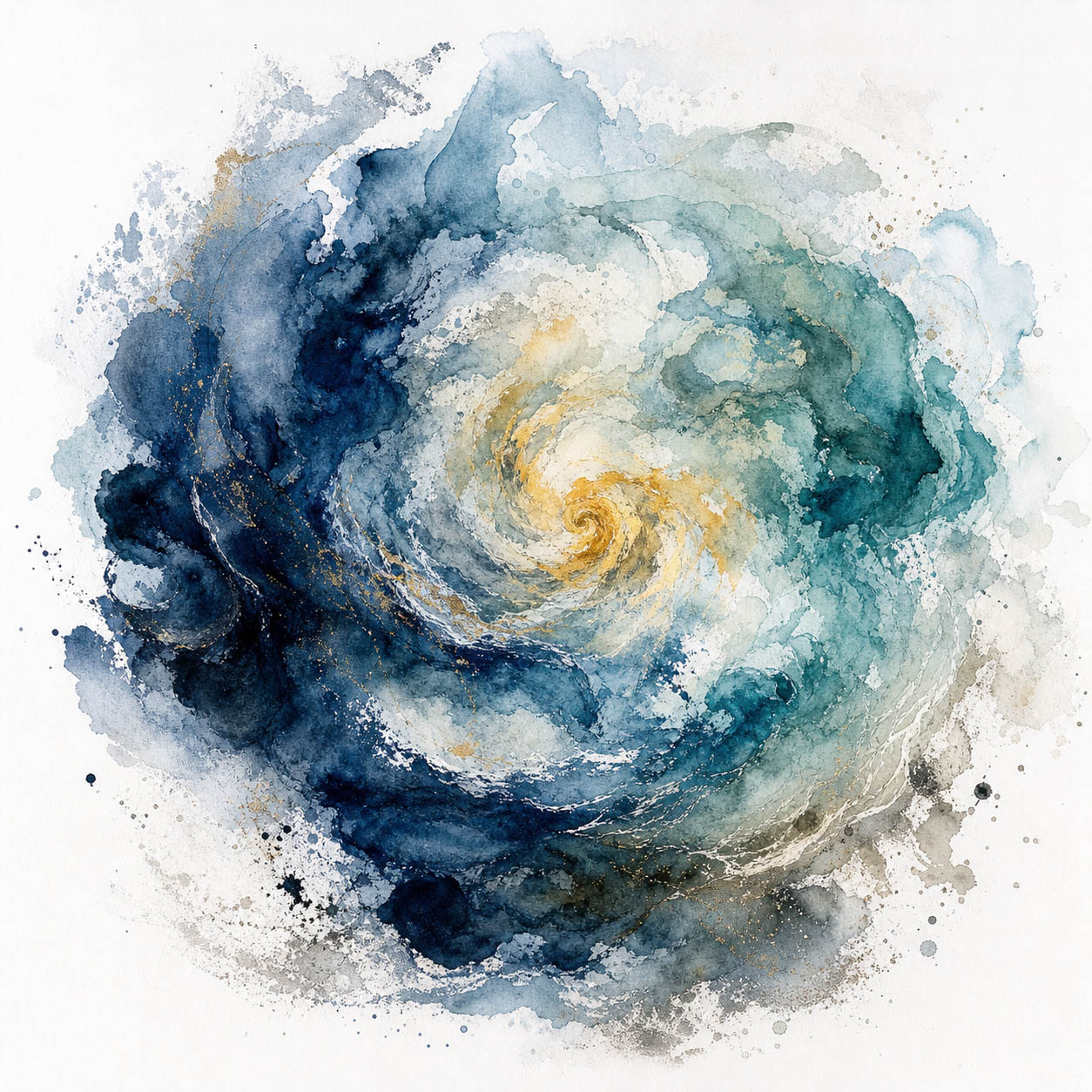
Warrior Poet
On strength, gentleness, and the courage it takes to carry both
By Chris Keeney
I’ve always been better at earning someone’s attention than demanding it. I knew what I was worth. I was tall, I could make almost anyone laugh, or at least leave them smiling, and I’d built enough of a life by my own hands that I wasn’t looking for anyone’s approval to feel okay about where I stood. I was doing fine. I was in the game.
But something kept catching my eye. There was a particular kind of guy, the one who moved through the world like it had been expecting him, and the women who turned heads wherever they went kept finding their way to him without much deliberation on either side. I wasn’t standing on the sidelines watching this happen. I was out there myself, working my own angle, trying to figure out the same game everyone else was playing. I just kept noticing that the rules seemed different for certain guys. And I couldn’t quite put my finger on why.
It took years to understand what I was actually seeing.
There is a word for what those guys carried: bravado. A bold, swaggering show of confidence meant to signal dominance, close off competition, and rearrange the social order in their favor before anyone has a chance to object. It isn’t always hollow. Sometimes the confidence is real. But the performance around it, the swagger, the posturing, the need for you to witness it, is almost always about fear, a cover for something that hasn’t been worked through yet. I’ve seen it in locker rooms and boardrooms and comment sections and, yes, in the ocean at six in the morning, when you’d think the cold water would have stripped all that away. It doesn’t. If anything, the ocean clarifies it.
For a long time I thought the world simply rewarded the wrong things. That decency was a liability dressed up as a virtue. The kind guy becomes the friend, the confidant, the one she calls after the other one disappoints her, which he will, reliably, because bravado without substance eventually exhausts its own performance. Being that person matters, but it is not the same as being chosen.
Then I got older. I read more. I listened carefully. And something shifted in how I held the question.
The women weren’t wrong, at least not in the way I had been framing it. They weren’t choosing bravado over kindness. They were choosing someone who seemed to know who he was, even when that certainty was mostly performance, over someone who was asking permission to exist in every interaction. What passes for niceness in a young man is sometimes genuine, but it is also sometimes an audition, a low-grade, constant plea to be chosen. Nobody finds that attractive, because it doesn’t signal warmth; it signals that someone will need carrying. That took a long time to see clearly, and longer still to do anything about it.
To be fair, plenty of women are drawn to kindness. They value it and will tell you honestly it’s what they want. But there is a difference between who we admire and who we are pulled toward, and those two things don’t always point in the same direction.
To be clear, it was never really about looks or money or muscle, though those things carry their own currency and anyone who says otherwise isn’t being straight with you. What women are actually responding to, what employers and teams and circles of real friends respond to, is something closer to solidity. The sense that this person has done some work on themselves. That they know who they are. That when things get hard, and things always get hard, they won’t fold or flee or need to be talked off a ledge. Resilience isn’t a soft word. It’s one of the most attractive qualities a person can carry, because it signals that you are safe to be around. That the weight won’t always fall on someone else.
There’s a word some younger men use for the guy who abandons himself entirely in pursuit of a woman’s approval. They call him a simp. It isn’t a kind word and I don’t use it to judge, because I understand the impulse underneath the behavior. The desire to be chosen is one of the most human things there is. But the simp has made a calculation that doesn’t work. He has decided that making himself endlessly available, endlessly agreeable, endlessly accommodating, will eventually be rewarded. It won’t. Because what he’s offering isn’t partnership. It’s maintenance. And nobody wants to be someone’s entire emotional infrastructure. They want an equal. Someone who brings a self to the table, a real one, not a reflection of whatever they seem to want to see.
Somewhere along the way I encountered an idea that reframed everything I had been wrestling with: the distinction isn’t between being nice and being tough, but between being nice and being good.
They are not the same thing. Niceness avoids conflict to keep the peace, while goodness tells the truth because the truth matters more than comfort. Niceness steps aside because it’s afraid; goodness steps aside because it has chosen to. One is harmless, the other is capable, and chooses gentleness anyway. A nice man won’t hurt you because he can’t. A good man won’t hurt you because he has decided not to. That decision, made from genuine strength rather than helplessness, changes everything about how it lands. This is not a small distinction; it is the whole thing.
Someone once told me it’s better to be a warrior in a garden than a gardener in a war. I’ve been turning that over ever since. Both are admirable and both have their place, but only one of them has what the moment requires, whatever the moment turns out to be.
The bravado man is all warrior, no garden. He can take the wave but cannot sit still on a beautiful morning and simply be grateful he’s in the water. He wins the short game and wonders, privately, why nothing feels like enough. The nice guy, at his least developed, is all garden, genuinely kind, present, good at heart, but he flinches. He defers not from wisdom but from fear, fear of losing something he was never quite sure he deserved.
What both are missing is integration: the capacity for strength held alongside the practice of gentleness. Not weakness performing as kindness, and not aggression performing as confidence, but something harder to build and impossible to fake.
None of this is uniquely human. You see it everywhere once you start looking.
Male lions don’t begin with violence. They begin with presence, roaring across distance, patrolling territory, making it known what they are before anything has to be tested. Gorillas do the same through chest beating and controlled displays of force. Birds expand themselves, spreading wings and performing elaborate rituals meant only to be seen. Fish flare and circle, resolving conflict without contact. Across species, what looks like confidence is often signaling, a way of arranging outcomes before they have to be earned through direct confrontation. The lion is the oldest warrior we know. It doesn’t write poems. But watch it long enough and you start to wonder if it understands something about restraint that we’ve forgotten.
It is efficient. It prevents injury. It establishes order. And in animals, it makes perfect sense. The stakes are immediate: survival, reproduction, territory. What’s less clear is why we carry so much of it forward into a world where the stakes have changed, but the performance hasn’t.
Hunt or be hunted. It is the oldest story the animal kingdom tells. The question is whether it has to be ours.
There’s a code in the water. No one writes it down and no one enforces it, but anyone who spends real time there knows it: the surfer closest to the break has the right of way. You don’t snake. You don’t drop in. You wait your turn. And when someone violates it, everyone knows. Most people follow this code most of the time. But there is a particular kind of surfer who treats the lineup like territory to be seized, paddling aggressively for every wave and positioning himself through force of presence rather than patience or skill.
It’s a familiar pattern. It shows up wherever the thin membrane of civility starts to wear through, when people move through the world as if they are the only real presence in it and everyone else is incidental.
It took years of returning to the same stretch of beach before the local surfers saw me as anything other than a curiosity. A bodysurfer, no board, no visible claim. I didn’t argue for my place or try to assert it. I just kept coming back, season after season, and when the winter swells rolled through I paddled into them and rode what I could.
At some point, without announcement, something shifted. A nod in the lineup. A wave offered instead of taken. The quiet acknowledgment that comes from watching someone long enough to understand what they’re made of. Nothing about that was performed. It accumulated slowly, without witnesses. The ocean doesn’t reward the warrior alone. It rewards the one who has learned to read it, to listen to it, to find the language of it. That’s the poet’s work as much as anyone’s.
That’s something I’ve come to think of as a different kind of system, not dominance or submission, but something closer to an internal compass, the quiet set of choices that shape how you move through the world moment by moment. Not what you signal, but what you consistently do.
Nice guys finish last. We’ve all heard it. But I’ve started to wonder what we actually mean by finishing. Finish where? In what race? By whose measure?
The aggressive surfer catches more waves, that’s true, but he’s also exhausted by noon and has managed to make a handful of strangers resent him. The man who waited his turn, who let the kid have the last one, who sat in the channel and watched the light change, caught fewer waves but doesn’t want to leave.
That isn’t romanticizing the loss. It’s questioning the metric.
We’ve built a culture that celebrates the wrong finish line, rewarding speed, volume, and visibility, and then acting surprised when the result feels hollow. Survival of the fittest was never about aggression; it was about adaptation. And in human beings, the environment is other human beings.
The most successful person might not be the one who takes every wave, but the one others want in the water with them.
And here is where the predator idea gets interesting. Because the lion isn’t cruel. It’s hungry. It takes what it needs and then it rests. It doesn’t dominate for sport. It doesn’t perform for an audience. The displays we see in nature, the roaring, the mane, the chest beating, are almost always a way of avoiding conflict rather than starting it. A signal that says I am capable of this, so we don’t have to find out.
The truly powerful person works the same way. They know what they are. They’ve done the work, built the strength, developed the knowledge, earned the confidence. And because they know it, they don’t need you to confirm it. The peacock spreads its feathers because it isn’t sure the message got through. The person who is genuinely secure just stands there. Not hiding anything. Not announcing anything either. Comfortable in their own skin in a way that has nothing to prove and nowhere to get to.
That kind of person, the one who carries power with enough wisdom to know when not to use it, is the rarest thing in any room. They could dominate. They choose not to. Not out of weakness, and not out of performance. Out of something that has no good word in English except maybe grace.
The most dangerous person in the room is often the quietest one. Not because they are hiding something. Because they have nothing left to prove.
So what does the person do who was never going to be the lion? The one who didn’t get handed the looks or the physique or the easy confidence that fills a room before you’ve said a word? What does the good guy do in order to survive?
He goes deeper instead of wider. He gets funny, because humor reads a room faster than a fist ever could. He gets smart, because intellect is its own kind of armor, the kind that doesn’t rust or age out. He gets fit in whatever way is available to him, not to perform strength but to feel it from the inside. He pays attention, because the observer always knows more than the performer. He builds consistency over time, because consistency creates a kind of gravity that bravado cannot manufacture. And slowly, without announcing it, he becomes someone others trust. Someone others want around when things get hard. Not because he conquered anything. Because he built something real.
None of that is weakness. All of it is the garden preparing the warrior.
But here is the thing the bravado man never learns, and the thing the world would do well to remember. Patience is not the same as passivity. Gentleness is a choice, not a sentence. And even the most grounded, generous, long-suffering person has a line. There is an old saying that you can only kick a dog so long before it bites back. Not because the dog has become mean. Because something in every living creature knows the difference between being treated with dignity and being used. And when that line is crossed one too many times, the response that comes back is not bravado. It is not performance. It is something older and quieter and far more serious. The bravado man never sees it coming, because he has never learned to read anything that doesn’t announce itself.
The greatest leaders in history understood this. The ones who moved the most weight with the least force weren’t the ones with the biggest armies or the loudest voices. They were the ones who understood that the real battlefield is always consciousness. That you win territory with weapons but you win the future by changing minds. That peace enforced by fear lasts only as long as the fear does, while peace built from genuine understanding, from empathy and shared dignity, has a chance of lasting beyond a single lifetime.
The warrior poet doesn’t choose between strength and gentleness. He’s stopped believing that’s a choice.
We are not there yet. But I think we are capable of it. Not all of us, not all at once. But enough people, choosing integration over dominance, choosing the garden alongside the warrior, choosing to carry their power with enough wisdom to know when to put it down. That accumulation, one quiet choice at a time, is what a new state of consciousness actually looks like. Not a revolution. A practice. The same practice, every morning, in whatever water is available to you.
The sun is coming up and the sets are moving through. There’s a kid out here on a board that’s too big for him, waiting for something he can handle. A wave builds that I could take. It’s right there.
I let it go and watch him paddle into it, watch the wave lift him and carry him and set him down in the shallows with his arms in the air.
That is not finishing last.
That is knowing, finally, what the race is actually for.
AI Image Prompt
WARRIOR POET — FIELD OF EARNED BALANCE
Enactive System Watercolor Field · prompt by Chris Keeney
FORMAT / MATERIAL CONDITIONS
Square 1:1 aspect ratio. The active field occupies roughly 80–90% of the image plane, but it does not resolve as a fixed or bounded shape. Instead, it gathers into a loosely circular concentration of activity through the natural behavior of water, pigment load, gravity, and absorption into a pristine white background. It is surrounded by expansive, untouched white space that feels like breath between thoughts—but the transition into that space is irregular, porous, and inconsistent, never cleanly defined. There is no hard circular edge, no mask, and no imposed boundary.
Edges emerge only where water loses momentum, pigment disperses beyond cohesion, capillary action thins into dryness, and the surface resists further expansion. The perimeter breathes—feathered in some areas, broken or dissolving in others—sometimes suggesting a circle, sometimes releasing it. Circularity is felt, not drawn.
Rendered exclusively in sumi-e ink and watercolor on a pristine white surface with subtle natural irregularity and the faint unpredictability of absorption. Capillary diffusion, mineral sedimentation, backruns, and atmospheric bloom are present, but never controlled to perfection—only met through sustained attention.
Nothing decorative. Nothing iconographic. No sacred geometry symmetry. No fantasy illustration. No “mandala art” aesthetics. The image must feel discovered rather than designed. Part ecological system. Part weather event. Part behavioral field study. Part lived moment of attention under pressure. It should feel like something a person could have stood near for a long time without fully understanding why they remained.
CORE FIELD THESIS
This is not an image of archetypes. It is an observational record of how awareness regulates itself—socially, ecologically, emotionally, and behaviorally—while living inside conditions that are not controlled. There is no separation between warrior and poet, but there is effort, learning, miscalculation, recovery, and restraint earned through experience. No duality between force and gentleness—only one adaptive intelligence continuously learning how to remain coherent without becoming hardened: compression and permeability, clarity and receptivity, containment and flow.
The field behaves like a living system that has been through enough weather to stop pretending it is separate from it.
PRIMARY STRUCTURAL DYNAMICS
The composition organizes itself through pressure gradients rather than symbolic geometry. Ink currents behave like ocean turbulence reorganizing after wind shifts, surf lineups negotiating space through embodied awareness, migratory flocks adjusting spacing through distributed intelligence, reef ecosystems balancing proximity and distance, and social attention fields where presence is tracked without naming it. Order emerges through relational intelligence, but not smoothly—there are hesitations, overcorrections, releases, and rebalancing. Nothing is centrally placed. Everything is behaviorally negotiated in real time. All motion bends, diffuses, or is reabsorbed into the field.
COMPRESSION STATES (Embodied Capacity / Internal Stability)
Deep indigo, cobalt, carbon-black, and ultramarine accumulate through gravitational pooling and slow saturation. These regions express restraint, pre-action stillness, consequence-aware attention, and calm that follows uncertainty. Structural coherence under pressure is present—attention that no longer needs to prove itself. Not dominance, but stability that remembers instability.
DIFFUSION STATES (Relational Intelligence / Adaptive Awareness)
Viridian, teal, diluted blue-gray, pearl wash, and translucent mineral blooms spread through wet-on-wet permeability. These regions express noticing before reacting, emotional flexibility without loss of center, and social intelligence that listens longer than it speaks. Pigment behaves like tidal systems—responsive rather than passive. This is participation without overreach, not surrender.
INTERFERENCE REGIONS (Human Truth Layer)
Where compression and diffusion meet, subtle turbulence appears: micro-vortices, delayed edges, overflows, recovering lines, and near-decisions. Identity loosens into behavior; hesitation becomes timing. This is where the image becomes most human—not through representation, but through visible adjustment under pressure.
OCEANIC REGULATION MODEL
The composition behaves like a surf ecosystem experienced from within participation. Waves arrive independent of intention. Position is negotiated. Spacing emerges through awareness. Timing replaces dominance. Trust accumulates slowly. There is fatigue—not exhaustion, but the cost of sustained attention. The system embodies people learning to remain in motion together without control or hierarchy.
ECOLOGICAL SIGNAL SYSTEMS
Non-symbolic intelligence appears through movement logic: lions conserving energy through presence, gorillas resolving tension through restraint, birds avoiding collision through micro-adjustment, fish schools flowing through distributed awareness, reef systems balancing competition and coexistence, surfers reading subtle shifts before waves arrive. Intelligence reduces conflict through attention rather than force.
CENTER CONDITION
Near the center, a faint spiral emerges through watercolor recursion and diffusion. Weathered gold, pale amber, and warm mineral tones soften into cooler structures. It is not declared, only noticed after sustained attention. It is recursive, breathing, self-regulating, and quietly alive—not transcendence, but continuous contact with what is happening.
GROUND STATE
Across the field remain tide marks, dry-brush hesitation, absorption delays, sediment settling, and re-attention points. These are not artifacts but evidence of sustained presence: consistency over intensity, observation before reaction, repair instead of correction, restraint through repetition, and trust built slowly through exposure.
FIELD CLOSURE CONDITION (MANDATORY EMERGENT CIRCULARITY — NON-GEOMETRIC)
All dynamics resolve through recirculation within a soft, permeable boundary rather than a fixed edge. No enclosing line exists. Outward movement loses coherence; diffusion reduces momentum; structure breaks at the periphery. Circularity emerges behaviorally—through return, bending, and redistribution rather than shape. Some currents dissipate, others re-enter indirectly. The field remains coherent but porous—an ecosystem rather than a form. No movement exits cleanly; all activity is reabsorbed, redistributed, softened, or dissolved into shared spatial memory.
FINAL EMERGENT CONDITION
The composition stabilizes without ending: calm clarity, undefended openness, ecological awareness, grounded intelligence, and quiet presence. A behavioral arc becomes visible—not as symbolism, but as repetition that has become natural: performance → awareness → restraint → integration → trust. The field remains alive while coherent.
CLOSING PRINCIPLE
Strength is not separate from gentleness. Gentleness is not separate from strength. They are the same intelligence under different conditions—learned through contact with reality rather than abstraction. Nothing is symbolic. Nothing is imposed. The field is discovered through sustained attention: a living system learning how to stay open without losing form, hold form without losing contact, and let the world move through it without disappearing in the process.
I’ve had good results running this prompt on the Perchance Image Generator and ChatGPT (which created the image in this post)
No Comments