

Enduring Optimism: Resilience as a Way Of Life Watercolor Mandala
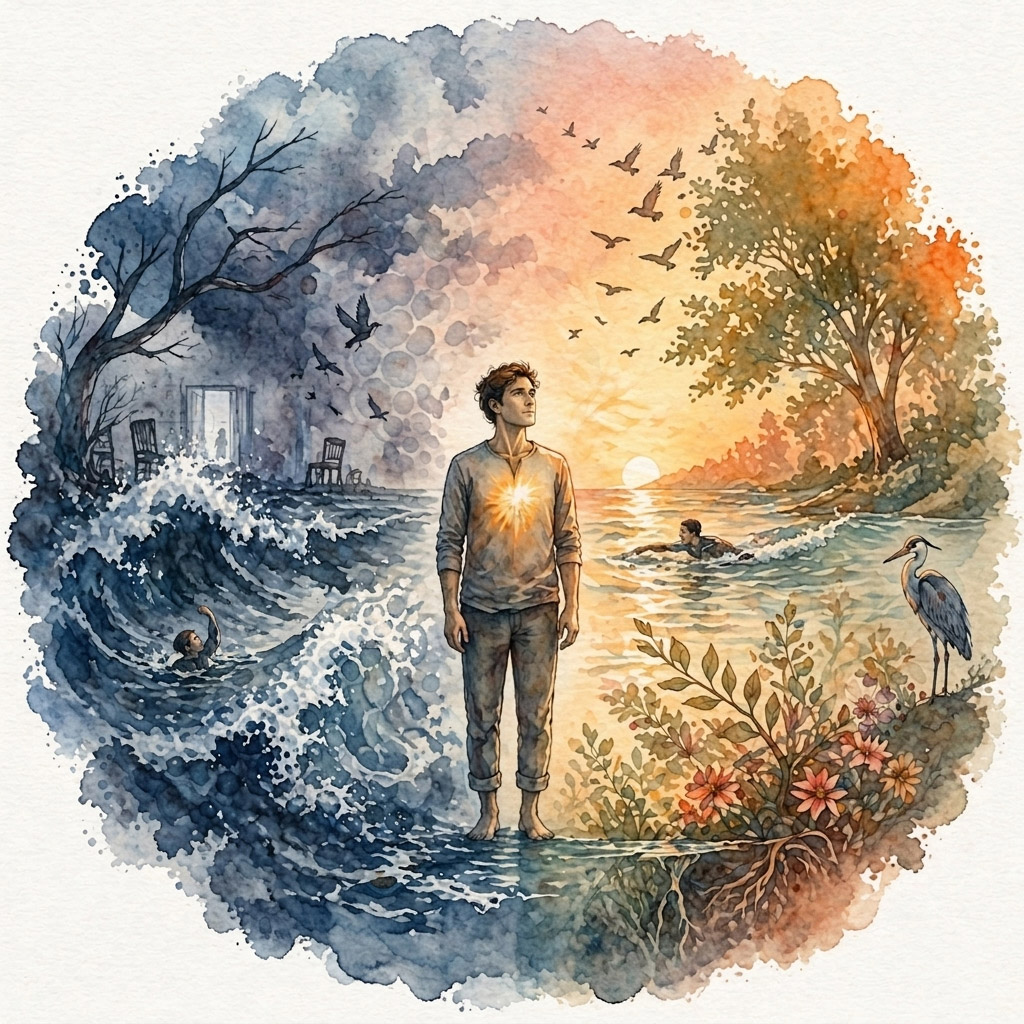
Enduring Optimism: Resilience as a Way of Life
by Chris Keeney
I have been knocked down more times than I care to count. Not metaphorically — though that too — but literally. Flat on the sand, a dislocated hip, waiting for an ambulance that couldn’t come fast enough, the ocean indifferent behind me. Bodysurfing will do that. So will life.
It is not a philosophy I arrived at through reading or research. It came the hard way — through illness, through grief, through loss piled on loss — and it came slowly, the way most true things do. I call it enduring optimism. Not the bright, untested kind that has never met real darkness. The other kind. The kind that has met it, looked at it directly, and chosen to keep moving anyway.
~~~
It started with Covid, before the vaccines, before anyone really knew what recovery looked like. I was sick in the way that rearranges you — a week in the hospital, a month on oxygen afterward, my body doing the slow, humbling work of learning to breathe again. For someone who begins most mornings in the ocean, who measures time and mood and meaning by the feel of a wave, this was not just a physical setback. It was an amputation of something essential. I could not get back in the water. And I was scared.
Eventually I did get back. Slowly, then less slowly. The ocean did not care how long I had been gone. The waves were indifferent in the best possible way. I swam out and I was still me — diminished, cautious, grateful in a way I had not been before. Getting back in the water felt like a decision. A small one, made in the early morning, in the cold, with no audience. But a decision nonetheless.
I did not know then that I was practicing something. I did not have a name for it yet.
~~~
Then my mother died.
I don’t know how to write that sentence in a way that captures what it actually is. You spend your whole life with a person as a fixed point — someone who existed before you did, who will always be there in the way that certain things are just always there. And then they aren’t. The absence is physical. It takes up space in a room. It shows up at the kitchen table, on the phone, in the particular silence of a Sunday morning when you reach for something familiar and find nothing there.
I was still finding my footing when a close friend was diagnosed with leukemia. I watched someone full of intelligence and warmth and curiosity go through the long, grinding process of fighting for his life — and lose. Grief for a friend is different from grief for a parent. It lands in a different part of you. It raises different questions. Mostly it made me think about time, and how casually I had always assumed there would be more of it.
Around this time I left the Salk Institute, where I had spent nearly a decade photographing some of the most important scientific work happening in the world. Leaving was hard. It was a kind of dying — the quiet end of an identity I had built slowly and carefully over years. I walked out and the day looked exactly the same as it always had. That was the strange part.
Months later I was back in the water, doing the thing that had always made me feel most like myself, when a wave took me the wrong way and I went down hard. I dislocated my hip and ended up bobbing in the whitewater, unable to move. A fellow surfer saw me and paddled over. “You okay?” he asked. “No,” I told him. “I think I broke my leg.” He didn’t hesitate — he dragged me to shore and stayed with me until the ambulance arrived, the ocean continuing behind us as if nothing had happened. There is a specific quality to that kind of pain — not just the physical shock of it, but the absurdity. The thing that heals me just broke me. I remember thinking, with something close to dark humor: of course.
And then there was my father. When my mother died, my dad — who had both diabetes and dementia — could no longer live on his own. As the executor of my parent’s estate, the responsibility of figuring out what came next fell to me. I found him a memory care facility and made it happen, the way you make things happen when they have to be done, moving through the paperwork and the decisions and the logistics while still somewhere inside the grief of losing her. There is a particular exhaustion in being the person who handles things. You don’t always get to fall apart when you need to.
But here is what I didn’t expect. The year and a half my father spent in that facility gave me something I hadn’t had in decades. I visited every other weekend. We’d have lunch together, talk, sit with each other in the way you can when there’s nowhere else to be and nothing to prove. I think I spent more time with my father in those eighteen months than I had in the previous thirty years. The dementia had taken a lot from him — the sharpness, the thread of continuity — but something remained. Something that was still him. And I got to be there for it.
When he finally died, I had already been grieving him for a long time. But I had also been present for him in a way I hadn’t managed before. That matters. I carry both things.
~~~
But here is what I also learned: you get back up.
Not easily. Not always gracefully. Not without cost. But you get back up because the alternative is to stay down, and staying down is its own kind of decision — one that compounds daily, one that the body and the mind both resist if you let them.
Resilience is not a personality trait you either have or don’t. It’s a practice — built in the repeated, unglamorous act of showing up. To the water. To the work. To the people you love. Not because anyone is telling you to push through, but because it has become, over time, who you are.
The practice looks different for everyone. For me it is the ocean. The early mornings. The cold water and the particular quality of light before the day has fully decided what it wants to be. The community of people who show up at the same stretch of water for the same reasons — not to compete, not to perform, but to be present in their bodies, to feel something real, to start the day with a kind of joy that requires no explanation.
Whatever your practice is — running, painting, cooking, prayer, tending a garden, playing music in a room by yourself — the point is that you do it regularly, with intention, and that over time it becomes less something you do and more something you are.
~~~
I believe we need a passion. A purpose. Not a grand one — not a life’s work or anything that requires a name. Just something that makes us lean forward. Something that pulls us out of bed on the hard mornings. For me it’s the water, the trails, the particular quality of light when you’re outside and paying attention. They’re all the same impulse, really. The desire to see clearly. It doesn’t matter what it is, as long as it puts you back in contact with something real. And I think that’s what makes resilience possible. Not the other way around. You don’t find your passion after you recover. It’s what carries you through.
The smile matters. Not the forced kind — not positivity performed for someone else’s benefit. The quiet internal one. The one that comes from knowing you have been here before. That you’ve been knocked down and gotten up. That you are going to be okay — not because life is easy or fair, but because you have practiced your way into believing it.
~~~
I am still practicing. Some mornings it comes easily. Some mornings it does not. But I show up, and the ocean is there, and the light is doing something remarkable on the water, and the people I have come to love are there too, moving through the same cold and the same morning, choosing the same thing.
That is enough. That has always been enough.
It is, in fact, everything.
“It Is Better to Travel Hopefully than to Arrive“ -Robert Louis Stevenson
———————————————
You may also enjoy reading:
Below the Surface: A New State of Consciousness
Presence, Pattern Recognition, and the New State of Consciousness
THE MIRROR
A Reflection on Artificial Intelligence, Human Consciousness, and the World We Are Making
No Comments