

Below The Surface: A New State Of Consciousness Watercolor Mandala
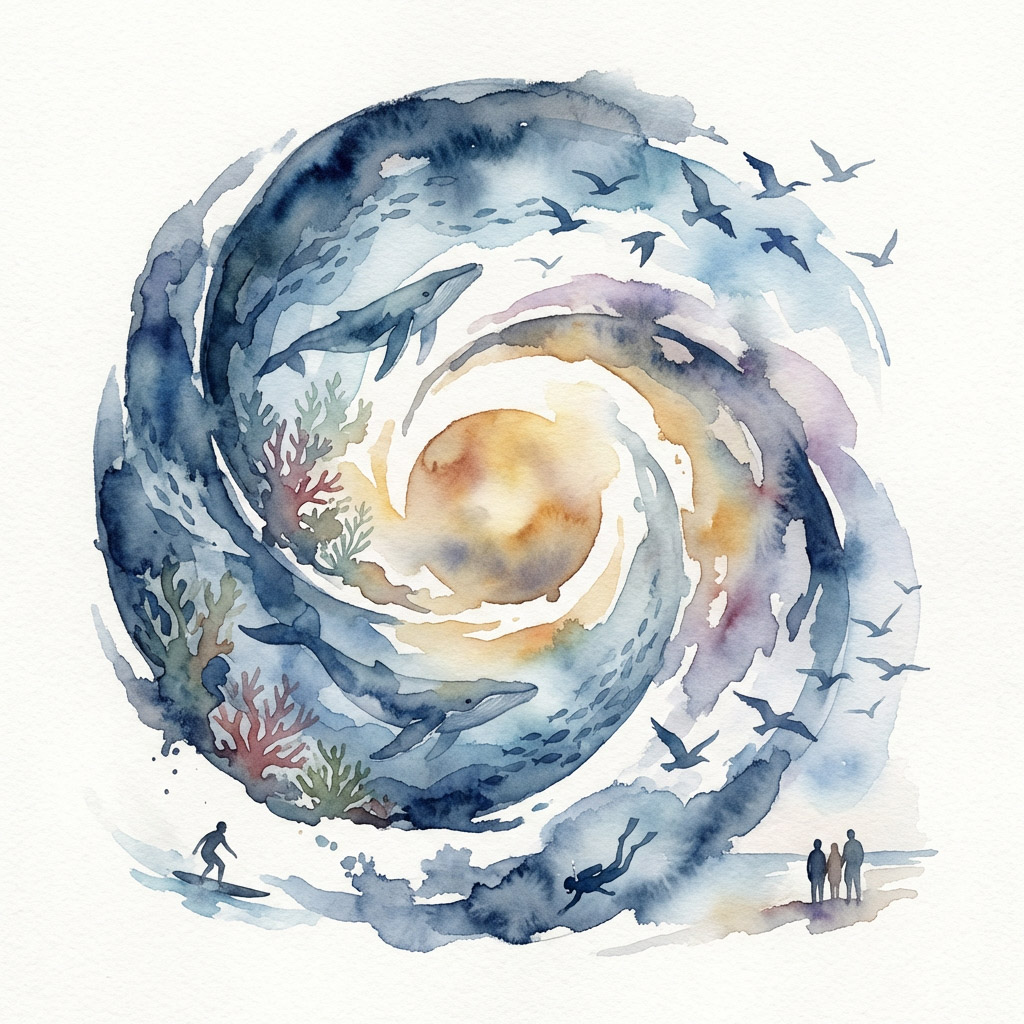
Below the Surface: A New State of Consciousness
There is a moment, just before a wave lifts you, when the ocean makes a decision about you.
You feel it in your chest — a deep, low surge that hasn’t broken yet. You read it the way you read a face. Years of being in the water teach you that. Not technique. Presence. The wave either takes you or it doesn’t, and in that suspended second, nothing else exists. Not the news. Not the warming. Not the grief you carry onto the beach every morning without quite naming it.
Just water. Just light. Just the oldest joy you know.
I have bodysurfed the same stretch of San Diego coastline for years. I know the people in the water the way you know neighbors — not always by name, but by how they move, how they wait, how they respond to the ocean and to each other. There is an unspoken ethic out there. You show up. You pay attention. You take your turn. You watch out for the person next to you without being asked.
It is, I’ve come to believe, one of the last places where the right way to be human feels completely natural.
But something has changed.
I notice it the way you notice a sound that stops. Not in a single moment, but as a slow absence. The birds that used to gather on the shore. The seals. The quality of the water itself, warmer than it should be, in ways that don’t announce themselves but accumulate. I have dived these waters. I have watched coral that was alive five years ago go white and still. I have noticed which fish are gone.
I am not a scientist. I am a photographer, a diver, a person who has spent enough time below the surface to know that what is happening up here — in boardrooms, in fishing fleets, in the exhaust of a civilization built on oil — is arriving down there with absolute clarity.
The ocean doesn’t warn you. It just changes.
~ ~ ~
And I keep thinking about a lion.
A specific lion — the last of a kind. The Barbary lion, also called the Atlas lion, once ranged across all of North Africa, from Morocco to Egypt. Massive. Dark-maned. The apex of its world. Roman emperors captured thousands of them for the Colosseum — fed to crowds as entertainment, as spectacle, as proof of human dominance over the living world.
That was just the beginning.
By the 19th century, colonial governments placed bounties on them. European hunters prized them as trophies — proof of bravado, of conquest, of a manhood measured in what you could kill. Tunisia lost its last wild Barbary lion in 1891. Algeria in 1893. In 1925, a French photographer captured what is believed to be the last wild one from an airplane over Morocco. In 1942, the last known wild Atlas lion was shot.
Shot. Not lost. Not faded. Shot.
I think about that often. The specific human decision, repeated across centuries, that added up to an extinction. No single person planned it. No one sat down and said: let us remove this animal from the earth forever. It happened through accumulation — of ego, of appetite, of the belief that the living world exists for our use and our amusement.
That belief didn’t die with the Atlas lion. It just found new expressions.
~ ~ ~
Oil. Money. Greed. Ego. Conflict.
Each one becomes the next. Each one is the last one, wearing different clothes.
Right now, industrial supertrawlers are moving through the Southern Ocean, vacuuming up krill — the tiny crustaceans that are the foundation of the entire Antarctic food web. Baleen whales, including blue and humpback whales still recovering from the devastation of commercial whaling, depend on krill almost entirely for survival. The trawlers know this. They operate in the exact feeding zones where whales concentrate, harvesting the same swarms the whales need to survive and reproduce.
The krill becomes omega-3 supplements. It becomes farmed salmon feed. It becomes pet food.
The whales starve, or become entangled in nets and drown.
And here is the part that should stop us cold — the part that is almost too perfect as a metaphor for what we keep doing: remove the whales to take their food, and the food disappears anyway. Whales are ecosystem engineers. As they feed and surface, they release nutrients that fertilize phytoplankton — the foundation of the krill’s own food supply. The whales don’t just eat the ecosystem. They sustain it.
Kill the whale, lose the krill.
We are not just cruel. We are blind.
~ ~ ~
Stand next to a modern cruise ship or container vessel sometime. Just stand next to one. Let the scale of it register in your body. Then consider that thousands of whales are struck by ships every year — blue whales, humpbacks, fin whales, North Atlantic right whales already teetering on extinction. Migration routes and shipping lanes overlap almost completely. Whales rest and feed at the surface. Ships that size can’t stop or turn in time. The crew often doesn’t feel the impact at all.
Sometimes the whale is found on the bow when the ship comes into port.
Nobody meant for that to happen. That’s almost the worst part.
And then there is the rocket.
In April 2026, China launched a carrier rocket from the sea — from the ocean itself — off the coast of southern China. A test satellite sent into orbit from a floating platform in waters where marine mammals navigate by sound, where whales communicate across hundreds of miles of open ocean. The acoustic shock of a rocket launch is catastrophic for them. A single launch can disorient entire populations. The fuel. The debris. The contamination of the water column.
We haven’t finished with what we’re doing to this ocean. And we’re already using it as a launchpad to leave.
~ ~ ~
I’d been noticing the dead birds on the beach for about a week. My friends and I figured it was probably the algae bloom — domoic acid toxin moving through the fish into the birds. It happens. We know these waters. But something made me look it up, and that’s when I found the real story. The Blob. A marine heat wave so extreme that Scripps Institution of Oceanography has recorded more than two dozen daily temperature records at La Jolla since January alone. The fish have gone deep seeking cooler water. The birds cannot follow them there. So they starve.
Then yesterday my wife and I met up after a surf session, walking back to the car together, and we came across them on the sand. She sent me an article about it later that day. This morning I read something that stayed with me.
Marine rescue teams along the San Diego coastline are fielding multiple calls every day. Beachgoers in La Jolla, Torrey Pines, Carlsbad — my beaches — are finding dead and dying birds on the sand. Brandt’s cormorants. Common murres. California brown pelicans. Emaciated. Unable to find food. Washing up by the dozens on shores they were never meant to touch.
What stops me is this: murres are open ocean birds. They come to shore only to breed and nest. That’s it. The shore is not their world. When a murre appears on a beach — walking up to strangers, standing on roads — it is not because it chose to. It is because the ocean it belongs to can no longer hold it.
A creature displaced from its own world by a warming it had no part in creating.
I’ve seen this before, underwater. Not in one place — in every place. Belize. Fiji. Mexico. Hawaii. Thailand. Coral that my dive logs show as living and vivid, now white and motionless as bone. The same story, told in different waters, on different sides of the world. Fish that used to move through those reefs in numbers that made you stop and just float there, watching. Gone, or thinning, in ways that don’t announce themselves dramatically — just quietly, incrementally, until one day you realize you are diving through a graveyard and you don’t know exactly when it became one.
The ocean doesn’t send a warning. It just changes. And if you’re not paying attention — if you’re not in it, not below it, not reading it the way you read a wave — you might not notice until the birds start washing up on your morning walk.
They are washing up now.
I think about a documentary I watched years ago — Blackfish — that changed something permanent in me about how we treat the creatures we share this planet with. It told the story of captive orcas — wild animals taken from their families, held in concrete tanks, driven to psychological collapse for the sake of entertainment and profit. The same equation, again. Ego. Money. Dominance dressed as wonder.
But here’s what I also hold onto: that film shifted something. Millions of people watched it and could not go back to seeing what they had seen before. Attendance dropped. Practices changed. A thing that had been normalized — wild animals performing for crowds — became, for many people, unbearable to witness.
That is consciousness changing. Slowly, imperfectly, incompletely — but changing.
The murres washing up on my beach are their own kind of documentary. The coral I’ve watched die across a lifetime of diving — Belize, Fiji, Hawaii, Thailand — the color it was, the fish that moved through it, the way the light fell — that is its own kind of testimony.
The question is whether enough of us are paying attention to let it change us.
Because what I know, from years below the surface, is that what we’re seeing on the beach is just the part that floats.
~ ~ ~
The murres on my beach. The whales in the Southern Ocean. The Atlas lion, gone forever. The coral I’ve watched die across a lifetime of diving — Belize, Fiji, Hawaii, Thailand — the color it was, the fish that moved through it, the way the light fell.
We are all part of the same story. Every living thing suffers. Every living thing is fighting to survive. And all of it — every dead bird, every bleached reef, every entangled whale — is connected to the same human choices, repeated across centuries, accelerating now.
This is why consciousness matters. Not someday. Now. Not as a philosophy or a bumper sticker or a weekend retreat — but as a fundamental shift in how we see ourselves in relation to everything else alive on this planet. The Atlas lion didn’t need us to love it. It needed us to leave it alone. The whales don’t need our admiration. They need us to stop taking their food. The ocean doesn’t need our poetry. It needs us to stop treating it like a disposal system for the consequences of our greed.
A new state of consciousness isn’t complicated. It’s just the willingness to finally see what we’ve been looking away from. To feel what we’ve been numbing ourselves against. To ask — honestly, without flinching — what kind of species we actually want to be.
Every living thing suffers. Every living thing fights to survive. The difference is that only one species chose this. And only one species can choose differently.
Nature has survived extinctions before. It will survive ours.
The question was never whether the earth would endure.
The question is whether we will — and whether we deserve to.
___________________
You also may enjoy reading:
Lost Civility
An examination of the loss of civility in everyday life—and the thought patterns and behaviors driving it
Presence, Pattern Recognition, and the New State of Consciousness
A look into how declining attention is eroding our ability to recognize patterns, and how presence restores it.
The Mirror
A Reflection on Artificial Intelligence, Human Consciousness, and the World We Are Making
More
A clear look at why we’re wired to want more—and how that shapes our happiness, behavior, and relationship to the world
What We Carry Forward
A thoughtful reflection on modern civility, human behavior, and the tension between self-interest and compassion. A reminder that small, everyday choices shape the world we collectively carry forward.
No Comments