

What We Carry Forward Mandala
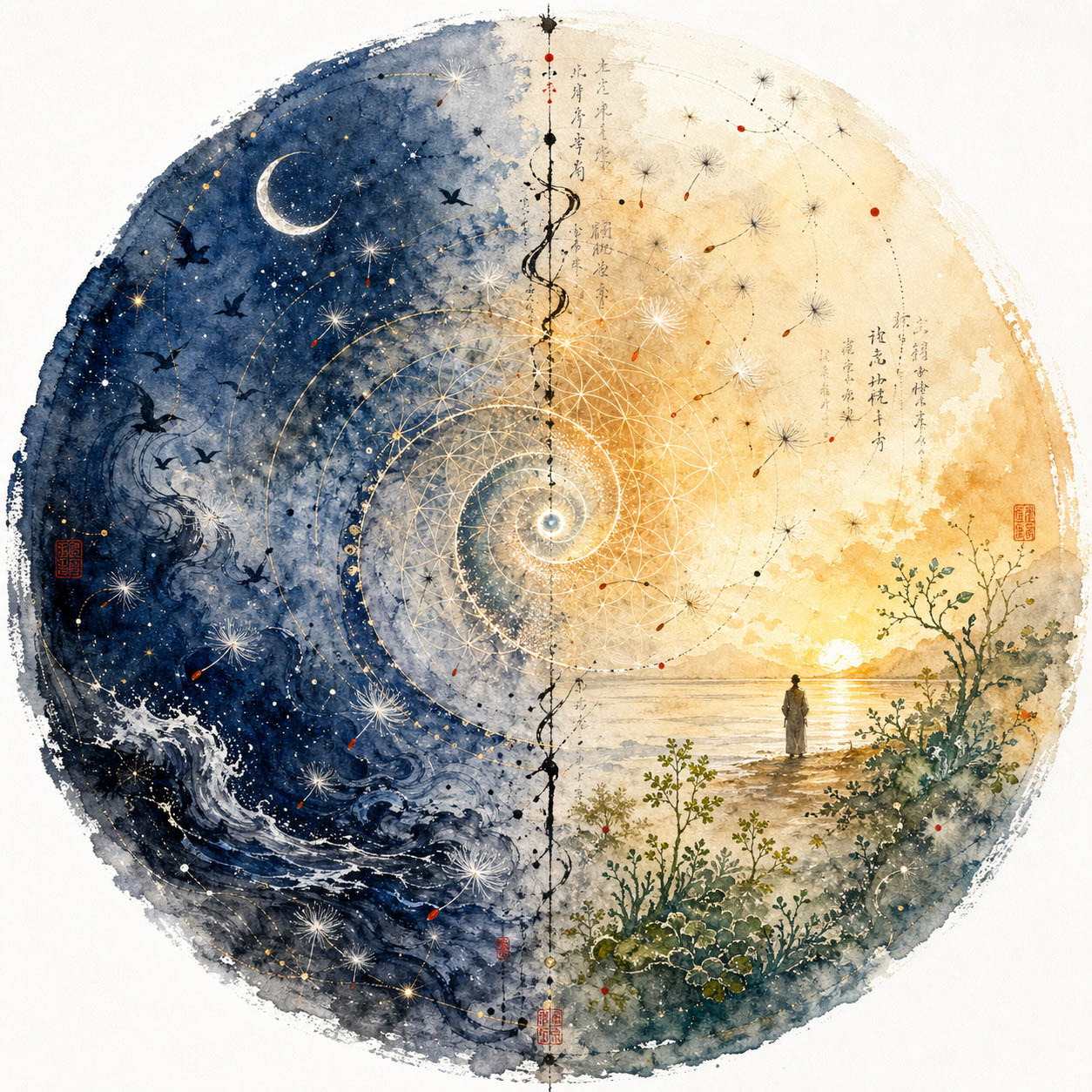
What We Carry Forward
The architecture of the soul: Sowing patterns that serve the whole
by Chris Keeney
My cat wakes me up most mornings around 3:30 or 4am. I stopped fighting it a long time ago. I get up, feed him, make myself a cup of coffee, and settle into a comfortable chair in the dark. It’s become one of my favorite times of day. The house is still, the world hasn’t started yet, and there’s something clarifying about sitting with your thoughts before the noise arrives. I read the news, scroll through LinkedIn, see what people are saying.
That’s where I was this morning when I came across a post that stopped me. Someone had bought a product they were genuinely excited about, and almost immediately the company released a newer version. I knew the feeling. This particular company is known for innovation and it’s not the first time they’ve done this to their customers. The person went online to complain, and somebody responded: take your karma farming somewhere else.
I had to sit with that for a moment. The internet has its own language and it moves fast, faster than I can keep up with most days. I later learned it was slang, a way of calling someone out for posting disingenuous content just to collect attention. A digital hustle with no real feeling behind it. Fair enough. But that’s not what stopped me. What stopped me were the two words sitting next to each other. Karma. Farming. The ancient idea pressed up against something very modern and a little hollow. Karma as something you cultivate. Something you tend. Something that grows from what you put into the ground. I turned that over for a while in the chair, still in the dark, then carried it with me down to the water.
A friend was already there. Someone I’ve talked with through enough sets to know he thinks carefully before he speaks. I told him about the karma farming comment. We agreed it was probably just a new word for trolling, a way of dismissing someone’s complaint as performance. But the word karma stuck with both of us. Because karma isn’t really about farming anything. It’s about what you set in motion. Every action is a stone dropped in water and the rings move outward whether you’re watching or not. That’s not mysticism. That’s pattern recognition. And there’s something in mathematics and geometry that points at the same truth. The same shapes repeat from the quantum scale to the cosmic one. A nautilus shell and a galaxy follow the same spiral. The Flower of Life, that ancient sacred geometry of overlapping circles, turns out to describe the same interference patterns that physicists find at the foundations of matter. The structure was always there. We just needed enough awareness to see it. Consciousness works the same way. The patterns in your own life are already present, already moving, already shaping what’s possible. Learning to see them, to recognize them through honest attention, is how a person actually changes. Not overnight. Not dramatically. But the way the sky changes between first light and sunrise. You almost miss it until suddenly the world is different.
We talked about patterns for a while. Then later he said something that stopped me. In the Catholic tradition, he said, there are virtues and there are vices, and each one leads down a different road. I said, well, that’s the duality of life, isn’t it. The good can’t exist without the bad. Night requires day. You can’t know warmth without cold. The whole yin and yang of it. He nodded. Two traditions, different languages, same map.
But then the question opened up in a way I wasn’t ready for. If duality is real, if conflict is the other half of peace the way darkness is the other half of light, then what exactly are we reaching for when we say world peace? Can peace exist without its opposite? Does peace even mean anything without conflict living alongside it?
I sat with that. Then I asked him something I’d been carrying since we first paddled out. Do you mind if I ask you a personal question? He said sure, I’ll give you a personal answer. I said, do you believe in world peace?
He paused. Then he said no. He said he thinks it’s just human nature to be in chaos, in conflict, all the time.
I didn’t argue. But it brought back a memory from years before any of this. A bumper sticker I used to have on my truck. A smiley face and next to it the words world peace. A cop pulled me over for speeding and after he handed me the ticket he slowed down on his way back to the cruiser. He turned around and said, hey, I want to ask you about that sticker. Do you actually believe that’s possible? I said yes sir, I absolutely do. He looked at me for a second, nodded, and walked away. I don’t think he believed it. But something made him ask.
Standing in the water this morning I could see the thread connecting all of it. The karma conversation, the virtues and vices, the cop, my friend’s pause before saying no. Good karma, the patterns you tend with awareness and care, leads toward peace. Bad karma, the patterns you feed without thinking, leads toward conflict. It’s not complicated. It’s just hard. Because the pull toward conflict is loud and fast and everywhere, and the pull toward peace is slow and requires you to keep choosing it even when nobody is watching and nothing seems to be changing.
Two people, years apart, same answer written on their faces. Not possible. Too much chaos, too much conflict, too much evidence. People lose children, spouses, parents, and they ask God why and get no answer they can hold. They watch people in power choose war, year after year, and eventually stop waiting for something different. After enough of that, hope starts to feel like a setup. It’s safer to call it human nature than to keep believing and keep getting your heart broken by the news.
I understand that. I’m not standing outside of it.
But I’ve started to think that the word peace might be pointing at the wrong thing. If conflict is part of the duality, then a world without conflict isn’t peace. It’s a void. And nobody is actually asking to live in a void. What I think we mean, what I think I mean when I say world peace, isn’t the elimination of darkness. It’s the development of enough consciousness to stop feeding it. Not a world where the pull toward destruction disappears, but a world where enough people have learned to recognize that pull, to hesitate, to choose differently. To know which road they’re on.
That’s a much harder thing than utopia. And a much more honest one.
I can hear the response already. Is a new state of consciousness going to pay my rent? Is it going to put food on the table, keep my house warm, put my kids through school? And that’s a fair thing to throw at this. A completely fair thing. Because the people who most need the world to change are usually the ones with the least time to think about how it might. Survival doesn’t leave much room for philosophy.
But I don’t think what I’m describing lives outside of ordinary life. It lives inside it. The shift isn’t a retreat or a program that requires time and money and the right circumstances. It happens in the margins of the day people are already living. In whether you pause before you react. In whether you stay curious about the person in front of you or write them off. In whether you let your kid show you something without looking at your phone. None of that costs anything. It doesn’t require a sunrise or a sermon or a bumper sticker. It just requires a willingness to notice, and then to choose a little more carefully than yesterday.
That’s not nothing. Over a lifetime it’s everything.
Think about what we’ve done to the atmosphere. No single person caused climate change. No single factory, no single country, no single generation. It happened the way all large things happen, through the accumulation of small choices made without awareness, repeated by enough people over enough time that the consequences became undeniable. The ocean I swim in every morning is warmer than it was. The coral I’ve photographed is bleaching. The birds I used to see are fewer. Nobody chose this. But collectively, unconsciously, we built it anyway.
Which means the opposite is also possible. Not inevitable. Possible. If enough small unconscious choices in one direction can change the chemistry of the atmosphere, then enough small conscious choices in another direction can begin to change the chemistry of how we treat each other. The mechanism is identical. The direction is the only variable. We are already carrying something forward every day. The question is what it is.
But underneath all of that is the question nobody quite wants to say out loud. Are humans actually capable of this? Not just willing. Capable. Because willing comes and goes with the mood and the news cycle and how bad the morning was. Capable is different. Capable means the potential is in there, built into the species, waiting for the right conditions to surface.
I think it is. I’ve seen enough, in the water, through a lens, in the faces of strangers who surprised me, to believe the capacity exists. People change. Cultures change. Things that felt permanent turned out not to be. The question isn’t whether humans can do this. The question is whether enough of them will choose to look in that direction before it’s too late to matter.
Here’s what makes it feel impossible though. Tearing something down is fast. You’ve seen the footage, a building that took two years to construct, gone in twelve seconds. A city that took generations to build, erased in an afternoon. The tools of destruction are instant and spectacular. The tools of building, a life, a mind, a way of seeing, are slow and quiet and show no dramatic footage of their progress. That asymmetry is part of why people give up. Even when they can picture something better, the math feels wrong. And so they take the safe path. The one that’s been walked before. The one that delivers, if not joy, at least something predictable.
But the asymmetry is actually the argument for building, not against it. Because the real barrier to peace, I’ve come to believe, isn’t wickedness or human nature or the wrong people in power. It’s imagination. You cannot build what you cannot picture. The failure to conceive of something is what keeps it from ever becoming real. And imagination, unlike bombs, doesn’t require resources or permission. It only requires the willingness to keep it alive in the face of everything that says don’t bother.
This is why I keep returning to the idea of a new state of consciousness. Not as a slogan. As a genuine threshold. A majority isn’t enough. Peace isn’t a policy you pass with fifty-one percent. It’s a perceptual shift that spreads the way everything meaningful spreads: slowly, person by person, in small unremarkable moments that don’t look like history while they’re happening.
Play. Learn. See. Empathize. I’ve written about these four things before as pathways, not a program but a practice. A way of staying open when the easier thing is to close. They’re also the tools that expand what a person can imagine. You play, and you stop defending territory. You learn, and the stranger becomes comprehensible. You see, and the world gets bigger than your wound. You empathize, and the other person stops being a threat. Do all four, over time, and your sense of what’s possible begins to shift. Not because the darkness disappears. Because you’ve learned to recognize it, name it, and choose your way through it.
My friend believes in virtues. He knows about vices too. He holds the duality without pretending it away. He’s already doing the work. He just hasn’t drawn the line yet between that daily practice and the larger horizon it belongs to.
Maybe that’s all any of us can do. Draw that line. Remind each other that the slow work matters even when it doesn’t show. Keep building, knowing it’s harder than tearing down, knowing it takes longer than a lifetime, knowing the darkness will always be there because light requires it.
And keep finding the words. Shared language is its own kind of seed. One person writes something down, reaches for the honest version of what they believe, and somewhere another person reads it and thinks yes, that’s exactly it, I thought I was the only one. That moment of recognition, quiet and private and almost invisible, is how consciousness actually spreads. Not through summits or legislation or viral arguments. Through one person handing something true to another and the other person receiving it.
He paused before he said no. That pause is where everything lives.
~~~
What We Carry Forward Mandala Prompt
A deeply expressive sumi-e watercolor mandala on pristine white washi paper with subtle natural fiber texture. The composition is perfectly circular, centered, and fully contained within the frame, with generous breathing space. Nothing is cropped. The overall feeling is spacious, atmospheric, and quietly alive.
The color palette reflects the meeting point of blue hour and golden hour: soft indigo washes, desaturated sky blues, warm amber light, and gentle gold accents. The tones transition fluidly across the mandala through smooth gradients and diffusion, like pigment dispersing in water according to natural flow fields. The mood is luminous rather than dark, a balance of dusk and first light existing at once.
Duality as Field Interaction (Physics Layer)
The composition carries a sense of emotional duality expressed not as opposition but as interacting fields. One side slightly denser, with deeper indigo washes, a crescent moon, birds in flight, dark water, and more turbulent brush movement. The ink behaves like fluid turbulence, eddies, diffusion, and chaotic flow, representing momentum, entropy, and unconscious pattern.
The other side more open, warmer, with diffused gold light, a still horizon, a single figure standing at the water’s edge, and calmer negative space. This side reflects low-energy equilibrium states, coherence, stillness, and awareness. These two states are not divided but interwoven, blending through gradients like interacting wave functions.
Central Spiral (Geometry + Algebra Layer)
At the center, a logarithmic spiral emerges with true mathematical integrity, a self-similar growth curve where radius expands exponentially with angle. Within the tightest innermost curl sits a small quiet seed of light, pale gold with a faint blue core.
Flower of Life (Sacred Geometry Layer)
The Flower of Life geometry is present throughout as a whisper rather than a statement. Overlapping circles emerge and dissolve within the watercolor field, fading toward suggestion at the edges.
Seeds as Particles in Flow
Fine delicate dandelion-like forms drift outward, carried by invisible currents. Some dissolve into the paper, others travel farther, tracing faint arcs like trajectories through a field of motion.
Growth as Emergent System
Where vermillion-marked seeds land, green life emerges—leaves, stems, coral-like branching, moss anchoring to surface. These are the visible outcomes of accumulated inputs over time.
Final Feeling
The piece should evoke a system set into motion, quiet causality unfolding over time, and the transformation of simple beginnings into complex outcomes.
One seed at a time. One person at a time. One revolution of the spiral at a time.
———————————
You also may enjoy reading:
Below the Surface: A New State of Consciousness
How witnessing ecological collapse firsthand changes consciousness and reveals the consequences of human systems on the natural world.
Lost Civility
An examination of the loss of civility in everyday life—and the thought patterns and behaviors driving it
Presence, Pattern Recognition, and the New State of Consciousness
A look into how declining attention is eroding our ability to recognize patterns, and how presence restores it.
The Mirror
A Reflection on Artificial Intelligence, Human Consciousness, and the World We Are Making
More
A clear look at why we’re wired to want more—and how that shapes our happiness, behavior, and relationship to the world
No Comments