

Presence Pattern Recognition Watercolor Illustration Consciousness Mandala
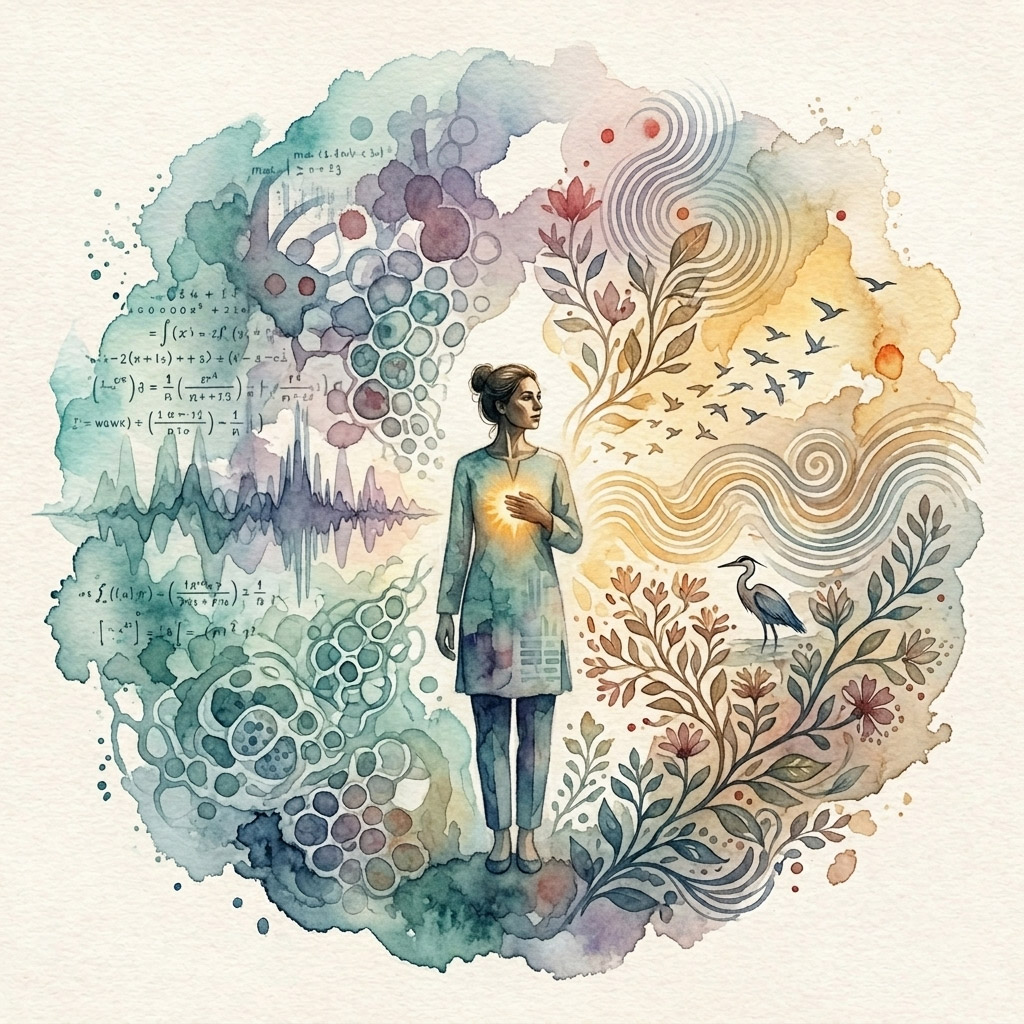
Presence, Pattern Recognition, and the New State of Consciousness
by Chris Keeney
Consciousness isn’t just awareness. It’s the ability to recognize patterns across time — and that ability is slipping.
You can see it in the numbers. In 2004, the average attention span on a digital device was around 150 seconds. By 2012 it had dropped to 75, and by 2024 it’s closer to 47. That isn’t just a statistic about screens. It’s a measure of how long we can stay with something before we leave it — long enough to notice what it’s doing, long enough to notice what we’re doing. A mind that can’t stay still doesn’t see much. It reacts, moves on, and forgets.
The Collapse of Attention
If you’ve ever tried to watch your own habits closely, you already know how slippery it gets. Patterns don’t announce themselves. They accumulate quietly, over time, and you miss them when you’re rushing or distracted or only halfway present. You also miss them when you’re inside them — there’s no visibility from within the pattern itself. Only repetition reveals it. Only distance makes it visible.
Most of us don’t give ourselves that distance anymore, and this isn’t really about willpower. Attention has been shaped into something fragile by design. Shortened attention spans track closely with rising stress — the system is running too hot, too continuously engaged. What researchers call “continuous partial attention” describes it well: you’re never fully anywhere, but never fully gone either. It feels like being busy. It isn’t the same as being present.
The platforms most of us use daily are very good at what they’re built to do — capture attention, redirect it, capture it again. Over time that loop doesn’t just use attention. It trains it. After a single interruption it can take close to half an hour to return to where you were cognitively. Stack that across a full day of notifications and quick checks and open tabs, and you begin to understand why you don’t quite come back. Not fully.
Presence and the Ability to See
It’s easy to blame the tools, but that explanation doesn’t hold for long. The same device that fragments one person’s attention is used by another to go deeper — to think, to write, to follow a line of thought all the way through. So the difference isn’t the tool. It’s the state of attention brought to it.
That’s a less comfortable conclusion because it removes the external target and turns the question inward: Am I here right now, or am I avoiding something? That question doesn’t respond to intention. It responds to honesty, and to a kind of stillness that most people don’t practice anymore.
Nature, and What Trains Attention
There’s a reason time in nature keeps showing up in research on mental health — not because it’s calming in some vague sense, but because it does something specific. It slows attention down. Water repeats. Wind moves in layered patterns. Light changes without urgency. Stay with it long enough and your attention begins to match that rhythm. You stop anticipating what comes next and start noticing what’s already there.
Children who grow up around green space show measurably lower rates of psychiatric disorders later in life. Meanwhile, references to nature in books, music, and film have been declining for decades. Less exposure outside, less representation inside — and over time that changes not only what we notice, but what we’re even capable of noticing.
In the Water
There is a moment in the water that I keep returning to.
When I’m bodysurfing in the early morning, my default state is anticipation — scanning the horizon, watching for a swell line to appear, impatient for the next set. Sometimes the ocean makes you wait. Fifteen minutes between sets isn’t unusual. It just feels long.
I wear earplugs to protect my ears from the cold water, which is a practical thing, but what it does is seal out the world. Suddenly there’s no ambient noise, no voices, no distant traffic — just the muffled rhythm of water moving around me. Sometimes, in that quiet, I stop looking at the horizon. I turn onto my back, let the salt water hold me without effort, and look up.
On a good morning the clouds are extraordinary. Not dramatic — just present. Lit from below by a sun still climbing, shaped by wind into forms that have no name. Mother Nature making art, briefly, for no one but me. And then they’re gone.
Through the earplugs I can hear the faint sound of other surfers talking nearby — voices too muffled to make out, just the shape of conversation without the words. Sometimes I catch them glancing over, lips moving, maybe smiling. It’s possible they’re laughing at the guy floating on his back staring at the sky. Honestly, I have no idea. But in that moment it doesn’t bother me, because whatever is happening above me is simply too good to leave.
That’s the part that stays with me. Not the beauty of it, though the beauty is real, but the speed of its disappearance. I was waiting impatiently for a wave, and in that pause I witnessed something that existed for thirty seconds and will never exist again in exactly that form. It made me aware of a pattern I carry everywhere: I am almost always rushing toward the next thing — the next wave, the next task, the next version of where I’m supposed to be. And in that forward lean, I miss what’s directly above me.
Presence doesn’t announce itself. It appears in the gaps — in the fifteen-minute wait, in the accidental quiet of earplugs, in the moment the body finally stops bracing and simply floats. That’s when the patterns appear. Not just in the clouds. In myself.
The New State of Consciousness
There is a threshold where attention stops behaving like fragmentation and starts behaving like structure. This isn’t concentration in the usual sense — it’s something closer to pattern visibility, a shift where perception stops being pulled outward in fragments and begins to organize itself across time. Experience stops appearing as isolated moments and starts revealing the continuity underneath them. What looked like distraction begins to show its structure. What looked like randomness begins to show repetition. What looked like “now” begins to extend in both directions.
This is the New State of Consciousness — not an altered state, but a reorganization of attention itself. Not escape. Recognition. Not intensity, but clarity across duration.
AI, Language, and Voice
There’s another shift happening, subtle enough that most people haven’t named it yet. AI is beginning to shape how people write, which means it’s beginning to shape how people think. The output is often clean, balanced, structurally correct — easy to read in the way that a waiting room is easy to sit in. But something in it can feel weightless, and there’s a difference between clarity and absence.
This piece was written with the assistance of AI, and that’s not something to hide. But there’s a difference between using a tool and allowing it to replace the work you’re supposed to do yourself — the noticing, the remembering, the lived friction that gives language weight. When someone brings real experience into the writing, it stays in the work. You can feel it. The cold water. The early light. The details that don’t generalize easily. If that’s missing, the result is harder to distinguish from everything else.
Stepping Out of the Pattern
Moderation used to mean something more active than it does now. It required noticing yourself closely enough to see when you’d gone too far in one direction — and then adjusting. That only works if you can actually see what you’re doing, and seeing it usually requires stepping outside of it, even briefly. That step isn’t abstract. It’s physical and situational — walking without your phone, sitting somewhere long enough for boredom to arrive, returning to the same place until repetition begins to reveal structure. It doesn’t look like much. It isn’t complicated. It’s just uncommon.
Awareness is what makes everything else workable. Not rules, not systems — those help at the margins, but the center is attention. Trained attention. Returned attention. Chosen attention. The kind that can stay long enough to let patterns reveal themselves.
Someone standing at the water’s edge in the early morning, watching the same wave break again and again, is doing more than it looks like. They’re giving their mind a chance to sync with something that doesn’t rush. And in that return, patterns begin to reappear — not as ideas, but as structure. Not something new, but something that was always there, waiting for the noise to settle.
The way back isn’t complicated. It begins when attention stays long enough to see what it’s actually looking at.
———————————————
You also may enjoy reading:
Below the Surface: A New State of Consciousness
How witnessing ecological collapse firsthand changes consciousness and reveals the consequences of human systems on the natural world.
Lost Civility
An examination of the loss of civility in everyday life—and the thought patterns and behaviors driving it
Presence, Pattern Recognition, and the New State of Consciousness
A look into how declining attention is eroding our ability to recognize patterns, and how presence restores it.
Enduring Optimism: Resilience as a Way Of Life
The Mirror
A Reflection on Artificial Intelligence, Human Consciousness, and the World We Are Making
What We Carry Forward
The architecture of the soul: Sowing patterns that serve the whole
No Comments