

Lost Civility Watercolor Illustration Mandala
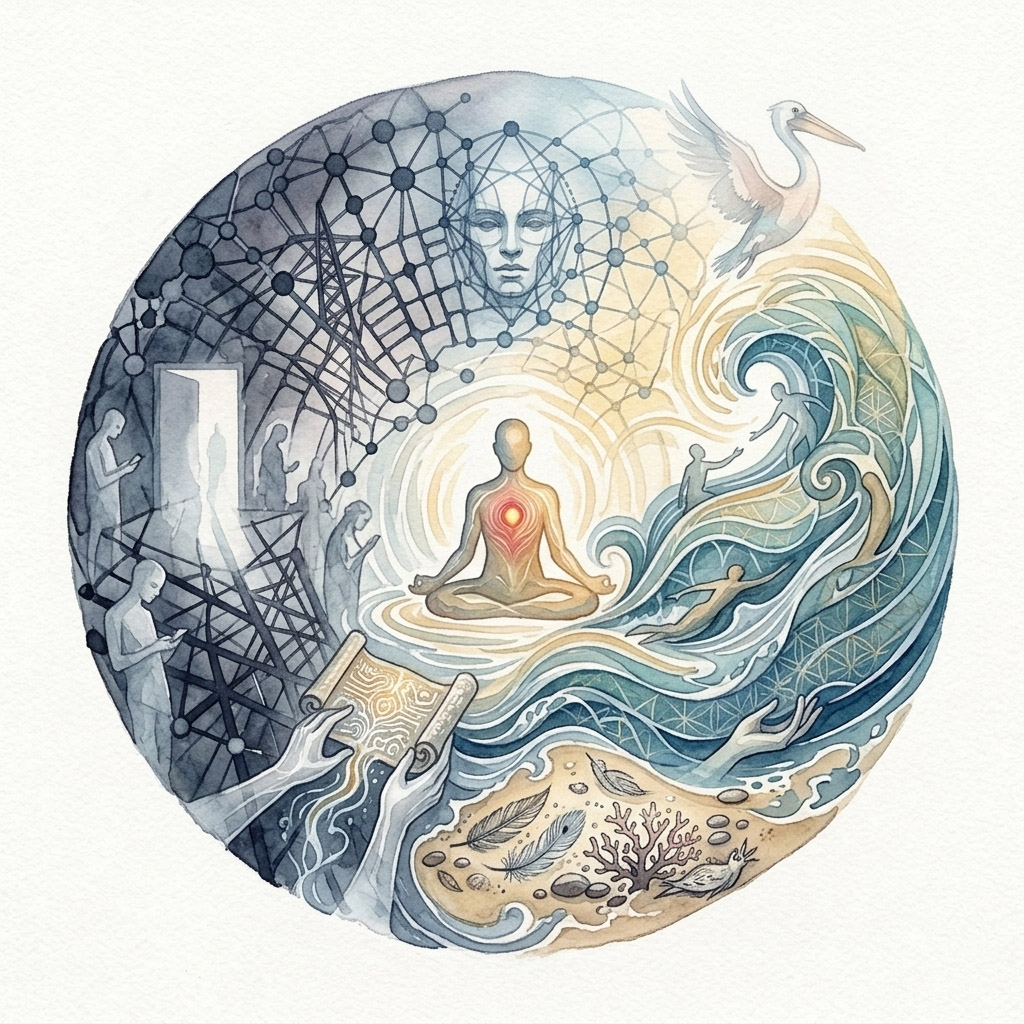
Lost Civility
by Chris Keeney
I used to watch a lot of zombie movies. I’m not entirely sure when I stopped, or why. But I know what drew me to them in the first place. There’s something about the moment civilization cracks open, when the power grid goes dark and the grocery stores empty and the social contract dissolves overnight, that I can’t look away from. I tell myself it’s entertainment. But I think it’s something closer to recognition.
We are fascinated by our own collapse because somewhere beneath the pleasantries and the traffic laws and the carefully maintained distances we keep from one another, we already sense how thin the membrane is. How much of what we call civilization is just agreed upon. A collective fiction we’ve all decided, mostly, to honor.
Mostly.
Watch how people drive. Watch how they talk to service workers. Watch what happens in a comment section, or an airport delay, or a parking lot at the end of a long day. The membrane thins. You can see it. Small acts of rudeness are not random. They are previews. Little rehearsals for who we might become if the lights ever actually went out.
And here’s the part I keep wrestling with: I still believe in chivalry. In holding the door. In letting someone merge. In doing the decent thing even when nobody is keeping score, even when it costs you something. Especially when it costs you something. I believe good people exist in every culture, on every continent, quietly choosing others over themselves a hundred small times a day.
But I’m also not going to pretend that nice guys don’t finish last. We do. Most of the time. And for a while that’s fine. There’s a kind of dignity in it, even a private satisfaction. You know who you are. You sleep well.
Until the day you don’t. Until you’ve watched enough selfishness rewarded and enough decency overlooked that something inside you starts to wonder: why am I playing by rules nobody else seems to know?
That’s what these thoughts want to sit with. Not whether people are good or bad — that’s too easy, and mostly wrong in both directions. But why goodness, when untethered from structure, so reliably gets outrun. And whether there is any path to a world where it doesn’t.
—
Where has it gone, exactly? That’s what I keep asking. Not in a nostalgic, things-were-better-back-then way, because they weren’t, not for everyone, and anyone who tells you different is remembering selectively. But something has shifted. Something small and hard to name.
It used to be, or maybe I just want to believe it used to be, that a stranger’s discomfort was your problem too. That you noticed. That the person behind you in line, the driver who needed to merge, the woman struggling with her bags, that they registered. That common decency was actually common.
Now I’m not so sure. Or maybe I’m sure in the wrong direction.
There’s a particular kind of invisibility that’s become normal. People moving through the world like they’re the only real person in it, everyone else just background. Not malicious. Not even conscious. Just absent. Checked out from the basic transaction of being human around other humans.
And I wonder how much of it is exhaustion. How much is fear dressed up as indifference. How much is the slow accumulation of a thousand small disappointments that teach you, eventually, to stop extending yourself. To stop being the one who smiles first. To stop holding the door for someone who walks through without looking up.
Maybe civility didn’t disappear all at once. Maybe it just got tired of holding the door for people who never looked up.
—
There’s a code in the water too. No one writes it down. No referee enforces it. But surfers — most of them, most of the time — follow it anyway. The person closest to the breaking part of the wave has the right of way. You don’t drop in on someone else’s wave. You don’t snake. You wait your turn. And when someone violates it, everyone knows. The look exchanged between strangers says everything.
I’ve seen people respect it beautifully — pulling back at the last second, gesturing someone else forward, giving up a wave they could have taken. And I’ve seen people ignore it completely, paddling through like the ocean belongs to them alone. Both happen. Both are human.
But what strikes me is that the code exists at all. Nobody had to make it official. It emerged because people who love the water recognize, on some level, that the experience is diminished when everyone acts only for themselves. That there’s something worth protecting — not just the wave, but the shared encounter with it.
Maybe that’s the moral fiber that gets talked about in the abstract but lived in the specific. You know it’s the right thing. You do it anyway. Not because someone is watching. Because you’ve internalized something larger than yourself.
—
Maybe this is what a new state of consciousness looks like. Not a revelation. Not a movement. Just a person standing at the water’s edge before the world wakes up, learning to pay attention.
The ocean has always been a teacher, but only for those willing to be students. To bodysurf is to negotiate — with force, with timing, with something that doesn’t care about you but will carry you anyway if you meet it right. You have to feel what’s actually there. The cold. The pull. The strange gift of surrender. That kind of attention — embodied, humble, reciprocal — might be the most radical thing a person can practice right now.
I don’t know what artificial intelligence will ultimately reveal about us. But I find myself hoping it becomes a mirror more than a tool. That somewhere in all that pattern recognition, all that vast cross-referencing of human behavior and consequence, something gets reflected back that we finally can’t look away from. Not to shame us. To show us ourselves clearly enough that we choose differently.
And maybe that’s already beginning. Not in policy. Not yet in the systems that would need to change most. But in people who are starting to feel the grief and stay anyway. Who walk into the water knowing a bird died on this beach and swim in it anyway — not in denial, but in love. Holding both. That’s not nothing. That might be everything.
A pelican lifts off the surface fifty yards out. It catches the updraft and rises without effort, reading something in the air I can’t feel from here. The wave I’m waiting for gathers behind me. I turn toward shore.
————————-
You also may enjoy reading:
Below the Surface: A New State of Consciousness
How witnessing ecological collapse firsthand changes consciousness and reveals the consequences of human systems on the natural world.
Presence, Pattern Recognition, and the New State of Consciousness
A look into how declining attention is eroding our ability to recognize patterns, and how presence restores it.
The Mirror
A Reflection on Artificial Intelligence, Human Consciousness, and the World We Are Making
More
A clear look at why we’re wired to want more—and how that shapes our happiness, behavior, and relationship to the world
What We Carry Forward
A thoughtful reflection on modern civility, human behavior, and the tension between self-interest and compassion. A reminder that small, everyday choices shape the world we collectively carry forward.
No Comments