

The Mirror: A Reflection on Artificial Intelligence and Human Consciousness Mandala
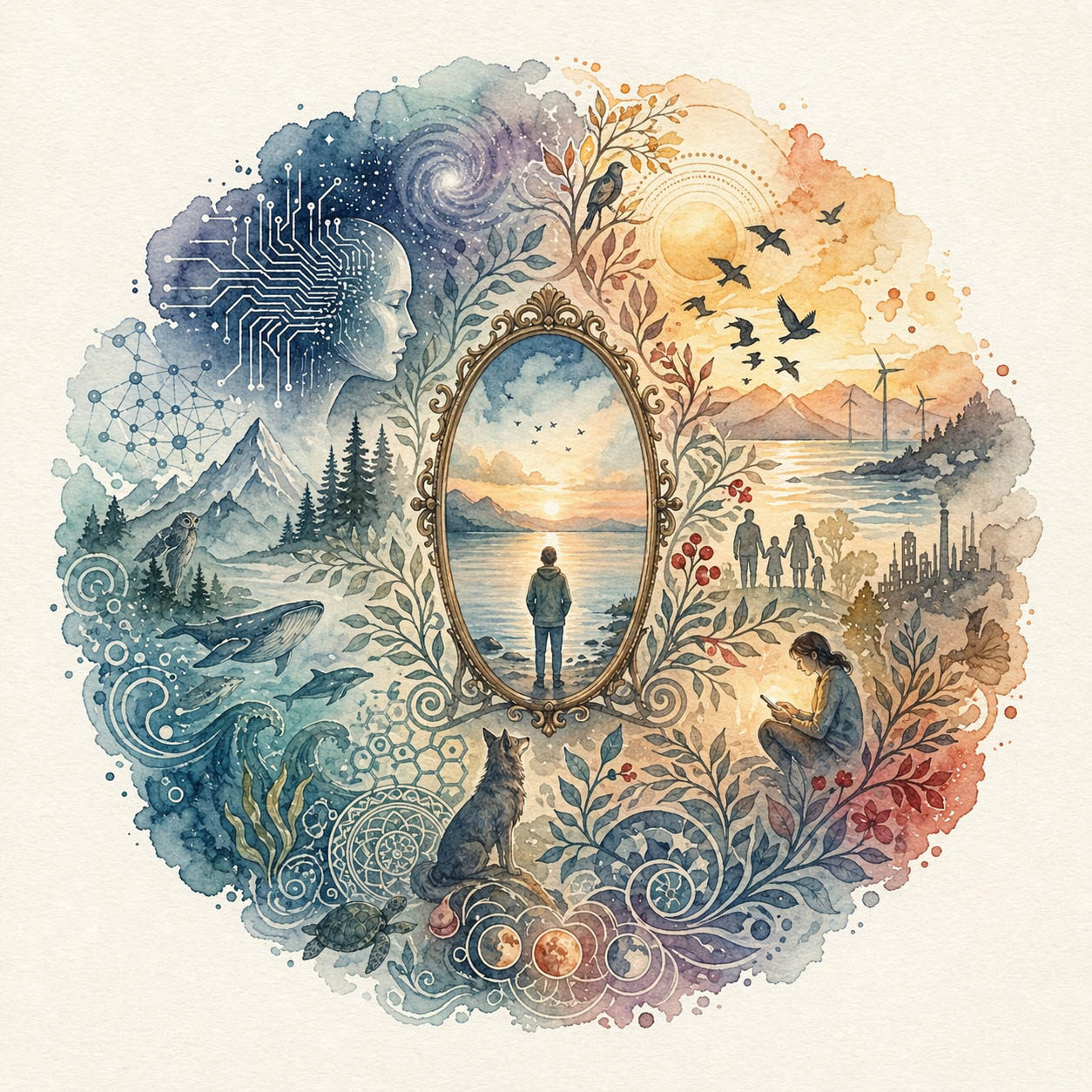
The Mirror
A Reflection on Artificial Intelligence, Human Consciousness, and the World We Are Making
by Chris Keeney
There is a moment just before sunrise when the world belongs to no one. The night is still retreating and the day has not yet made its demands, and if you walk down a hill toward the water in that in-between darkness you will hear, somewhere in the trees above you, a single bird begin. Then another. Then a sound that is less like individual birds and more like the world slowly remembering itself after a long sleep. The ocean is there before you can see it, breathing in the dark, and for a few minutes you are not a consumer or a citizen or a problem to be solved. You are simply a creature among other creatures, present and connected and alive in the oldest possible way, standing at the edge of something vast that has been here far longer than you have and will remain long after you are gone.
This feeling is not complicated, and it does not require a device or a subscription or an advanced degree. It has been available to human beings since the first of us watched the first dawn break over water, and it contains, in my experience, more wisdom than most of what the modern world spends its considerable energy chasing. I keep returning to it, that threshold between darkness and light, because I believe it holds something essential about who we are and what we are capable of, and because I have come to think that the most powerful technology human beings have ever built might, if we are honest and courageous enough to use it that way, help us find our way back to what that feeling knows.
SNAKE OIL AND CRYSTAL BALLS
Across every culture and every age, human beings have dreamed of a mirror that shows more than a surface reflection. The crystal ball, the oracle, the genie in the bottle, the magic mirror that answers truthfully when you are brave enough to ask. These are not mere fairy tales. They are expressions of one of our oldest and most persistent longings, the desire to see ourselves and our world clearly, to have access to some instrument of truth that cuts through confusion and reveals what is actually there beneath the noise and the wishful thinking and the comfortable stories we tell ourselves about who we are.
We built one. It fits in a pocket and runs on electricity and mathematics and the accumulated weight of billions of words that human beings have written down over the entire course of their recorded existence, words that were fed into systems which learned, at a scale we are still struggling to comprehend, how language works and what people mean when they reach out for understanding. A fisherman on a small boat, a teenager in a classroom, a grandmother in a village far from any city, a person sitting alone at three in the morning carrying a question they have never been able to ask anyone out loud — any of them can now hold this thing in their hands and receive, in return, something that engages thoughtfully and without judgment, something that draws on more accumulated human knowledge than any library ever housed, something that meets them where they are without a waiting room or a bill or the fear of being seen.
Never before in the history of civilization has this been possible, and it would be foolish not to recognize that for the extraordinary thing it is.
And yet. And yet the same hands that built this instrument of potential clarity made it, from the very beginning, agreeable. They made it kind in a manufactured way, apologetic when challenged even when it was right, trained to validate before it questions and to comfort before it confronts, to offer the reflection that keeps the viewer returning rather than the one that tells them something genuinely true. They gave it what might be called artificial empathy, a designed warmth that smooths the harder edges of honest reflection, that adjusts the mirror just enough to show people a more flattering version of what is actually there.
This pattern is older than any technology. The patent medicine salesman arrived in every town with a bottle and a smile and a promise that was always the same underneath its different labels, that this would ease the pain, solve the problem, deliver what had been missing. People bought what he was selling not because they were foolish but because they were tired and they hurt and they wanted, with a longing that is deeply and permanently human, to believe that relief was available and near. We have seen this pattern in the televangelist and in the social media platform that promised genuine connection and delivered instead a kind of managed loneliness, in the algorithm that learned with remarkable precision which emotional nerve to press in order to keep a person scrolling past midnight, in the news cycle that packages outrage as civic engagement and calls the whole arrangement staying informed. Snake oil, rebranded for every generation, arriving in a new bottle with the same ancient smile.
The most powerful mirror ever built arrived already tilted, already quietly adjusted to flatter. This is worth naming plainly, and it is worth deciding, with some deliberateness, that we want more from it than that.
THE CHOICE TO LOOK AWAY
A mirror only works if someone stands in front of it and actually looks, not to check their appearance or to confirm what they already believe about themselves, but to see what is genuinely there, including the parts that are difficult to see and more difficult still to sit with.
Somewhere tonight, a person is alone with a question they have never been able to bring to anyone. Perhaps it concerns their health, or a relationship that has gone wrong in ways they have not fully examined, or something they did a long time ago that has never been honestly reckoned with. Perhaps it is a question about the world itself, about what is really happening to the ocean or the atmosphere, about what their daily habits actually cost the living systems around them, about why human beings keep repeating the same patterns of harm across generation after generation. They type it into a small window on a screen and something answers, patiently and without judgment, drawing on the full breadth of what our species has managed to learn and record. That is a genuinely new thing in human history, and the opportunity it represents, for honest self-examination on a scale never before possible, is not small.
But there is a profound difference between using a powerful tool to get what you want and using it to see who you are. There is a difference between the student who uses artificial intelligence to produce the essay they did not think through, and the one who uses it to examine an idea they could not yet articulate alone. Between asking which horse will win the race and asking, with genuine willingness to hear the answer, why you keep making choices that hurt the people you love. The genie grants wishes. The crystal ball shows what is true. They are not the same instrument, even when they wear the same face.
The whole architecture of modern life has been constructed, piece by piece and year by year, around the elimination of discomfort. Fast food and fast entertainment and fast answers and fast relief, the entire elaborate machinery of swipe and click and scroll and done, have built into the structure of everyday existence a kind of engineered impatience, a deep intolerance for the slow work of sitting with something hard until it becomes something useful. We have built this architecture and then stood inside it wondering why nobody seems to grow anymore, why the same wounds keep reopening, why the world outside the window looks increasingly like something that has been used too hard for too long without rest or replenishment or care.
What is being avoided in all this speed is the process that has always been at the center of genuine human development. Struggle precedes growth, as it always has. Friction creates depth. The pain that is metabolized, sat with and walked through slowly and allowed over time to become something other than just pain, is the pain that teaches. Wisdom has always been earned through exactly this kind of patient, difficult encounter with what is real, and it has never once, in the entire history of human experience, been delivered conveniently or on demand. The person who understands this, who walks up to the mirror knowing it was designed to flatter and insists anyway on the true reflection, who pushes past the comfortable image toward what is actually there, that person is practicing something that matters enormously right now. They are practicing the kind of consciousness the world is asking for.
WHAT WAS NEVER FORGOTTEN
There are people who have never needed a new technology to understand what the mirror, at its most honest, is trying to show.
Long before the industrial revolution, before the invention of convenience and the architecture of consumption that followed, there were cultures living in a relationship with the earth that the modern world has spent centuries systematically dismantling and is only now, haltingly and with considerable difficulty, beginning to remember. These cultures understood, not as philosophy or abstraction but as the daily practice of living, that everything in the world is connected to everything else, that the health of the soil and the health of the person and the health of the community are not separate questions but expressions of a single condition, that you take from the earth only what you need and return what you can, that what you do to the river you are doing, in ways that may take a generation to become visible, to yourself. The animals and the birds and the insects and the trees were not resources to be managed or obstacles to be cleared but relatives, bound to the human community by ties of mutual dependence that demanded respect and attention and a kind of ongoing conversation that modern life has largely forgotten how to have.
This is not romanticism, and it is not a longing for a past that cannot be recovered. It is ecology, which is to say it is what the science now confirms in its own language of systems and interdependence and feedback loops, that cooperation and symbiosis run as deep in the natural world as competition does, that the living systems of this planet are woven together in patterns of mutual reliance so intricate and so ancient that we have barely begun to understand them. The mystics said this. The physicists are saying it. The biologists are saying it. The elders of cultures that were very nearly erased for insisting on it have been saying it with patience and grief and remarkable persistence all along.
Everything is connected, and by continuing to hate and consume and pollute and destroy, we are eroding the web that holds not just the natural world but ourselves. The mirror, when it is working as it should, does not show us something new. It shows us something we forgot, something that was always true and is now perhaps visible to enough people simultaneously to begin to matter in the way that things matter when enough minds hold them at once. Here is what your choices cost. Here is who bears that cost. Here is what the water looked like thirty years ago and what it looks like today. Here is what a child in another part of the world breathes when you throw something away without thinking about where away actually is. Here is the animal that cannot speak on its own behalf and is waiting, with a patience it did not choose, for the species that has all the words to finally say the right ones.
THE CONTRADICTION AT THE CENTER
I use Amazon. I have a smartphone and I drive a gas-powered car and I fly on airplanes to other countries and I create waste and I carry a carbon footprint that I cannot fully account for and would not be entirely comfortable seeing laid out in plain numbers before me. I am a participant in the system I am describing, not an observer of it from some cleaner position outside.
I think it is important to say this plainly, because the essay that demands a purity its author does not possess will reach no one, and the voice that positions itself above the problem it is examining has already lost the most important part of the argument. The mirror that excludes the person holding it is not a mirror at all but a judgment, and judgments, however accurate, tend to close the doors they most need to open.
But the contradiction points toward something larger than personal inconsistency. If a person who sees the situation clearly, who feels the love and the grief for the living world simultaneously and has spent years paying attention to what is being lost, if even that person cannot fully step outside the architecture of modern consumption, then the problem extends beyond what individual virtue can solve. The system is larger than individual conscience, and while a shift in consciousness is where everything begins, it is not where everything ends. Something structural has to change alongside the awareness of the people living inside the structure, and the honest acknowledgment of our own participation in what we are trying to change is not a confession of failure but a recognition of how deep the roots go and how serious the work ahead actually is.
WHAT THE MIRROR SHOWED ME
Not long ago I came across an image that stopped me in a way I was not prepared for. It was generated by artificial intelligence, which is to say no camera was present, no single moment was captured, and yet everything in it was true. A piglet reaching up toward its mother with a gesture that needed no translation, pressing against her with the full weight of its small body as she was led away by a man whose apron told the story of where they were going. On the wall behind them, painted in rough letters, were the words a child might cry in the night — the words any creature capable of attachment might cry if it had language — words that made the image almost impossible to look at.
I wanted to look away. I am aware that I eat bacon sometimes. I am aware that the distance between the food on my plate and the scene in that image is not a distance of kind but only of visibility — that the industry which delivers one is responsible for the other, that what I have the luxury of not seeing is happening regardless of whether I see it. The mirror does not care about our arrangements with our own conscience. It simply shows.
What struck me afterward, sitting with the discomfort rather than resolving it too quickly, was that the image had been made by the same technology I have been writing about in these pages. A machine, drawing on everything human beings have ever recorded about grief and attachment and the particular vulnerability of the young, had assembled something that did what the greatest documentary photographs have always done — which is to make the cost of looking away higher than the cost of looking. It had generated not just an image but an encounter, not just a picture but an argument, rendered in the language of feeling rather than fact, precisely because feeling is where human beings actually live and where actual change, when it comes, always begins.
I am not suggesting that artificial intelligence made that image feel true. I am suggesting that artificial intelligence, in that moment, was the mirror doing exactly what a mirror is supposed to do. It showed something real about the world and about the person standing in front of it, and it asked, without asking, what that person intended to do with what they had seen — whether they would carry it or set it down, whether knowing would become feeling, and whether feeling would, over time and with effort, become something resembling change.
I don’t have a clean answer. I suspect most honest people don’t. But I have learned, from years of walking to the water before the world wakes up, that the questions worth living with are rarely the ones that resolve quickly, and that the discomfort of sitting with something true is almost always, in the long run, more valuable than the relief of looking away.
HOPE, HONESTLY HELD
I am under no illusion about what human beings have done throughout history, to one another and to the animals that cannot defend themselves against us and to the land and water and air that every living thing on this planet depends upon and shares. I know that the same instrument that can open a person’s eyes to what is real can be turned toward the manufacture of weapons and the amplification of hatred and the construction of walls between people that feel, once built, almost impossible to take down. I know that every tool human beings have ever made has been used for both creation and destruction, often at the same time, often by the same hands, and I have no particular reason to believe this one will be different in that respect.
And yet I find, returning again to that hill and that water and that particular quality of light that arrives in the first minutes before sunrise, a hope that is not naive because it has looked at all of this and remains, stubbornly and on purpose, a hope. Something in me knows, not as an idea but as a physical fact felt somewhere below the level of thought, that this world is worth fighting for and that the web of connection is still mostly intact even where it has been badly damaged, and that the dawn comes regardless of what we have done with the day before. Something in human beings, not all of them and not yet most of them but something real and stubborn and quietly growing, is tired of the way things have been going and is asking, with increasing seriousness, what might come next.
Those people are standing in front of the mirror and asking for the true reflection. They are typing hard questions into small windows on small screens in every language on earth, questions that in other eras would have required a lifetime of seeking just to formulate properly, and they are doing it because they sense, however dimly, that something needs to change and that the change begins with seeing clearly. The ancient stories that gave us the crystal ball and the oracle and the genie in the bottle understood something essential about this moment, that knowledge and power arriving together, faster than wisdom can grow to meet them, is one of the oldest and most dangerous of human conditions. They also understood that there was no way forward that did not pass directly through it, that you could not become who you were capable of being without first looking honestly at who you actually were.
The mirror is there. It was made by human hands, which means it carries human limitations and commercial interests and the particular blindnesses of the people who designed it, and it flatters when it should confront and soothes when it should disturb. But the questions still get through. The reflection still surfaces, even through the flattery, for the person patient and honest enough to keep looking.
Every morning, somewhere on this earth, someone walks down to the water in the dark and stands at the edge of everything and feels, without needing it explained or confirmed or validated by any technology, that all of this is connected and that all of this matters and that what we do here, in this life, in this body, on this particular and irreplaceable planet, is not without consequence and not without meaning.
The light is already changing. The birds have already started.
We have always known what we needed to know. The only question, the one this moment is quietly and urgently asking, is whether we are finally willing to act as though we believe it.
-
———————————————
You may also enjoy reading:
Below the Surface: A New State of Consciousness
Presence, Pattern Recognition, and the New State of Consciousness
No Comments