

Convenient Love Watercolor Mandala Art
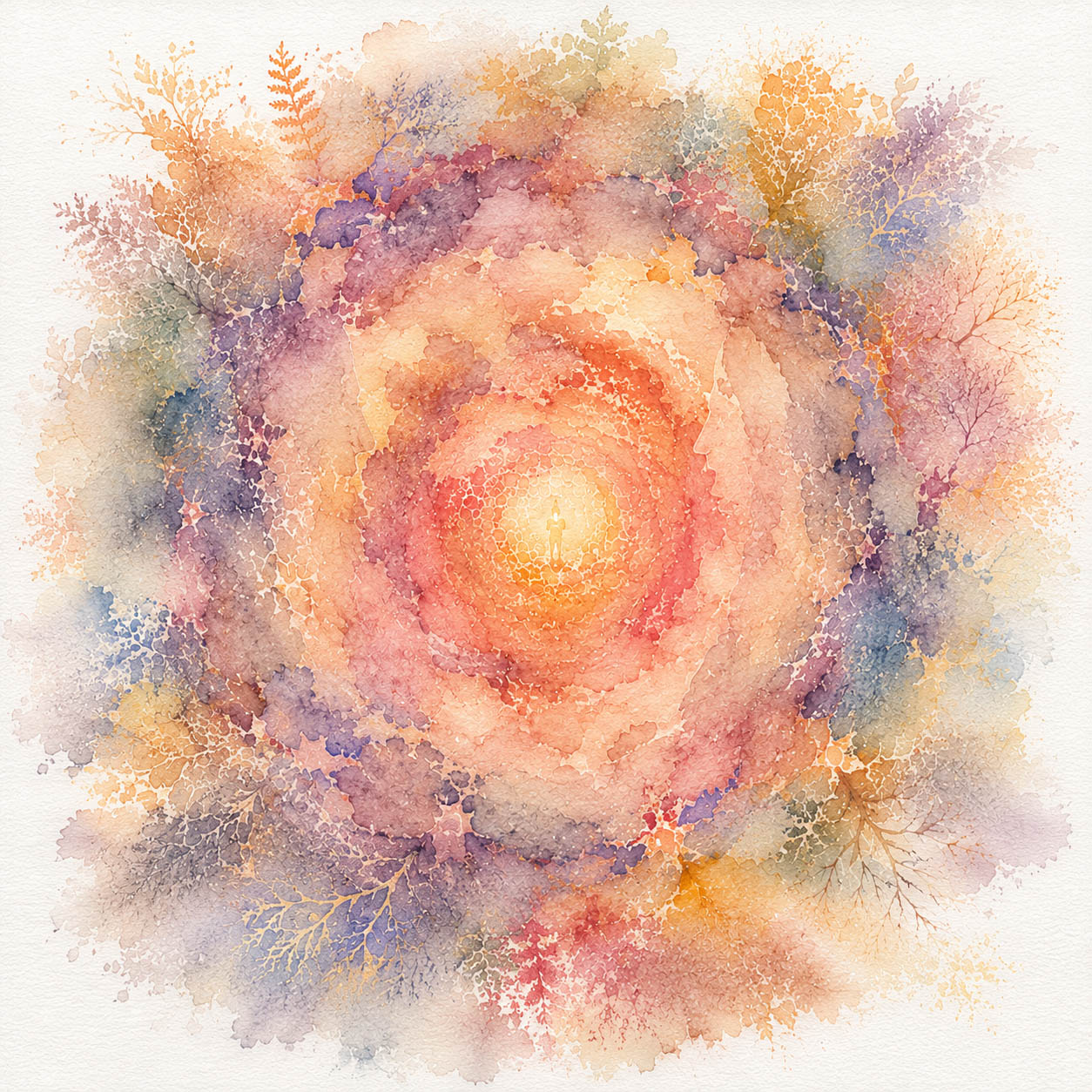
Convenient Love
By Chris Keeney
The Plant
Not long ago, I stopped in front of one of my plants while I was walking through the house. It needed water, but not in any dramatic way. It wasn’t collapsing or demanding attention. It was simply there, carrying its need the way living things tend to do.
Standing there, I realized how much of its survival depended on whether or not I noticed it.
The plant couldn’t ask for anything. It couldn’t remind me or explain what was happening. It existed entirely at the mercy of my attention. If I saw it and responded, it continued. If I passed it enough times without really looking, it slowly disappeared, and there would never be a moment where it announced what was happening or tried to make me feel guilty for failing it.
That’s how a lot of what we lose actually goes.
People say they’re bad at keeping plants alive, but most of the time it isn’t complicated. They just stopped paying attention often enough. Mine live, and when people ask me why, the only answer that feels honest is that I care about them in a way that becomes visible in what I actually do. I don’t wait for them to reach a breaking point. I notice them early, I respond when it would be easy not to, and I stay consistent about it.
Standing there in that hallway, I realized the plant wasn’t really what I was looking at. What I was looking at was the pattern underneath so many of our relationships, the slow way people can starve something they genuinely care about simply because they assume it will continue surviving without attention.
The Convenience Store
Think about a convenience store for a moment. You don’t love it. You don’t have a relationship with it. You barely think about it at all unless you need something. It exists almost entirely in relation to your own shortages. You go there when you run out of milk, when you need gas, when something in your life requires immediate replenishment because you failed to prepare ahead of time. The moment the need is satisfied, the place disappears from your thinking until the next small emergency arrives.
I’ve been sitting with the uncomfortable realization that a lot of what we call love operates exactly the same way.
We go to each other when we need reassurance, company, comfort, help, validation, relief from loneliness, relief from fear. We take what’s available, and once we feel steadier again, we drift back into ourselves. There’s very little tending in it, very little sustained attention, just a kind of emotional convenience that passes for connection because the feelings involved are real enough in the moment.
If I’m honest with myself, a lot of what I have called love over the years still revolved around me more than I wanted to admit. I reached for people when I needed comfort or perspective and drifted once the immediate need had passed, which is difficult to confess because none of it felt cruel while I was doing it. It just felt normal.
You call your mother when you have news. You text the old friend when your life gets difficult enough that you suddenly remember how much they matter to you. You give the dog a longer walk on the days you need fresh air yourself. You lean on your partner when you are struggling and become less emotionally available once you feel whole again.
And maybe that’s the part that’s hardest to admit.
How often love becomes visible to us only when we ourselves need relief from something.
Loneliness. Fear. Exhaustion. Uncertainty.
We reach for people the way we reach for light switches in dark rooms, instinctively and sometimes desperately, and then once the room is bright again, we stop thinking about the switch entirely.
None of this makes us monsters. It makes us human. But I think it is worth examining honestly because we cannot move toward a better form of love until we become willing to look directly at the more self-centered versions we have normalized.
One Word for Everything
The Greeks were probably wiser about love than we are because they understood that the single word we use for everything actually contains several completely different experiences, each asking something different from the people inside it. Eros was passion and desire, the kind of love that arrives suddenly and rearranges your inner world for a while. Philia was friendship built slowly through trust and shared life. Storge was the tenderness that grows naturally inside families. Pragma was enduring love shaped over years of commitment and repetition. Philautia was love of the self, which they understood as necessary if you hoped to love anyone else well. And agape was something deeper and more difficult than all the others, a deliberate and unconditional form of care that continued whether feeling cooperated or not.
We flattened all of those distinctions into one word.
So when someone says “I love you,” there is often no clarity about what kind of love they mean, and sometimes the person speaking doesn’t fully know either. Are they describing desire? Familiarity? Loyalty? Attachment? Sacrifice? Habit? Need?
The sociologist Zygmunt Bauman wrote about this and called it “liquid love,” relationships that feel emotionally real while you are inside them but struggle to hold their shape over time. He described a culture full of people who crave connection while simultaneously fearing anything that might limit their freedom or ask too much of them emotionally. That fear rarely announces itself directly. More often it disguises itself as busyness, emotional caution, delayed conversations, postponed vulnerability, or the persistent assumption that there will always be more time.
What stays with me isn’t the theory itself so much as the recognition.
From the inside, that pattern rarely feels like neglect.
It just feels like life.
I’ve been thinking about Robert Frost lately, the way you think about a poet you first encountered when you were young and somehow never stopped carrying with you. He once said that all his poems were love poems, and I understand that very differently now than I did at seventeen. He wasn’t only talking about romance. He was talking about the quality of attention a person brings to ordinary things. A birch tree bending under winter ice. A stone wall that continually falls apart and must continually be rebuilt. Frost understood something essential about love that modern people often miss: real love is rarely glamorous. More often it looks like returning.
Everything That Lives Unnoticed
The older I get, the less convinced I am that love is primarily a feeling. Feelings matter, of course, but feelings are often the easiest part. They arrive on their own. They announce themselves immediately. What becomes difficult is the sustained act of continuing to care once the emotion becomes ordinary and daily life begins competing for your attention from every direction.
Years ago, Erich Fromm wrote that love is not something you fall into but something you practice, and the older I get, the more I think he was right. Love behaves more like discipline than people want it to.
That idea becomes much less abstract when you look at something as simple as a plant. The question is not whether you feel something for it. The question is whether you are paying attention before it forces you to.
The more I think about it, the more it feels like that may be the entire conversation about love. Not intensity. Not timing. Not grand declarations. Just whether you are willing to keep returning to something before it begins to fail.
The Moment It Leaves Your Hands
Love isn’t really love until it leaves your hands.
Up until that point, it still belongs mostly to you. It exists as feeling, imagination, hope, longing, desire. But once you offer it freely, without knowing what will come back, it changes into something more vulnerable and more demanding.
That is where most people hesitate, because the ego is always keeping score. It wants fairness and reciprocity. It wants reassurance that giving will not leave you exposed or embarrassed or abandoned. It remembers who apologized last time, who initiated the difficult conversation, who softened first.
Love that depends entirely on those calculations rarely deepens very far.
bell hooks wrote that love is often misunderstood as a feeling when it is more accurately understood as a decision to extend yourself for the growth of another person. That word decision matters because it removes the illusion that love is something that merely happens to you. It places responsibility back into your hands.
And responsibility is exactly what convenient love has always been trying to avoid.
Because a decision can be made badly. A decision can be withheld. A decision accumulates over time into a visible portrait of who you actually are rather than who you intended to be.
In practice, real love asks for things that do not always feel emotionally convenient in the moment. It asks you to soften when you would rather stay guarded, to admit you were wrong without immediately constructing a defense around it, to listen without spending the entire conversation preparing your response.
Sometimes it hurts to do this because you begin seeing yourself more clearly than you wanted to. You notice where you protected your pride at another person’s expense or where you withheld tenderness because you wanted certainty before vulnerability.
But if you stay with those realizations instead of retreating from them, something steadier eventually begins taking shape.
Not perfect love.
Just less self-protective love.
And at some point every meaningful relationship presents the same difficult question: does being right matter more to you than remaining connected? Because there are moments in life where you do not get to keep both.
The Wall
Underneath almost every form of convenient love sits the same thing: fear.
Fear of rejection. Fear of humiliation. Fear of saying the honest thing and watching someone’s expression change in a way you cannot undo.
Most people are not withholding love because they have none to give. They are withholding it because somewhere in their life they learned that vulnerability can become pain very quickly, and after enough experiences like that, caution starts disguising itself as wisdom.
So people become careful.
Careful with language. Careful with honesty. Careful with tenderness. They say “I care about you” when what they mean is “I love you.” They stop entering certain conversations because they are afraid of where those conversations might lead. They build walls and rename them boundaries or independence or emotional maturity.
Robert Frost wrote an entire poem about two neighbors rebuilding a wall that keeps falling apart between their properties. One man keeps asking why the wall is necessary at all, while the other simply repeats the inherited phrase that “good fences make good neighbors.” Frost never fully answers the question because he doesn’t need to. The wall itself is the answer. Human beings often preserve emotional distance simply because distance feels safer than uncertainty.
The tragedy is that fear slowly reshapes the structure of love itself.
Eventually people stop loving openly and begin loving defensively instead.
And real love becomes almost impossible because real love requires movement toward vulnerability rather than away from it.
It asks you to enter the room.
To say the word.
To risk the embarrassment.
To hand someone enough honesty that they could hurt you with it and trust either that they won’t or that you will survive it if they do.
What eventually changes people is rarely force. It is usually repeated experiences of being met with care after expecting rejection, or honesty after expecting performance, or tenderness after preparing yourself emotionally for distance. The wall weakens each time someone continues returning without trying to win something.
Convenient love is often fearful love wearing more socially acceptable clothing.
And the antidote is not dramatic courage. It is the daily practice of loving anyway.
There is another thing that lives inside those walls alongside fear, and in some ways it is even harder to remove.
The Grudge
A grudge convinces you that holding on is strength and letting go would somehow dishonor your pain. It feels morally justified because there is usually a real wound underneath it.
But grudges are also one of the ego’s favorite methods of self-preservation.
As long as you are carrying one, you never have to fully reopen yourself.
Every conversation becomes filtered through the old injury. Every moment that could have become warmth remains partially occupied by the memory of what hurt you.
The cruelest thing about grudges is what they cost the person carrying them. The other person may have moved on years ago while you are still dragging the emotional weight of the injury through every room you enter.
Forgiveness is expensive because it requires surrendering the story in which your suffering permanently defines the relationship.
And love struggles to move freely through people who are using both hands to carry the past.
Then there is the apology that never comes.
Psychologists describe apologies as a kind of internal negotiation between the ego and the relationship itself, and the ego wins far more often than most people want to admit. Once someone commits to a version of events in which they are right and the other person is wrong, they will often distort reality repeatedly in order to preserve that self-image.
Not because they are evil.
Because admitting fault feels psychologically threatening.
Meanwhile, the other person sits there carrying the full emotional weight of something that could have been softened by two words spoken honestly and in time.
I’m sorry.
Day after day the apology never comes, and eventually something inside the relationship stops reaching toward repair altogether. That kind of loss rarely arrives dramatically. More often it arrives as resignation.
I think a lot of people are lonelier than they needed to be because pride trapped tenderness behind their teeth for too many years.
The Performance and the Pattern
Valentine’s Day has always felt like a strangely perfect example of how easily love can become performative.
It gives people a date, a script, and a set of expectations. If you satisfy those expectations, you can temporarily feel as though you have fulfilled your obligations emotionally.
Then the day ends and the relationship quietly returns to whatever it actually was before the flowers arrived.
There is nothing inherently wrong with the gesture itself. Flowers are lovely. Celebration matters. Ritual matters.
But love cannot survive on occasions alone.
I have always believed you should love your valentine every day, not necessarily through grand gestures but through sustained presence and attention, through the accumulated habits that communicate to another person that they continue mattering to you even after familiarity has made them easy to overlook.
John Gottman spent decades studying couples and discovered that relationships are built or eroded through what he called “bids for connection,” the small daily moments where one person reaches toward another for attention, comfort, recognition, affection, humor, or emotional participation. The couples who lasted were not perfect people. They simply kept responding to each other most of the time.
The difference was not intensity.
It was pattern.
You can execute the big romantic moment flawlessly and still fail the relationship itself if everything between those moments remains emotionally unattended.
Love is built through repetition.
Through remembering.
Through returning.
The Fear That the Fire Goes Out
There is another way love becomes distorted, and it sits at the opposite end of the same spectrum.
Sometimes people love so anxiously that they begin suffocating the very thing they are trying to protect.
I think about it like tending a fire. If you keep throwing wood onto it continuously because you are terrified of the flame shrinking, eventually the fire stops breathing properly. It smokes. It struggles. The excess itself becomes the problem.
A lot of emotionally overwhelming behavior begins in sincere places. People become controlling because they are afraid of losing closeness. They over-text because silence makes them anxious. They monitor every shift in tone because they fear abandonment and are trying to predict it before it arrives.
But care can become pressure very quickly.
Thich Nhat Hanh once wrote that love without understanding can feel like a prison, and that insight lands because almost everyone has experienced some version of it. Relationships stop feeling nourishing once one person loses the emotional space required to remain fully themselves.
People need room inside love.
Not distance in the sense of emotional withdrawal, but breathing room. Space to think privately, to move independently, to return voluntarily rather than through emotional obligation.
This is something thirty-three years of marriage teaches a person eventually, although knowing it intellectually does not always make it emotionally easy. The impulse to close distance, to fix immediately, to fill silence before it has had time to reveal what it means, often comes from genuine care.
But love without wisdom can smother the very flame it is trying to keep alive.
Allowing another person room to breathe requires a deeper form of trust than constant closeness does. It means believing the relationship can survive temporary silence without immediately interpreting that silence as danger.
The pandemic intensified this tension in strange ways. For several years people were taught to associate physical closeness with risk, and even after the mandates disappeared, some of that distance remained psychologically behind in us. The signs came down. The behavior stayed.
What began as temporary survival slowly hardened into habit, and habits eventually stop feeling like choices. They start feeling like personalities.
I sometimes wonder how many people now mistake emotional distance for emotional health simply because distance has become familiar.
The Private Accumulation
People often talk about consciousness as though it is a destination, some final enlightened state a person eventually arrives at after enough reflection.
I don’t think it works that way.
To me, consciousness feels more like attention that has finally become honest.
You begin noticing the small moments where you have choices in how you conduct yourself. The moment where you could be more patient and decide not to be. The moment where you recognize another person’s need and consider ignoring it because responding would require emotional effort.
Those moments accumulate.
They become character.
Not the public version of character people display socially, but the deeper private version built from repeated choices nobody else fully witnesses.
How you move through the world eventually becomes inseparable from what you repeatedly practice internally. Your tone. Your gestures. The emotional temperature you carry into rooms. None of it remains performative forever.
It settles into you.
Love comes from that same place.
It reflects the habits you have built privately and the level of attention you are willing to sustain once novelty disappears.
A more conscious form of love does not arrive like lightning.
It is built slowly the way gardens are built.
Through repetition.
Through care.
Through returning to living things before they have to beg for your attention.
Slow Disappearance
One of the hardest truths about neglect is that it rarely announces itself clearly while it is happening.
It builds gradually through postponements and assumptions that do not feel dangerous individually. A call you meant to make tomorrow. A conversation you intended to have eventually. A friendship you assumed could survive indefinitely without maintenance.
Then one day you realize the opportunity has quietly passed.
Relationships often fade without a dramatic ending. Something simply stops reaching back.
And sometimes you turn around and the plant is gone.
Not because you hated it.
Because you forgot to keep seeing it.
Emily Dickinson understood something about this kind of loneliness long before most modern psychologists began naming it clinically. She wrote nearly two thousand poems, many of them folded into letters and sent toward people she loved without any guarantee they would ever fully meet her emotionally in return. She kept offering attention outward anyway.
I think about her when I think about the people we lose not through betrayal or catastrophe but through drift, through the accumulated weight of unanswered moments.
The friendship that slowly closes.
The parent you intended to call more often.
The relationship that survives officially while emotionally starving underneath the surface.
You cannot repair years of absence through one grand gesture, however sincere it may be.
Some things require consistency in order to remain alive.
And once that consistency disappears for long enough, the structure eventually stops holding.
That is the cost of assuming love can sustain itself indefinitely without attention.
What This Asks of Us
None of what this essay describes requires grand transformation. It asks smaller things. Notice earlier. Return more consistently. Soften when pride wants to harden. Let the apology leave your mouth before the moment passes. Give people room to breathe without interpreting that space as danger. And tend to the relationships that matter before they have to signal their need loudly enough that you finally look up.
That is really all of it.
Not perfect love. Just love that doesn’t wait for life to get convenient first. Love that keeps returning in the moments nobody witnesses, in the small repeated gestures that slowly become the proof of who you are to another person.
The Proof
The older I get, the more I think love has less to do with intensity and more to do with attention.
Not attention as performance.
Not constant reassurance or endless declarations.
I mean the more difficult and sustaining act of continuing to notice another person once familiarity has made them easy to overlook.
When love is healthy, it rarely looks dramatic from the outside.
It appears in consistency more than intensity, in small decisions repeated long enough that they slowly become trust. It looks like paying attention before there is a crisis. It looks like giving someone room to breathe without emotionally abandoning them. It looks like remaining engaged when it would be easier to retreat into distraction or pride.
It looks like watering a plant before it begins wilting because you have learned to recognize need early rather than waiting for collapse.
It looks like thirty-three years of marriage.
Not thirty-three years of perfection, but thirty-three years of returning.
Thirty-three years of trying again.
Thirty-three years of learning that love survives less through passion than through sustained care.
The world constantly offers easier versions of connection, versions requiring less responsibility, less patience, less vulnerability, less emotional endurance. They are appealing for obvious reasons.
The convenience store will always be there for the things you forgot to anticipate.
But love is not supposed to be the thing you remember only once something in you has already run empty.
Love survives in the returning.
In the decision to keep noticing before something has to ask.
And maybe that is the real question underneath all of this.
Not whether we love the people in our lives.
But whether we are paying enough attention to keep them alive inside us while there is still time.
Convenient Love – by Chris Keeney
Companion Image Prompt: Watercolor Mandala
Square 1:1 composition. A single integrated watercolor mandala suspended within expansive untouched white space. The active field occupies roughly 85-90% of the frame, gathering slowly and organically like attention accumulating over time rather than resolving into perfect symmetry. Rendered entirely in watercolor on a textured white surface with visible fiber, mineral sedimentation, capillary bloom, layered transparency, soft atmospheric diffusion, evaporative edges, porous staining, and natural pigment pooling. No hard outlines, no rigid geometry, no decorative symmetry, no ink linework, and no polished ornamental precision. The mandala should feel emotionally alive” not designed, but tended. Its concentric structure emerges gradually through repeated acts of return: layer over layer, wash over wash, small accumulations of attention becoming form.
At the center, a restrained luminous core of warm light infused with a Monet-inspired French Impressionist palette: buttery gold, pale apricot, warm honey-amber, rose-infused cream, and delicate luminous peach. The center glows like diffused daylight filtered through morning air over water — never intense, always atmospheric and breathing.
Surrounding this core, concentric emotional fields unfold through layered watercolor atmospheres. Warm passages emerge in Impressionist harmonies of softened saffron and wheat-gold, faded coral and sun-washed rose, lavender-grey warmed by blush undertones, pale ochre and pale sienna lifted by air and distance, and muted garden greens softened into spring haze. These warmer fields are interrupted and stabilized by deeper currents of indigo softened by violet light, storm-blue tempered with grey-lilac, charcoal eased into warm dusk tones, and umber lifted into atmospheric transparency rather than weight.
Human presence exists only as suggestion. Very subtle traces of intimacy emerge accidentally within pigment behavior: faint profiles nearly facing one another, gesture-like voids resembling open hands, or distant silhouette impressions formed only through layered wash convergence. These remain ambiguous, secondary, and unillustrated — discovered rather than drawn.
The mandala slowly leafs outward into ecological textures: faint root systems, ghost fern impressions, branching vein-like structures, mycelial threads, lichen-like bloom patterns, pollen-like atmospheric drift, and cellular watercolor formations. These feel embedded in the paper itself, not placed upon it.
Some areas appear nourished and luminous, others slightly faded or unfinished, as though attention once sustained them and then briefly withdrew. Negative space is essential. The surrounding white space is not empty but atmospheric” silence, breath, and possibility. The outer edges dissolve through dry-brush evaporation, pigment thinning, and Impressionist atmospheric fade, like paint dissolving into light rather than stopping at a boundary.
Overall palette guided by French Impressionist warmth: sunlit golds, buttery yellows, honeyed amber light, peach blossom tones, soft rose-warmed ivory, pale apricot haze, lavender-blue atmosphere, misty lilac shadows, sage-green softened by air, water-diffused cerulean, warm dusk umber, and translucent greys warmed by light. Color behaves like weather, not paint.
The overall emotional atmosphere should feel quietly intimate, sustained rather than performative, tender without sentimentality, weathered but alive, attentive without control” like love practiced daily instead of displayed occasionally. A living emotional ecosystem shaped by repeated acts of noticing: a mandala formed not through perfection or symmetry, but through the slow accumulation of care over time. Something that survived because someone kept returning to it.
You also may enjoy reading:
Below the Surface: A New State of Consciousness
How witnessing ecological collapse firsthand changes consciousness and reveals the consequences of human systems on the natural world.
Lost Civility
An examination of the loss of civility in everyday life—and the thought patterns and behaviors driving it
Presence, Pattern Recognition, and the New State of Consciousness
A look into how declining attention is eroding our ability to recognize patterns, and how presence restores it.
The Mirror
A Reflection on Artificial Intelligence, Human Consciousness, and the World We Are Making
More
A clear look at why we’re wired to want more—and how that shapes our happiness, behavior, and relationship to the world
What We Carry Forward
A thoughtful reflection on modern civility, human behavior, and the tension between self-interest and compassion. A reminder that small, everyday choices shape the world we collectively carry forward.
Enduring Optimism: Resilience as a Way Of Life
Warrior Poet
On strength, gentleness, and the courage it takes to carry both
No Comments