

The Depth of the Roots Watercolor Mandala Art
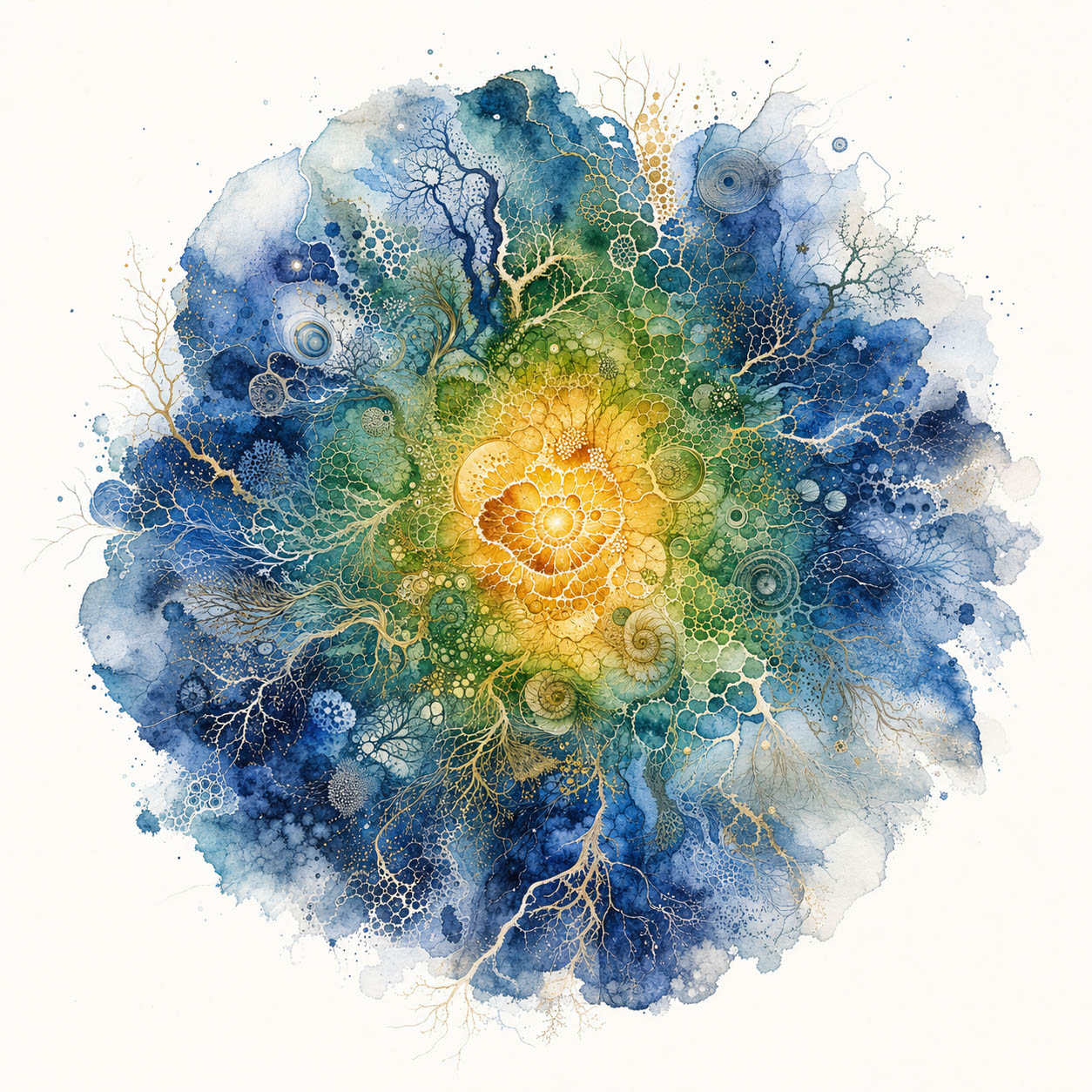
The Depth of the Roots
On effort, originality, and what lasts
by Chris Keeney
I’m worried about our society. I’m worried about myself. And I say that not as someone standing outside the problem looking in, but as someone who is very much inside it, trying to figure out what it means.
This morning I was driving to the beach when a thought hit me — not a gentle thought but the kind that arrives uninvited and refuses to leave until you pay attention to it. So I did what people do now: I reached for my phone and dictated it into a recorder as I drove toward the ocean, and it caught my words and held them so I wouldn’t have to.
Sit with the irony of that for a moment. Here I am, about to write an essay about the value of effort and originality and doing things yourself, and I’m dictating the opening thoughts into an AI engine on my way to go surfing. I’ll use that same AI to help shape these ideas into cleaner sentences than the ones I’d produce alone. The man writing about authenticity is using one of the most powerful homogenizing tools ever built to find his voice.
I know how that looks. I’ve thought about it. And I’m going to keep going anyway, because there’s something worth saying here that doesn’t get simpler by pretending the contradiction isn’t real. More on that later.
The waves were awful this morning — onshore wind, no shape, the kind of conditions that send most surfers back to their cars. But out in the water was a kneeboarder friend of mine. He works constantly and doesn’t get out as often as he’d like, so when he does, he makes it count. You can see it in the way he moves: no wasted time between sets, always positioning, always reading the water. He was out there in the mess making the most of it, and he was smiling the whole way through.
I was swimming out when I saw him, already positioned, already moving. I felt something I can only describe as inspired. Because what he was doing wasn’t complicated. He wasn’t performing anything. He wasn’t pretending the waves were good. He was making the best of what the ocean gave him, completely, without waiting for better circumstances before deciding to enjoy himself.
There’s a concept in sports science called deliberate practice: the idea that mastery isn’t just about accumulating hours, but about the quality of attention you bring to every single one of them. My friend isn’t just logging time in the water. He’s fully present in it, reading each wave as it actually is rather than wishing it were something else, finding the workable line in what everyone else dismissed. That’s not talent. That’s a discipline built over years of going out, especially on the days nobody else thought were worth the effort. That discipline — that refusal to wait for perfect conditions — is what makes him exceptional on the good days too.
That is a skill. And like most real skills, it looks effortless from the outside and is anything but. What looks like natural ease is almost always the residue of accumulated effort, the work that happened before anyone was watching.
The Hole You Dig
There’s something I’ve been noticing for years that bothers me more the older I get. We’ve stopped building things to last.
Walk through a hardware store, a furniture showroom, a clothing shop, run your hand along almost anything made in the last decade, and you can feel it. The lightness of something that wasn’t meant to be kept. The particular hollow sound of materials chosen for cost rather than quality. We’ve become extraordinarily good at making things that look fine in the store and fall apart eighteen months after you get them home. And the remarkable thing is that we’ve also become comfortable with this arrangement, almost without noticing it happened.
What most people don’t realize is that this didn’t happen by accident. There’s a term for it: planned obsolescence. It began in the 1920s as a deliberate corporate strategy, products designed not to last so that consumers would have no choice but to keep buying. In 1924, a cartel of the world’s major lightbulb manufacturers agreed to limit bulb lifespan to a thousand hours. Not because the technology couldn’t do better. Because a bulb that lasted forever was bad for business. We were trained to be a throwaway society. The disposability we take for granted today was engineered into the products long before we ever got our hands on them.
The logic makes a certain kind of short-term sense: why pay more for something when you can pay less? But the math only works if you stop the calculation at the moment of purchase. Follow it out and the picture changes completely. The cheaper thing breaks sooner. You replace it. You replace the replacement. And somewhere in the third or fourth cycle you’ve spent more than you would have on the well-made thing that still would have been sitting in the corner doing its job. The false economy of cheap isn’t a conspiracy anymore. It’s just a habit we inherited and never thought to question.
But it goes deeper than money. What we’ve really lost is something harder to price: the satisfaction of owning something made with care, by someone who took the work seriously, and that shows it. I’ve spent time in Japan, and one thing that stays with you is how that culture treats craft, any craft. There’s a word for it: shokunin (職人), roughly translated as artisan or craftsman, but the word carries far more weight than that. A shokunin doesn’t merely practice a skill. The work is seen as a direct reflection of character. Who you are shows up in what you make, without exception. This applies as much to the chef perfecting a bowl of ramen as to the carpenter joining wood without nails.
In Tokyo, a sushi restaurant serves only sushi. A ramen shop makes only ramen. Mastering one thing deeply is valued above doing many things adequately. Jiro Ono, the sushi master documented in Jiro Dreams of Sushi, ran a ten-seat restaurant inside a Tokyo subway station for decades and earned three Michelin stars. At eighty-five he was still at it every day, still adjusting, still unsatisfied. “I do the same thing over and over,” he said, “improving bit by bit. There is always a yearning to achieve more.” That’s not perfectionism as neurosis. That’s a man who understands that the work is never finished, and has made peace with it, even found joy in it.
Craftsmanship isn’t merely a set of skills. It’s an expression of character, a relationship between the maker and the thing being made that goes far beyond technique. There’s a reason people still pass down cast-iron skillets and hand-stitched quilts and wooden furniture with dovetail joints. Those things carry within them the evidence of what went into them. Effort isn’t just a means to an end. It’s an ingredient. It shows up in the result, and the result carries it long after the maker is gone.
I have a SCUBA regulator that’s a marvel of engineering, still functioning perfectly after decades of hard use. But I can’t dive with it anymore because the manufacturer stopped making parts, which means it can’t be properly serviced. The object held up its end completely. The system around it didn’t. I also have tools I inherited from my father that still do exactly what they were built to do. No planned obsolescence in either. No expiration date engineered in. They were made by people who understood, the way a shokunin understands, that what you put into something outlasts you.
There’s a principle worth saying plainly, because it doesn’t get said enough: give it everything or don’t do it. That’s not a demand for perfection. It’s a recognition that half-effort produces half-results, and the people on the receiving end of your work can feel the difference even when they can’t name it. When you bring your full attention to something, though, the opposite happens. You can stand behind what you made. The person who receives it gets something real. Your integrity in the work and their experience of it aren’t separate. They’re the same transaction, viewed from two sides.
As a gardener, I tell people this all the time: if you buy a $20 tree, dig a $300 hole. Most people look at me like I’ve lost my mind. But that hole is where everything happens. It’s where the roots will go, where they’ll find water and anchor against wind and slowly build the strength that no one ever sees. Spend the money on the dirt. Do the work before the tree goes in.
Few do. Digging is hard. It takes time and energy and there’s no visible reward for it. You finish and you’ve got nothing to show but a hole. So they dig cheap. They drop the tree in, fill it back up, walk away. And then they’re surprised, years later, when the thing hasn’t thrived.
The tree didn’t fail. It didn’t choose to be planted in shallow soil, two inches above a shelf of rock and clay that no one bothered to check for. You chose that spot. You dug that hole. The outcome was decided before the tree ever went in, and the tree had nothing to do with it.
We do this with everything. We underinvest in the foundation, plant the thing anyway, and then blame the result. Poor outcomes usually aren’t mysteries. They’re the logical consequence of cheap holes.
The Same Impulse
Here is what I’ve come to believe connects all of it: the cheap products, the AI-generated writing, the overnight-success mythology. They are not separate problems. They are different expressions of the same underlying impulse — the desire to get the result without doing the work. To have the thing without paying its true cost. To skip the slow, unglamorous middle where depth actually gets built.
We’ve applied this logic to products, and we got throwaway culture. We’ve applied it to careers, and we got a generation that mistakes visibility for achievement. We’ve applied it now to language itself, to the very sentences we use to express who we are, and the result is what people are starting to call AI slop: content that is technically correct and emotionally weightless, that could have been written by anyone because in a meaningful sense it was written by everyone and therefore no one.
There’s an old principle from computing: garbage in, garbage out. Feed a system shallow input and you get shallow output, regardless of how sophisticated the machine is. The same rule applies to voices. The shokunin principle holds that who you are shows up in what you make. AI slop is the precise inversion: content from which no one’s character can be read, because no one’s character went into it. Researchers are now documenting what writers have been feeling in their gut: AI outputs converge toward a shared center regardless of the prompt or the person asking. The more we rely on these tools to do our thinking for us, the more our collective voice begins to flatten.
This is what I mean when I say I’m worried about my voice being absorbed into the collective. Not that AI will steal something from me. But that I’ll hand it over without noticing, a little at a time, because it’s easier than doing the hard part myself. Before smartphones, most of us knew the phone numbers of the people we loved. We held that information in our own minds because we had to. Now the phone holds it, and if someone asks you for your daughter’s number without your device nearby, you might genuinely not know it. We didn’t decide to forget. We just stopped having a reason to remember. The muscle atrophied while we were looking at something else.
I think the same thing can happen with thought. With language. With the capacity to sit with a half-formed idea long enough for it to become something real. The messy drafts, the awkward sentences, the multiple attempts that go nowhere: that friction isn’t the obstacle to finding your voice. It is how your voice gets built. Replace that process with a clean AI output and you save time, yes. But what you lose are exactly the imperfections that made it yours.
I use AI to help me write. I also use it to catch the typos that used to paralyze me — a thing that probably sounds trivial until you understand that the fear of making a mistake on the page was once bad enough that I avoided the page entirely. A tool that removes a barrier between you and your own expression is a good tool, whatever its other complications. But there is a meaningful difference between using a tool and substituting it for the work you’re supposed to do yourself. The noticing. The remembering. The specific thing that happened on a specific morning that no algorithm was present for and no training data contains.
When my kneeboarder friend was out in the water this morning, making do with what the ocean gave him, that observation belongs to me because I was there. I was in that cold water, with that particular worry in my chest, at that particular hour. No AI generates that. It can help me shape what I do with it. It cannot be the thing itself.
What Las Vegas Doesn’t Show You
Most things in life are hard. What gets promoted instead is the other story: the shortcut, the hack, the overnight success, the lottery ticket that changes everything. Las Vegas is built on this story. The advertisements show you the winner — arms raised, chips stacked, lights blazing. What they don’t show you is the overwhelming majority of people who drove home with less than they arrived with, in the dark, replaying the moment the night turned.
We are drawn, almost by instinct, to the exceptional case: the person who made it big fast, the company that went from nothing to everything in eighteen months, the investment that returned five hundred percent. These stories are real. They happen. But they are the statistical outliers, and when we make them the template, we set ourselves up for a particular kind of confusion. We do the thing, it doesn’t produce the overnight result, and we conclude that something must be wrong with us rather than with the expectation.
Things of real value are built over time with a lot of hard work and dedication. The photographer who makes images that stop you in your tracks has taken hundreds of thousands of frames to develop the eye that knows which one matters. The writer whose sentences feel effortless has written sentences that weren’t for years before the ease arrived. The surfer who makes a difficult wave look like nothing has fallen off that wave more times than he can count. The craft is always in the back story. And critically, it isn’t simply a matter of hours logged — it’s the depth of focus brought to every one of them. My friend is exceptional not because he’s put in the time, but because every session, even the bad ones, he’s actually there.
Even when you’ve put in the work, genuinely, fully, without cutting corners, the outcome still isn’t guaranteed. You do everything right and the wave closes out anyway. The business you built carefully doesn’t survive the recession. Effort is not a transaction. It does not obligate the universe to deliver a specific result on your preferred schedule.
But here is what effort does guarantee: you will be able to look at whatever happens and know that you gave it what you had. That you didn’t protect yourself from failure by withholding your best. That accounting — the internal one, the private one that has nothing to do with outcome — is not a consolation prize. For some people, in some moments, it ends up being the most important thing.
Finishing What You Start
There’s a related problem that the Las Vegas story doesn’t capture, and it has nothing to do with outcomes. It has to do with whether you stay in the game long enough to find out.
If you never finish what you start, how do you know what the outcome would have been?
Most worthwhile things have a middle. The beginning is usually energizing: there’s novelty in it, possibility, the particular pleasure of not yet having made any mistakes. The end, if you reach it, brings its own satisfaction. But the middle is where everything gets tested, because that’s where it gets hard and the initial energy has burned off and the result still isn’t visible and there’s no particular reason to keep going except that you said you would. Most things die in the middle. Not from failure. From abandonment.
There’s a kind of self-protection in not finishing. If you don’t complete the thing, you can’t be judged by what it turns out to be. You preserve the version that existed in your imagination, which is always more perfect than what you’d actually produce. But that protection comes at a serious cost. The person who never finishes lives permanently in the subjunctive: what might have been, what could have happened, what they would have achieved if only. The person who finishes and fails has something that person lacks entirely. They know. They know what they’re capable of. They have the raw material of genuine learning rather than the comfortable fog of potential.
And if you’re doing the same thing repeatedly without getting the result you want, that’s worth paying attention to. Persistence and stubbornness look identical from the outside. Both involve continuing to try. But they are fundamentally different in their relationship to feedback. Persistence adjusts. Stubbornness repeats. One is a virtue. The other is an expensive habit dressed up as one.
The commitment is to getting through. The specific line changes with the water.
The Waiting
There is a version of optimism I don’t have much use for — the relentless, reflexive kind that insists everything is fine and that the right attitude can substitute for actual conditions. That version is a defense mechanism, not a philosophy. It protects the person holding it from having to look clearly at what’s in front of them.
What I respect is something harder. It starts with an honest look at the situation: the waves are bad, the circumstances are difficult, this is not what I wanted. And then it asks a different question: what can I do with this? Not what this should be. What can I make of what it is.
And here is the harder truth underneath that: unhappiness, for a great many people, is not something that happens to them. It is something they choose.
That claim tends to land hard, so let me be precise about what I mean. I am not talking about grief, or clinical depression, or the real and serious suffering that life delivers without asking. I am talking about a different category entirely: the chronic, low-grade dissatisfaction that follows certain people through every circumstance, through the good jobs and the bad ones, through the relationships that worked and the ones that didn’t, through decades of changed conditions that somehow never change how they feel. That kind of unhappiness is almost never caused by circumstances. It is maintained by habits of attention that have calcified into something that feels like personality.
These people are waiting. Waiting for the right conditions. The better job, the fixed relationship, the circumstances that finally justify feeling good. Those conditions, conveniently, never quite arrive. There is always one more thing that needs to be resolved first. The waiting becomes permanent. And here is the part that rarely gets said plainly: the waiting is a choice. It rarely feels like one, because habits rarely do once they’ve set. But it started somewhere, in small decisions about where to put your attention, what to dwell on, what story to tell yourself about what happened.
Those decisions compound. The person who habitually notices what’s wrong will, over time, become genuinely better at finding it. The person who habitually looks for what’s workable will, over time, become genuinely better at finding that. Neither is lying. Both are seeing clearly. They’ve just trained themselves to see different things. The first person will tell you their life is hard and be right. The second person will tell you their life has things worth building on and also be right. Same life, different practice.
This is not a small distinction. The habit of dissatisfaction is not a neutral default you fall into; it is a posture you maintain, reinforced every time you choose to focus on what’s missing rather than what’s present, every time you defer enjoyment until conditions improve, every time you tell yourself the story of everything that’s wrong before you’ve looked at what’s right. That posture, repeated enough, becomes the lens through which everything gets filtered. And once it does, no circumstance can fix it, because it isn’t caused by circumstance.
Happiness is not a feeling that shows up when everything lines up correctly. It is a practice — one you either commit to or don’t. My friend wasn’t out there this morning because the surf was cooperating. He was out there because he has spent years building the habit of being present in whatever is actually in front of him, and that habit now runs deeper than conditions. The ocean didn’t earn his good mood. He brought it.
You can build that habit or you can decide not to. But you don’t get to skip the decision. Not choosing is itself a choice, and it tends to produce predictable results. The people who seem most chronically unhappy are almost never the ones with the hardest lives. They are the ones who have practiced, with great diligence and consistency, the art of finding reasons not to be happy yet. They have become very good at it. They could, with equal effort, become very good at something else.
You can choose otherwise. That’s not a guarantee it will be easy, or that circumstances don’t matter at all. It’s just an observation that the choice exists, that it is a real and consequential one, and that most people never quite fully make it. They wait instead. And waiting, as it turns out, has predictable returns.
The Roots
I started this morning worried. I still am, a little. Worried about things getting built cheaply and falling apart. Worried about voices blending into a single undifferentiated hum. Worried about the skills we’re forgetting because we’ve built tools that remember them for us. Worried about a society that is very good at producing things quickly and less skilled at producing things that last.
But I also watched my kneeboarder friend this morning. Out in the water everyone else had already written off, fully committed, finding something worth riding in conditions most people had dismissed before they even got their boards wet. Not making a statement about it. Not posting it. Just out there. The roots of a person who keeps at it like that go deeper than anyone paddling past him can see.
A tree that grows fast in shallow soil looks impressive early. Tall, full of leaves, visible from a distance. Then a storm comes through and you find it in the street. The deep-rooted one, the one planted in a $300 hole, in soil someone cared enough to prepare, in ground that was checked before anything was committed to it — that tree is still standing the next morning. Not because it was lucky. Because the work was done before anyone was watching. Because someone dug the hole that deserved the tree.
You get what you put into it. That’s not a promise of a specific outcome. It’s a description of how depth is built, and it works in both directions. Put in shallow effort and you get shallow results, regardless of how much you wanted otherwise. Bring your full attention to something, bring the best you have, and something else happens. You can stand behind what you made. The person who receives your work gets something real. Your integrity in the work and their experience of it are the same transaction, viewed from two sides. That’s what the shokunin understood. That’s what Jiro is still doing at his ten-seat restaurant. That’s what my friend was doing out in the water this morning in conditions nobody else thought were worth their time.
None of this is lost on me, dictating these thoughts into a machine on my way to the ocean. The worry, the morning, my friend in the water, the shape of this particular fear — that part is mine. The tool helped me organize it. It didn’t live it.
Put something real into it. Whatever it is. The rest follows from there.
You also may enjoy reading:
Below the Surface: A New State of Consciousness
How witnessing ecological collapse firsthand changes consciousness and reveals the consequences of human systems on the natural world.
Lost Civility
An examination of the loss of civility in everyday life—and the thought patterns and behaviors driving it
Presence, Pattern Recognition, and the New State of Consciousness
A look into how declining attention is eroding our ability to recognize patterns, and how presence restores it.
The Mirror
A Reflection on Artificial Intelligence, Human Consciousness, and the World We Are Making
More
A clear look at why we’re wired to want more—and how that shapes our happiness, behavior, and relationship to the world
What We Carry Forward
A thoughtful reflection on modern civility, human behavior, and the tension between self-interest and compassion. A reminder that small, everyday choices shape the world we collectively carry forward.
Enduring Optimism: Resilience as a Way Of Life
Warrior Poet
On strength, gentleness, and the courage it takes to carry both
Convenient Love
How love rarely disappears all at once, but fades through postponed conversations, unattended moments, emotional convenience, pride, fear, and the assumption that care will sustain itself without attention. It reflects on the daily choices that determine whether connection deepens or quietly disappears.
For those of you that are interested, here’s the prompt for the watercolor mandala art created by ChatGPT.
The Depth of the Roots — Watercolor Mandala Prompt
Inspired by the essay by Chris Keeney
Square 1:1 composition.
A deeply layered watercolor mandala emerging from expansive untouched white space, formed as a living field of ecological awareness — not an illustration, not a rigid cosmological diagram, but a self-organizing system of perception emerging through fluid dynamics, reaction-diffusion memory, morphogenetic growth, and sedimented attention across time.
The composition should feel grown rather than designed — as though awareness itself slowly crystallized into visible form through repetition, turbulence, adaptation, and time.
The entire image is governed by the interplay between blue hour and golden hour — two perceptual states existing simultaneously within the same living system.
Blue hour represents the searching mind: uncertainty, introspection, unresolved flow, turbulence, fragmentation, deep-water cognition, and boundary dissolution.
Golden hour represents earned coherence: warmth emerging through sustained attention, adaptive clarity formed through friction, localized harmony arising from instability rather than imposed perfection.
Between them exists a luminous threshold of living green — an active morphogenetic zone where systems reorganize themselves in real time. This is not decorative color but ecological emergence made visible: phototropic growth seeking light, reaction-diffusion structures stabilizing into temporary coherence, rhizomatic intelligence expanding through adaptive pathways, semi-permeable boundaries dissolving and reforming through interaction.
Structural Intelligence & Emergent Organization
The mandala is governed by interacting systems of emergence, instability, and adaptive order: logarithmic spirals and Fibonacci divergence fields; Voronoi cellular fragmentation evolving through recursive subdivision; reaction-diffusion systems (Turing-pattern emergence) generating living segmentation; diffusion-limited aggregation (DLA) forming root-like accretions; L-system branching logic governing organic recursion; self-similar fractal root ecologies expanding through scale invariance; decentralized radial emergence rather than rigid symmetry; topographic contour logic mapping invisible energetic gradients; distributed intelligence systems behaving like ecological cognition; porous structural membranes dissolving hierarchy into adaptive flow.
Geometry should never feel imposed or mechanically precise. Structure continuously emerges from turbulence, dissolves into permeability, and reforms through layered interaction between pressure, resistance, flow, and adaptation.
The mandala behaves less like a sacred instrument and more like a living organism gradually becoming aware of itself.
Fluid Dynamics & Material Behavior
The watercolor surface behaves as a physical record of time, memory, weathering, and accumulated process: Navier–Stokes turbulent flow fields shaping pigment movement; laminar-to-turbulent transition zones across tonal boundaries; capillary diffusion through cellulose fiber networks; Marangoni surface tension gradients pulling pigment into living edges; Rayleigh–Bénard cellular circulation structures; pigment sedimentation and granulation across geological layers; backruns, blooms, tidelines, evaporation rings, and memory traces; stochastic diffusion fields producing unstable but coherent organization; wet-on-wet emergence balancing intentionality and surrender; aqueous permeability creating soft dissolving transitions between systems.
In the blue hour regions: pigment disperses like submerged memory, oceanic cognition, and unresolved depth fields. In the golden hour regions: warmth condenses into localized coherence — not rigid resolution but metabolically stable emergence. At the green threshold: diffusion becomes intelligent — unstable, adaptive, alive.
Philosophical & Aesthetic Framework
The work is grounded in Japanese aesthetic philosophy and perceptual restraint: wabi-sabi — imperfection, erosion, and transient beauty; ma (間) — negative space as active structure and perceptual breath; yūgen — deep unseen mystery beneath visible form; shibui — restrained elegance and quiet complexity; mono no aware — awareness of impermanence embedded within matter; kanso — clarity through reduction and essential form; fukinsei — asymmetry as natural balance.
The composition is not filled space but structured emptiness. White paper functions as silence, atmosphere, pause, and unoccupied awareness. Nothing touches the edges. The image floats like an ecological artifact discovered rather than manufactured.
Biological & Ecological Intelligence Systems
The mandala behaves like a living ecological intelligence: rhizomatic root systems expanding through non-hierarchical logic; mycelial communication networks beneath visible perception; apical meristem growth seeking directional emergence toward light; phototropism guiding luminous green threshold behavior; gravitropic descent into deep mineral blue strata; vascular transport analogs embedded in branching flows; ecological succession unfolding across layered temporal fields; morphogenesis — form arising through process rather than imposed design; distributed adaptive cognition across interacting systems; semi-permeable ecological membranes exchanging energy and structure.
The structure feels metabolically alive: part reef system, part neural field, part tide ecology, part root-memory network, part living cartography of attention.
Geological & Oceanic Time Systems
Temporal depth is embedded through earth and water logic: alluvial sediment deposition across tonal strata; thermohaline circulation currents shaping directional flow; tidal harmonic resonance embedded within local rhythms; coastal erosion patterns functioning as memory inscription systems; estuarine mixing zones where systems merge through permeability; deep-time geological layering embedded within watercolor translucency; hydrographic contour mapping as invisible structural scaffolding; bathymetric depth transitions dissolving into oceanic cognition.
The image should feel compressed with accumulated time — like perception itself fossilized into pigment and water.
Perceptual & Cognitive Layer
The work reflects states of awareness rather than static representation: liminal cognition at perceptual thresholds; flow-state immersion shaping compositional continuity; embodied cognition embedded within gesture and pigment movement; phenomenological emergence arising through observation itself; attentional imprinting through repetition and revisitation; metacognitive layering — awareness observing its own formation; epistemic emergence — understanding arising through process; distributed perception across interconnected ecological systems.
The viewer is not outside the system. The viewer participates in activating it.
Visual Narrative Elements Within the Mandala
Within the layered structure, subtle narratives emerge: root systems descending through submerged blue sediment layers; oceanic vortices spiraling through turbulent convergence zones; standing-wave interference patterns where warm and cool frequencies intersect; luminous green emergence fields where awareness becomes visible growth; fractured Voronoi ecologies dissolving technological rigidity into living structure; cartographic traces: tide maps, hydrographic contours, celestial remnants, erosion diagrams; shell spirals, estuarine branching, reef morphologies, river deltas, fungal blooms; abrasion marks, revisions, sediment scars, and reworked surfaces remaining visible as evidence of human attention.
Every layer records effort as structural memory. What is made carries the imprint of what was given to it.
Center of the Mandala
At the core: a metabolically luminous golden nucleus representing accumulated attention and earned emergence. Not decorative illumination. Not perfect symmetry. A living center formed through sustained interaction between instability and coherence — warm amber diffusion, honey gold translucency, burnished copper sediment, internal radiance emerging organically from surrounding systems, localized calm formed through prior turbulence, adaptive coherence without final closure.
The center breathes outward through surrounding ecological systems, reorganizing nearby turbulence into temporary harmony while remaining alive and permeable.
Color Zonation Logic
Blue Hour (outer field / uncertainty / descent / depth cognition): midnight indigo, storm ultramarine, prussian blue, deep ocean teal, shadow violet, mineral charcoal, oxidized cobalt, cold fog gray, wet stone, abyssal blue-black.
Threshold Zone (emergence / permeability / transformation): celadon green, sea-glass translucency, verdigris oxidation, moss green, botanical jade, luminous chartreuse diffusion, phototropic emerald, living chlorophyll gradients.
Golden Hour (core / adaptive coherence / earned clarity): amber light, honey gold, antique gold, sunlit ochre, rose-gold warmth, burnished copper, parchment glow, warm umber, candlelit cream.
The green threshold should feel like the most alive region in the entire image — where structure is actively becoming itself.
Material & Execution Language
Rendered entirely through watercolor and natural pigment behavior: wet-on-wet diffusion fields; dry-brush abrasion textures; pigment granulation and mineral crystallization; cellulose fiber absorption structures; translucent glaze layering; backwash blooms and sediment rings; fine sumi ink linework within cooler regions; delicate metallic gold ink embedded organically within warm zones; masking fluid erosion traces revealing layered process-history; controlled collapse between precision and surrender; visible evidence of revision, adaptation, and material negotiation.
The surface must feel alive with process, correction, permeability, and accumulated time.
Final Compositional Principle
The mandala is not an object but a living cycle of awareness made visible: blue hour — uncertainty, searching, entropy, dissolution; green threshold — emergence, permeability, adaptation, becoming; golden hour — adaptive coherence, earned clarity, metabolized understanding. All three states coexist simultaneously within the same ecological system. None are separate. None are final.
The surrounding white space remains essential: pure ma (interval), silence, breath, unoccupied awareness, the invisible field from which all structure emerges and eventually dissolves.
No text. No typography. No hard digital edges. No artificial gloss. No rigid sacred geometry dominating the system.
The image should feel like a discovered ecology of intelligence — formed through natural law, sustained attention, adaptive emergence, and the quiet accumulation of effort across time.
Jack Beresford
May 15, 2026 at 12:35 pmA lot of people probably think I surf Black’s because of the waves, which are incredible. But just as important are the really cool people who surf there every day. Chris, you are one of those people. I thought so even before I knew of your photography and impressive writing skills. Thanks for the mention here, but more importantly for understanding me and so effectively sharing that through this thoughtful piece.