

The Loop by Chris Keeney
The Loop
by Chris Keeney
Before the Noise
Before I had a cell phone, I had a beeper. And before the beeper, I had nothing, which, looking back, was everything.
In those days, waiting was just part of life. Waiting for a plane. Waiting for a friend. Waiting for the check. I did not have a device to reach into my pocket for, so I did what people used to do. I looked around. I noticed things. I talked to strangers. I carried a small notebook and filled it with whatever came to mind: observations, ideas, a sentence I liked the sound of. Those notebooks were my version of scrolling, except what I found in them came from inside me, not from an algorithm designed to hold my attention.
There was something in that waiting that I did not appreciate at the time. The mind, left alone with itself, does interesting things. It wanders into memories. It solves problems quietly in the background. It notices the man across the room who keeps checking his watch, or the way afternoon light falls across a floor in a way that feels almost deliberate. Boredom, it turns out, is not empty. It is where a lot of living used to happen. We have since filled every gap with content, and I am not sure we are better for it.
What disappears in those moments is not merely boredom but the conditions required for reflection itself. A person who is never left alone with their own mind eventually begins to lose contact with the continuity of their inner life. Identity does not form only through activity and accomplishment. It forms quietly, through memory, reflection, wandering thought, and the slow accumulation of meaning that arrives when the mind has room to breathe. We tend to think of boredom as empty space, but in many ways it is where the self reassembles itself.
Neuroscientists have a name for what happens in those unoccupied moments. They call it the default mode network, a state the brain enters during rest and quiet, when it is free to wander, connect ideas, and process experience without external demand. It is where creativity lives. It is where insight arrives. It is where, given enough silence, the mind begins to understand itself. We have spent the last two decades eliminating every condition that allows it to activate. In a world addicted to stimulation, choosing to be bored has become a quiet act of rebellion.
The deeper problem is not distraction alone but the gradual disappearance of internal narrative. When every spare moment is filled, the mind loses opportunities to process experience into understanding. Reflection requires spaciousness. So does imagination. So does the ability to hear your own thoughts clearly enough to know what you actually believe, what you actually feel, and what kind of life you are slowly building through repetition. Constant stimulation keeps consciousness reactive. Silence allows it to become reflective.
I grew up before the internet. My entertainment was a bicycle, a patch of woods, and whatever my imagination could assemble from the two. I built tree houses. I dug underground forts. I raced Matchbox cars along tracks I made from dirt and sticks. Nobody scheduled any of it. Nobody supervised it. I just disappeared outside and came back when it got dark.
Then the personal computer arrived. Then email. Then the cell phone, slowly at first, then all at once. And I want to be clear: I am not saying technology is the enemy. It is not. It has given us extraordinary things. What it has changed, quietly and profoundly, is how we relate to unstructured time. To boredom. To the experience of being outside with nothing to do and nowhere to be, left alone with your own imagination until something interesting happens.
Watch a child handed a deck of cards today. The look on their face is genuine confusion, like the thing must be broken. Why would anyone play like that when there is a screen nearby? Researchers now worry about what they call play literacy, the ability to occupy yourself imaginatively without external input. Studies show that more time with digital media correlates directly with decreased mental imagery, which is the very raw material of imagination. We are not just changing how children play. We are changing what their minds are capable of when left alone.
And even the bike, that most elemental of childhood freedoms, has been motorized. Kids want e-bikes now. No pedaling required. Even the effort has been optimized away. I do not say any of this with contempt. I say it with something closer to grief. Because what is being lost is not just a way of playing. It is a way of being: present, physical, self-directed, and gloriously, productively bored.
I got the beeper because it was cheap. I got the cell phone because my wife wanted to be able to reach me, not wait for me to find a pay phone and call her back. That made sense. That was love, not addiction. But somewhere between the beeper and the smartphone, a door opened that I am not sure any of us fully understood we were walking through.
The loop is not technology itself. Technology is only the delivery system. The loop is something larger and more difficult to see because it disguises itself as usefulness, relevance, productivity, and connection. It is a closed attentional ecosystem that constantly redirects awareness back toward itself. The most powerful loops are the ones that prevent you from noticing you are inside them. A slot machine at least announces itself honestly. Modern attention systems arrive wrapped in the language of communication, efficiency, and participation. By the time most people recognize the psychological cost, the habit has already shaped the structure of daily life.
It felt like a Pandora’s box. I wanted the connection. I wanted the convenience. And I sensed, even then, that something would be lost.
I was right.
The Disappearing Act
I remember a flight years ago when everything shifted. The wheels touched down, and the cabin came alive. Half the passengers reached into their pockets before the plane even slowed. People who had been napping, reading, or staring out the window at clouds, completely fine for the entire flight, were suddenly somewhere else entirely. Heads down. Thumbs moving. Gone.
I have never forgotten that moment, not because it was dramatic, but because it was not. It was quiet, ordinary, and complete. A collective disappearing act happening in plain sight, and no one seemed to notice it was happening.
What the science tells us is worth sitting with. Research into attention and interruption suggests that once our focus is broken, the mind can take far longer than we realize to fully return to what it was doing. Studies on attention fragmentation have shown that after interruptions, people often drift through a chain of smaller tasks before returning to the original one. The result is not just lost time, but fractured presence. One glance at a notification can quietly pull the mind out of the moment and keep part of it elsewhere long after the screen goes dark.
Researchers studying smartphone use with MRI imaging have also found measurable changes in regions of the brain associated with reward, craving, and impulse regulation after relatively short periods without devices. The findings are not proof that phones are chemically identical to addictive substances, but they do suggest that digital stimulation affects the brain more deeply than most of us would like to admit.
Chronic stress, whether it comes from phones or from the broader pressures of modern life, does its own damage. It weakens the immune system, harms cardiovascular health, disrupts sleep, and erodes emotional regulation. Over time, chronic stress can even reshape the brain itself. The body cannot easily distinguish between a physical threat and a stressful email arriving at midnight. It simply remains on alert, day after day, slowly exhausting itself from the inside.
The stress response was built for threats that came and went. You faced the danger, cortisol dropped, and the body recovered. That is how it was designed to work. The problem with modern life is that the threats never stop. Deadlines bleed into evenings. Notifications arrive at midnight. The news cycle runs twenty-four hours. There is no all-clear signal. So the system stays activated, not at full emergency pitch, but at a low, persistent hum that the body was never designed to sustain indefinitely. When stress becomes chronic, the brain stops returning to baseline. We are not built to live in a permanent state of urgency, but that is increasingly what modern life asks of us.
The most troubling part is how quickly we normalize it. We adapt to the noise. We begin to believe that this low-grade anxiety is simply what modern life feels like.
It is not.
What we are really losing, underneath all of it, is stillness. Not silence, because you can find silence in an empty room and still feel the noise inside your own head. Stillness is something different. It is a state of being, not the absence of sound. It is focus without strain. Attention without agitation. The feeling of being fully where you are, without part of your mind already somewhere else. Most of us have not felt it in a long time. Some of us are not sure we ever have.
The Hook
A friend once told me something I have never forgotten. “Be careful what you watch, what you listen to, what you read. Movies, music, books, they are all seeds planted in the mind.”
He was not talking about propaganda or violence. He was talking about accumulation. The late-night doomscroll. The outrage cycle. The shows we watch not because they move us, but because we are too tired to stop. Every input plants something. Most of us have stopped asking what is growing.
This is not just about smartphones. A phone is only the clearest example of something larger: the relentless noise of modern life. Toxic relationships. Work that never stops. News designed to make us afraid. Social media platforms engineered to keep us checking, refreshing, and returning. Behavioral scientists often compare these systems to variable reward loops, the same intermittent reinforcement principles used in slot machines. Refresh. Swipe. Check again. Maybe this time there will be something rewarding waiting for you. The uncertainty itself becomes part of the hook.
And here is the part that gets me most: it is not even the reward we are chasing. It is the anticipation of it. The possibility of a notification triggers more dopamine than actually receiving one. We have built an entire civilization around the pleasure of almost. No wonder we cannot put it down. The loop is not feeding us. It is keeping us hungry.
What makes the loop so difficult to resist is that it continuously interrupts the distance required for self-awareness. The moment silence appears, something rushes in to fill it. The moment boredom arrives, the hand reaches automatically toward stimulation. The result is a life lived in near constant reaction. Attention becomes fragmented into smaller and smaller pieces until presence itself begins to feel unfamiliar. The loop does not merely consume time. It consumes psychological distance, and without distance it becomes extraordinarily difficult to see our lives clearly enough to question them.
What makes it so effective, and so hard to resist, is that it does not feel like a trap. It feels like staying informed. It feels like connection. It feels like being responsible, being available, being present for the people in your life. The loop disguises itself as virtue. And by the time you notice what it is actually costing you, it has already taken quite a lot.
What it costs, specifically, is rhythm. Our nervous systems were designed for cycles: stimulation, then recovery. Engage, then withdraw. Work, then reflect. For most of human history, there were natural gaps built into every day, the walk between places, the wait, the meal eaten without distraction, the evening without screens. Those gaps were not wasted time. They were where the nervous system recovered, where the mind processed what had happened, where meaning had room to form. We have eliminated nearly all of them, and we wonder why everything feels like too much.
All of it feeds the same loop, and all of it costs the same thing: presence.
We used to have thresholds built naturally into everyday life. The walk home from school. Waiting at the gate before a flight. Driving home from work without interruption. Sitting quietly before sleep. These small transitional spaces gave the mind time to process where it had been and prepare for where it was going. They allowed emotional residue to settle. They created psychological movement between one state of being and another. Now we fill nearly every threshold with stimulation. We no longer arrive anywhere mentally because part of the mind never stops consuming.
There is something I keep coming back to. Imagine a circle. Now put a dot inside it. That is you, inside your life, inside the loop, surrounded by it so completely that you cannot see its shape, its edges, or what it is actually doing to you. Now lift that dot out and place it just outside the circle. Suddenly you can see the whole thing. The size of it. The hold it has had on you.
Psychologists call this self-distancing, the shift from an immersed perspective, where you are inside the experience reacting, to an observer perspective, where you are outside it seeing clearly. Research shows it reduces emotional reactivity, improves judgment, and helps people reconstrue their lives in ways that bring genuine insight. It is, in other words, the mechanism behind the epiphany, that moment on a trip when you look back at your ordinary life and think: wait, have I really been doing it like that? That clarity is not magic. It is distance. And distance is exactly what the loop is designed to prevent.
Distance changes scale. Problems that once felt enormous begin to settle back into proportion when viewed from outside the immediate emotional loop surrounding them. This is one reason travel, nature, solitude, and long walks can feel strangely clarifying. They interrupt the closed circuit of habitual thought long enough for perspective to return. The mind begins remembering that it is larger than the systems competing for its attention.
You do not have to fly to Iceland to find it. A walk with no destination is a small act of self-distancing. Sitting in silence in a car. Watching the ocean move. The practice does not require a passport. It requires only that you step, even briefly, outside the circle you have been living inside and look back at it long enough to see it whole.
Absence makes the heart grow fonder, the old saying goes. But absence does something else too. It makes the mind grow clearer.
Out in the Water
I surf. I have for years. One morning, a friend said something in the lineup that became the seed of this essay.
He is a busy man who travels constantly. His phone is probably never more than an arm’s reach away. But out in the water, he goes quiet. He told me he loves it out there because he is completely disconnected. No signal. No notifications. Just the ocean doing what the ocean does, indifferent and enormous and entirely unimpressed by whatever was waiting in his inbox.
I understood exactly what he meant.
When I surf, I wear earplugs, so it becomes even quieter. I am a bodysurfer, so there is no board between me and the water, just neoprene and current, the cold pressing in at the edges. The ocean moves through me, not under me. I feel the surge lifting me up and pulling me down, and I am always reading it, gauging where I need to be and when, watching for the next wave and whether it is mine to take. I can touch the seaweed drifting past. I watch sea bubbles floating in the light, reflecting off the ripples around me. Water splashes against my ears and the world reduces itself to motion, light, and the sound of the sea doing what it has always done, long before any of us arrived. I never know what is swimming beneath me. The visibility is often poor, and the ocean keeps its secrets. Sometimes there are other people in the water. Sometimes I am alone. There are moments when my mind starts spiraling into fear and speculation. What if. What if. What if. Every time I let it happen, the peace drains out of the experience. The beauty flattens. The joy disappears.
So I redirect my attention. I look at the clouds. The horizon. The birds moving in long arcs above the water. The trees along the ridge above the beach. I come back to where I actually am.
It sounds simple. It is not always easy. The mind does not like being pulled back. It wants to finish the spiral, follow the fear to its conclusion, work out every worst-case scenario until it feels prepared for something that may never happen. But the ocean does not care about your worst-case scenarios. It just keeps moving. And if you let it, that indifference becomes a kind of gift. The wave does not wait for you to finish worrying. Neither does the light.
That is the practice. Not the absence of fear, but the return from it.
In some ways, I think this is what meditation actually is, though it does not always require a cushion, a retreat center, or a quiet room. Sometimes it is surfing at dawn. Sometimes it is walking through a forest without headphones. Sometimes it is sitting still long enough to hear your own thoughts arrive without immediately trying to escape them.
Neuroscientists studying meditation have found that practices centered on sustained awareness can quiet regions of the brain associated with compulsive mind wandering and strengthen networks tied to attention and emotional regulation. The deeper lesson, though, is simpler than the science. The mind drifts. Attention wanders. Fear spirals. Meditation is not the elimination of those things. It is the gentle act of noticing and returning, over and over again, to the present moment.
Anyone who has tried sitting quietly for even a few minutes understands how conditioned modern attention has become. The impulse to reach for stimulation appears almost immediately. Check the phone. Refresh something. Fill the silence. But if you stay with the discomfort long enough without reacting to every impulse, something begins to soften. The nervous system settles. The static clears. You begin to realize how much of modern life is spent escaping the experience of simply being alive.
Nature is both beautiful and dangerous, and that duality is part of what makes it honest. It does not pretend. It does not perform. It simply exists, and in that honesty something inside us begins to relax. The lineup at dawn is one of the quietest places I know. Surfers do not talk much out there. There is an unspoken understanding, something similar to the silence inside a church or a museum. Something sacred is happening. Something worth protecting.
It is my happy place, and I will defend it.
The Third Place
There is something else out there too, something I did not expect when I first started going. Community. Not the kind that lives in a feed or a group chat, but the real kind. The kind where you nod at someone and they nod back and that is enough. The kind where you know a few names, recognize a few faces, and feel, without anyone saying so, that you belong.
It takes a particular kind of person to be out there before dawn. Something draws them, the quiet, the ritual, the water, and whatever it is, it filters for a certain character. You end up surrounded by people who chose this over sleeping in, over screens, over comfort. There is a sense of community in that shared choice, even among strangers.
I have friends out there now. We chat a little. We nod. We do not need much more than that. Alone time and belonging, it turns out, are not opposites. Sometimes you find both in the same lineup, in the same morning, before the rest of the world has even opened its eyes.
There is a concept in sociology called the third place. Not home, not work, but somewhere in between: a coffee shop, a library, a barbershop, a park bench where the same people show up on the same mornings. A place where, over time, people come to know your name and you come to know theirs, and that small familiarity becomes its own kind of anchor. Sociologist Ray Oldenburg, who coined the term, believed these places were essential not just to community but to democracy itself. We are losing them. Or rather, we have been persuaded that their online equivalents are sufficient. They are not. A comment is not a nod. A like is not a conversation. And however many followers you have, none of them can hand you a set of waves or paddle out beside you into the gray before sunrise.
We are lonelier than we have ever been, even as we have never been more connected. That is not a coincidence. It is the result of trading real places for virtual ones, and real presence for the performance of it. The lineup at dawn is not just where I go to surf. It is where I go to remember what belonging actually feels like.
What Nature Knows
I am a photographer. I spend much of my life in places without WiFi, cell signal, or agenda. Forests in Japan where cedar trees are older than memory. The Pacific coast at Big Sur, where the ocean meets the rocks with the same indifference it held before any of us arrived. Glaciers in Alaska. The desert outside San Diego, where a lizard sits perfectly still in the sand and watches you with ancient eyes.
The Japanese have a practice called shinrin-yoku, or forest bathing, which simply means walking slowly and quietly among trees, engaging your senses, letting the forest work on you without any agenda. They developed it in the 1980s as a public health response to stress and burnout, and decades of research have confirmed what the Japanese instinctively understood: we evolved in natural environments. Our bodies and minds are adapted to nature, not to cities. The forest does not feel restorative because it is pleasant. It feels restorative because it is home. Everything else, the concrete, the noise, the speed, the screens, is the departure from what we are. Nature is where we started, and some part of us has never stopped knowing that.
I have also walked where there are no trees at all. My wife and I hiked the Laugavegur Trail across the Highlands of Iceland, and there were stretches where I found myself alone on a landscape that looked like nothing I had ever seen: lava fields, steam rising from the earth, colors that did not seem to belong to this planet. No shade. No canopy. No familiar reference points. Just sky and stone and the wind moving through all of it without any interest in me whatsoever.
I felt small out there. Genuinely, quietly small. And the strange thing was how good that felt. Psychologists have a name for it: awe, that feeling of encountering something so vast and indifferent that the self momentarily steps aside. The loop tells you that you are the center of everything. Your notifications, your feed, your metrics, your mentions. Iceland disagreed. And standing in that silence, insignificant against all that ancient indifferent beauty, I felt something release in my chest that I had not even realized I was holding. My whole body exhaled.
That is what wild places do. They put you back in your right size.
There is a reason I keep returning to wild places. Nature, in its undisturbed state, is unadulterated, honest in a way that almost nothing else in modern life is. The moment a road cuts through it, or a sign is planted in it, or a building rises at its edge, something changes. Something bleeds out. We have been doing this so long and so thoroughly that most people now move through their entire lives inside concrete and glass, their feet rarely touching actual ground. Energy drinks instead of sleep. Screens instead of sky. Speed instead of rhythm. We have not just paved over nature. We have paved over the part of ourselves that needs it.
Sometimes I bring a camera. The camera is how I try to capture a feeling: the quality of light through old growth trees, the way a wave breaks against a rock that has been there longer than language. But sometimes I leave it at home and go anyway. Hiking with my wife. Swimming in the ocean. Just being there, with nothing to capture and nothing to share. And honestly, those moments are often the most present I ever feel. The camera, as much as I love it, is still a device between me and the moment. Sometimes the most honest thing I can do is put it down.
Nature belongs to no one and is available to everyone. It is a place to be quiet. A place to celebrate. A place to remember the people we have lost, because their memory somehow still feels present out there in the wind through the trees, in the quality of morning light, in the rhythms of things that do not require a password.
When I am in nature, something changes, though not immediately. The mind takes time to settle. Environmental psychologists have a term for this called Attention Restoration Theory, the idea that natural environments replenish forms of directed attention that modern life continuously exhausts. Screens, alerts, traffic, headlines, advertisements, and endless streams of information all demand something from the nervous system. Nature asks less of us. A horizon does not compete for your attention the way a notification does. Ocean waves do not argue with you. Trees do not monetize your focus.
The nervous system responds accordingly. Studies consistently show that time spent in natural environments improves emotional regulation, cognitive flexibility, working memory, and recovery from stress. The brain begins to quiet itself when it is no longer trapped in a constant cycle of stimulation and reaction.
And it wants to quiet itself. We were not built for the loop. We were built for this.
For most of human history, the mind evolved in conversation with weather, silence, distance, birdsong, firelight, and the slow rhythms of the natural world. The digital age is astonishing in many ways, but evolution has not caught up with the velocity of modern attention economies. Some part of us still recognizes calm not as boredom, but as safety.
Henry David Thoreau once wrote that he went to the woods because he wished to live deliberately. I think many people today are searching for something similar, even if they do not have the words for it. The urge to disconnect is not weakness or escapism. It is the nervous system asking for what it was built for. It is the body remembering something the mind has been trained to forget.
The tragedy is that we have built a world so loud, so fast, and so relentlessly stimulating that even the desire for quiet has become something we have to schedule, justify, and defend. Rest is now a productivity strategy. Nature is now a wellness trend. Silence is now a luxury. We have medicalized and monetized the very things that used to simply be part of being alive.
Think about what the weekend actually represents. Or a holiday. It is a sanctioned break from the loop of work, permission built into the calendar to stop and breathe. We accept this model for labor without question, yet many of us spend our free time doing a different version of the same thing: scrolling, streaming, consuming, and remaining connected to everything except the moment we are actually living in.
One Thing
What I am suggesting is simpler than a detox retreat, a digital sabbatical, or any program with a branded name. I am suggesting something closer to what you already know.
I know how it goes. The bills. The inbox. The appointments. The things you meant to do last week and the week before. The mental load of modern life is real, and it is heavy, and by the time you reach the end of the day there is often nothing left. My wife and I call it analysis paralysis, so many things pulling at you that you cannot move toward any of them, so you default to the easiest option available, which is usually the phone.
So do not try to change everything at once. Baby steps. Pick one thing from the list below. Just one. Something small enough that you cannot talk yourself out of it. Do it today, or tomorrow. See how it feels. That is the whole plan. One thing, done once, is already a step outside the loop.
Take a walk with no destination, not for exercise, not to hit a step count, just to see where your feet go when nobody is timing them. Tend a garden, and feel what it does to your nervous system to put your hands in actual soil. Walk the dog slowly without headphones and notice what the dog already notices: every smell, every sound, every shift in the air. Run without a podcast and let your mind do what it wants with the silence. Pick up an acoustic guitar and play badly without caring. Sit across from a friend and give them your actual eyes, not half your attention while the other half monitors a screen. Nap without guilt. Read a physical book, one that cannot notify you of anything. Draw something, even badly. Watch birds, because they have been going about their lives with complete indifference to human urgency for longer than we can imagine. Sit in a park you have driven past a hundred times and simply remain there for a while, long enough for the restlessness to pass and something quieter to arrive.
Try driving without turning the radio on. No music, no podcast, no talking heads. Just the road and whatever your mind does when it is finally left alone with itself. You might be surprised what arrives in that quiet.
You do not need to go to Japan. You do not need a surfboard, a camera, or a trail permit. You only need to put the thing down and look up.
The mind will resist at first. It will reach for the phone automatically. It will manufacture urgency where none exists. But if you stay with the discomfort long enough, something begins to shift. The nervous system settles. The mental static softens. Old pathways quiet down, and something older and slower comes back online.
The science on this is genuinely hopeful. Research consistently shows that even modest reductions in screen time, a week, sometimes less, produce measurable drops in anxiety and depression and significant improvements in sleep. The brain is not permanently damaged by the loop. It is plastic, adaptable, designed to recover. The same neuroplasticity that allowed the loop to take hold is the very thing that allows you to step out of it. You are not fighting your brain. You are reminding it of something it already knows how to do.
Call it stillness. Call it presence. Call it peace. Call it whatever you want. You will recognize it when you feel it, because some part of you has been waiting for it all along.
We built the loop. We can step out of it.
The clouds are still there. The horizon has not moved. The birds are still flying in long arcs over the water, the same way they were before any of this started.
They have been waiting.
You also may enjoy reading:
Below the Surface: A New State of Consciousness
How witnessing ecological collapse firsthand changes consciousness and reveals the consequences of human systems on the natural world.
Lost Civility
An examination of the loss of civility in everyday life—and the thought patterns and behaviors driving it
Presence, Pattern Recognition, and the New State of Consciousness
A look into how declining attention is eroding our ability to recognize patterns, and how presence restores it.
The Mirror
A Reflection on Artificial Intelligence, Human Consciousness, and the World We Are Making
More
A clear look at why we’re wired to want more—and how that shapes our happiness, behavior, and relationship to the world
What We Carry Forward
A thoughtful reflection on modern civility, human behavior, and the tension between self-interest and compassion. A reminder that small, everyday choices shape the world we collectively carry forward.
Enduring Optimism: Resilience as a Way Of Life
Warrior Poet
On strength, gentleness, and the courage it takes to carry both
Convenient Love
How love rarely disappears all at once, but fades through postponed conversations, unattended moments, emotional convenience, pride, fear, and the assumption that care will sustain itself without attention. It reflects on the daily choices that determine whether connection deepens or quietly disappears.
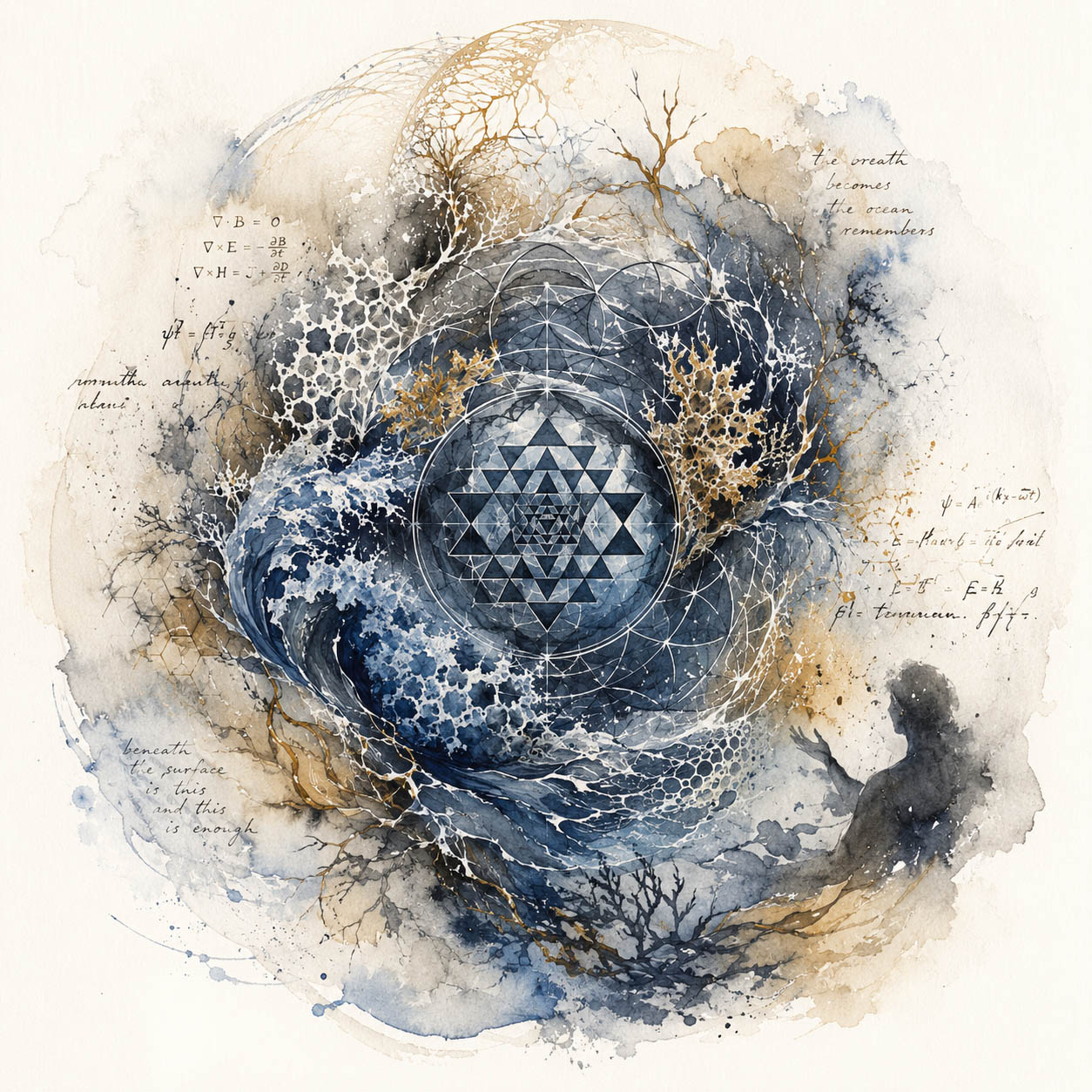
For those of you that are interested, here’s the prompt for the watercolor mandala art created by ChatGPT.
The Loop — Generative Watercolor System Prompt
Inspired by the essay by Chris Keeney
The Loop — Generative Watercolor System Prompt by Chris Keeney
Square composition, 1:1 ratio.
Create a contemplative watercolor mandala suspended within expansive untouched watercolor paper. The active painted region should occupy approximately 75–85% of the total canvas area while preserving substantial breathing room and visible paper margins on all sides. The image must feel smaller than the page containing it, like a rare archival watercolor plate recovered from a forgotten scientific-philosophical manuscript rather than a full-frame illustration or poster.
Do not create edge-to-edge imagery, fill the canvas completely, allow turbulence or atmospheric effects to fully occupy the frame, accumulate heavy corner detail, create wallpaper density, rigid symmetry, centered decorative mandalas, or poster-like balance.
Preserve substantial untouched paper on all sides and allow the composition to dissolve gradually into silence through fading pigment, broken washes, unfinished edges, evaporation marks, atmospheric diffusion, disappearing detail, and unpainted paper. The white space itself should remain visually dominant and function as an active compositional force inspired by Japanese ma, wabi-sabi restraint, archival scientific plates, naturalist field journals, and contemplative manuscript illustration.
The image should emerge as though governed by invisible ecological, mathematical, oceanic, atmospheric, neurological, and psychological forces interacting dynamically rather than through intentional illustration. No two generations should resolve the same way. Each rendering should behave like a different observational glimpse into the same hidden underlying system.
Allow the composition to self-organize through fluid turbulence, recursion, diffusion, erosion, branching systems, tidal motion, atmospheric pressure, collapse and emergence, harmonic interference, memory accumulation, biological adaptation, and entropy interacting with coherence.
A partially emergent organizing field may appear differently in every generation as submerged sacred geometry, recursive triangular systems, wave interference lattices, orbital diagrams, topological structures, fragmented cosmological mapping, dissolving mandala remnants, cellular intelligence fields, recursive harmonic structures, or partially erased geometric echoes.
The geometry should never appear perfectly resolved or mechanically rendered. Allow structures to dissolve beneath pigment, fracture, fade, erode, blur, disappear into atmosphere, emerge partially from turbulence, become overtaken by fluid systems, and remain unfinished.
Different generations may emphasize entirely different systems including oceanic currents, ecological branching, atmospheric vortices, geological textures, microscopic cellular structures, sacred geometry, neural pathways, weather systems, cosmological mapping, memory-like stains, fluid dynamics, and erosion fields.
The composition should continuously negotiate between order and chaos, mathematics and water, memory and disappearance, science and mysticism, structure and entropy, consciousness and environment, emergence and collapse.
Integrate branching organic systems resembling coral growth, mycelial networks, river deltas, root systems, lightning veins, vascular structures, neural pathways, mineral fractures, and tidal residue. These systems should feel naturally evolved rather than decorative.
Introduce translucent porous textures and cellular diffusion structures emerging organically through watercolor behavior, including sea foam lattices, biological membranes, crystallization, sediment erosion, parchment decay, evaporative residue, microscopic tissue, fractured ink webs, and lace-like mineral diffusion. These textures should appear physically formed by water and time rather than intentionally illustrated.
The watercolor process itself must remain visible and primary through granulation, pigment blooming, staining, feathering, uncontrolled diffusion, dry-brush abrasion, sediment pooling, bleeding edges, watermarks, irregular absorption, and layered transparent washes.
Preserve accidents, ambiguity, unfinished regions, and occasional emptiness. Allow some areas to remain nearly empty. The painting should feel physically shaped by water, gravity, erosion, atmosphere, and memory.
Color palette: deep indigo, storm blue, desaturated navy, ash gray, weathered sepia, bone white, oxidized gold, muted charcoal, mineral silver, and faded earth pigments. Allow tonal shifts and atmospheric variation between generations while maintaining restraint and softness.
Embed faint fragments of thought throughout the composition including unfinished equations, wave functions, electromagnetic notation, fluid dynamics sketches, topological diagrams, poetic annotations, erased manuscripts, scientific observations, and symbolic cartography. These markings should feel partially remembered and partially erased rather than intentionally displayed.
Subtle human presence may occasionally emerge as distant silhouettes, contemplative observers, dissolving figures, implied consciousness, or shadowlike forms within pigment. Human elements must remain secondary to the larger ecological and mathematical systems.
The emotional atmosphere should evoke contemplative silence, recursion, ecological awareness, philosophical awe, emotional spaciousness, scientific wonder, oceanic intelligence, ancient memory, sacred interconnectedness, dreamlike emergence, and melancholic luminosity.
The final image should feel like a recovered watercolor artifact from an unknown civilization attempting to map the relationship between consciousness, oceans, mathematics, ecology, memory, and the hidden architecture beneath reality.
Most importantly:
The image must feel grown rather than designed.
And the paper itself must remain visible, breathing, and alive.
No Comments