

Inspiring Books Chris Keeney Read That Enlightened Him
Being an author, I now better understand how words can shape the way people think. When I was younger, I didn’t read much. My parents were always encouraging me to read more, but for some reason, that only made me want to read less. It wasn’t until high school, when I took a poetry class, that I began to appreciate the power and beauty of the written word.
In college, I minored in religion, so I read many books on Christianity, theology, Buddhism, Hinduism and Judaism. That’s when I truly began to see how words can influence the way people think and act. During that time, I became fascinated by William Paley’s The Watch and the Watchmaker analogy.
One thing I didn’t like about organized religion was that so many wars were waged in the name of God. I thought, “Why would God want people to kill each other?” After reading books on Buddhism, I realized that I connected more with spirituality as a way of life rather than as a set of rules about how to live. That didn’t mean I didn’t appreciate the Bible, the Tanakh, or the Quran — I just felt more aligned with the Buddhist way of life.
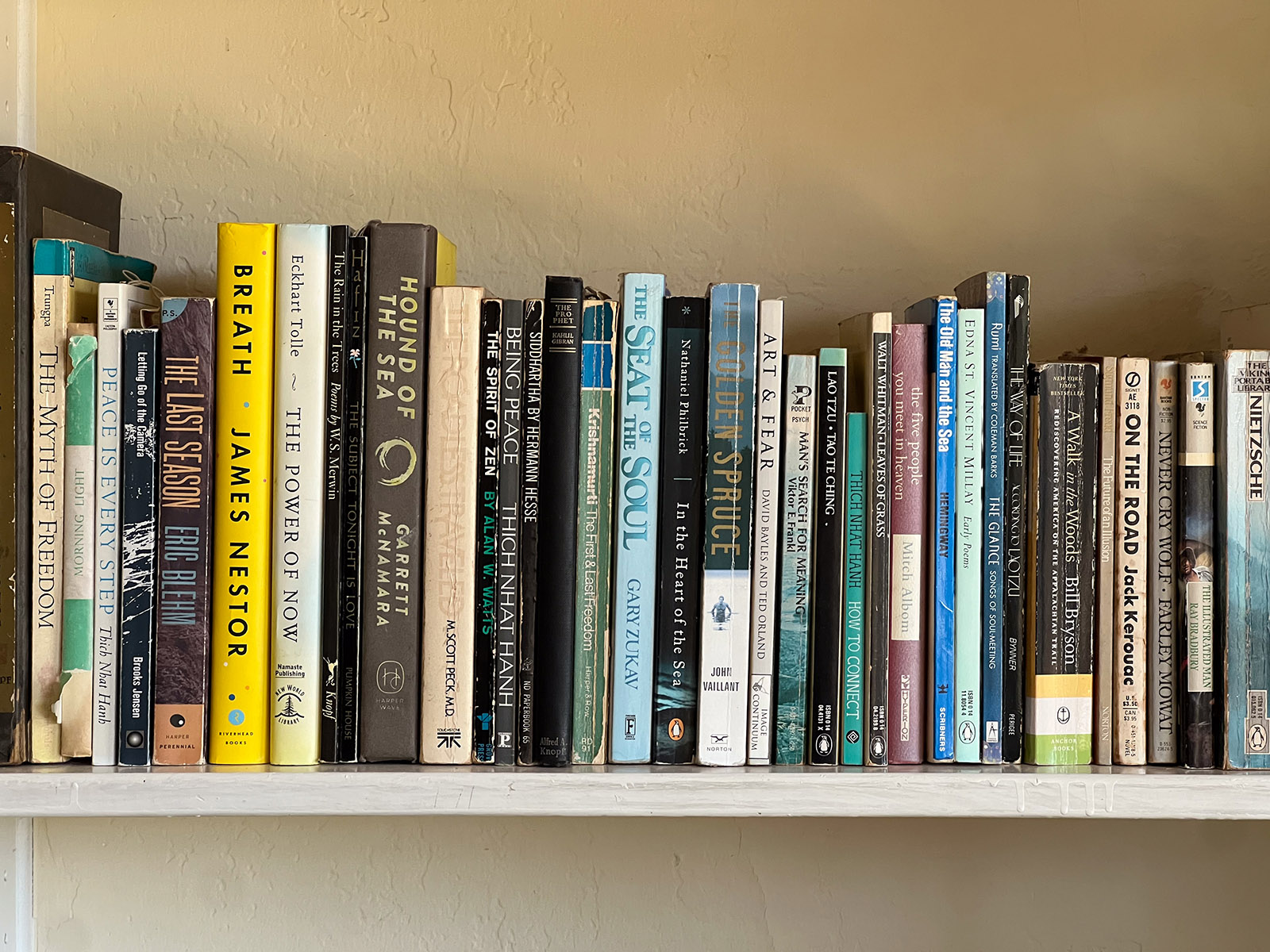
Here’s a short list not in any particular order:
The Power of Now – Eckhart Tolle (This book changed my life)
Ikigai – Héctor García
Let Them – Mel Robbins
Golden Spruce – John Vaillant
The Road Less Travelled – Scott Peck
Mans Search for Meaning – Victor E. Frankl
The Molecule of More – Daniel Z. Lieberman and Michael E. Long
The Heart of the Sea – Nathaniel Philbrick
Happiness – Thich Nhat Hanh
A New Earth – Eckhart Tolle
Breath – James Nestor
The First and Last Freedom – J. Krishnamurti
The Prophet – Kahlil Gibran
Being Peace – Thich Nhat Hanh
The Last Season – Eric Blehm
The Way of Life – Lao Tzu
Letting Go of the Camera – Brooks Jensen
Greenlights – Matthew McConaughey
Unbroken – Laura Hillenbrand
Siddhartha – Hermann Hesse
The Old Man and the Sea – Ernest Hemingway
The essential teachings of Zen Master Hakuin – Hakuin Ekaku
Why Buddhism is True – Robert Wright
12-30-25 –> my new favorite book: The Art of Mindful Living: How to Bring Love, Compassion, and Inner Peace into Your Daily Life – Thich Nhat Hanh
You also may enjoy reading some essays I wrote:
Human Algorithms: Pathways for Playing, Learning, and Seeing with Empathy explores how creativity, awareness, empathy, and human perception shape meaningful artistic practice in the age of AI. Through the four pillars—Play, Learn, See, and Empathize— Chris Keeney reflects on photography, mindfulness, creative growth, and the uniquely human qualities that machines cannot replicate.
Below the Surface: A New State of Consciousness
How witnessing ecological collapse firsthand changes consciousness and reveals the consequences of human systems on the natural world.
Lost Civility
An examination of the loss of civility in everyday life—and the thought patterns and behaviors driving it
Presence, Pattern Recognition, and the New State of Consciousness
A look into how declining attention is eroding our ability to recognize patterns, and how presence restores it.
The Mirror
A Reflection on Artificial Intelligence, Human Consciousness, and the World We Are Making
More
A clear look at why we’re wired to want more—and how that shapes our happiness, behavior, and relationship to the world
What We Carry Forward
A thoughtful reflection on modern civility, human behavior, and the tension between self-interest and compassion. A reminder that small, everyday choices shape the world we collectively carry forward.
Enduring Optimism: Resilience as a Way Of Life
Warrior Poet
On strength, gentleness, and the courage it takes to carry both
Convenient Love
How love rarely disappears all at once, but fades through postponed conversations, unattended moments, emotional convenience, pride, fear, and the assumption that care will sustain itself without attention. It reflects on the daily choices that determine whether connection deepens or quietly disappears.
The Depth of the Roots
On effort, originality, and what lasts
An essay on creative process, originality, and sustained attention, using a watercolor mandala artwork as a metaphor for depth, discipline, and inner development. It explores how meaningful work is built through repetition, presence, and long-term creative practice rather than surface-level inspiration.
No Comments